


-
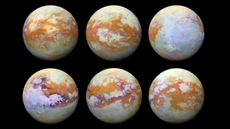 Saturn's largest moon may be riddled with 'slushy tunnels' that contain alien life, new study hints
Decades ago, a spacecraft suggested Saturn's largest moon, Titan, had an ocean. New observations suggest that the liquid may look more like slush.
saturn -
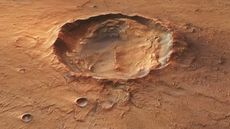 City-size 'cosmic butterfly' carved into Mars' surface contains traces of ancient water
The European Space Agency has released new images of a rare "butterfly" crater on the Red Planet. The bug-like structure sports a pair of smooth, rocky wings, which were likely "fluidized" by buried Martian ice.
mars -
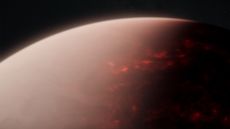 James Webb telescope uncovers a new mystery: A broiling 'hell planet' with an atmosphere that shouldn't exist
James Webb finds a hot planet that is tidally locked with its parent star, is coated with a thick atmosphere of volatile chemicals.
2 Commentsexoplanets -
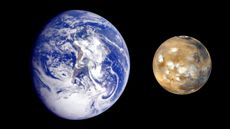 Time moves faster on Mars, posing new challenges to crewed missions
Clocks on Mars tick faster by about 477 microseconds each Earth day, a new study suggests. This difference is significantly more than that for our moon, posing potential challenges for future crewed missions.
33 Commentsmars -
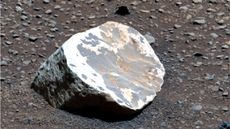 Strangely bleached rocks on Mars hint that the Red Planet was once a tropical oasis
Bleached clay rocks found on the Martian surface suggest that the Red Planet was once home to heavy rainfall and tropical conditions, new Perseverance observations hint.
10 Commentsmars -
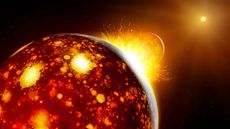 Earth had a secret neighbor, and it may explain our moon
Earth may have a moon today because a nearby neighbor once crashed into us, a new analysis of Apollo samples and terrestrial rocks reveals.
planets -
 See a rare conjunction of Mercury and Venus late tonight
The inner planets Mercury and Venus will both be visible in the east-southeast sky before sunrise on Tuesday, Nov. 25.
planets -
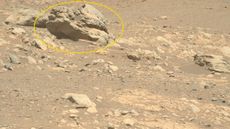 Odd-looking rock on Mars is totally alien to the Red Planet, Perseverance rover finds
NASA's Perseverance Mars rover recently came across an odd rock, dubbed "Phippsaksla," that is unlike anything else the robot has found on the Red Planet. It turns out that it probably isn't from our neighboring world and likely crashed on Mars instead.
mars -
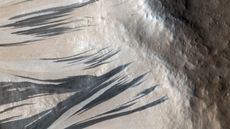 2 million black 'streaks' on Mars finally have an explanation, solving 50-year mystery
A new analysis of data from NASA's Mars Reconnaissance Orbiter reveals that the majority of the Red Planet's dark "slope streaks" did not form as most researchers previously assumed.
mars


