














Mercury probe snaps stunning photos of our planet during Earth flyby
A spacecraft bound for Mercury beamed home stunning views of Earth during a crucial flyby conducted early today (April 10).
BepiColombo, a joint mission conducted by the European Space Agency (ESA) and the Japan Aerospace Exploration Agency (JAXA), is headed to our solar system's innermost planet. But to reach that destination, the spacecraft, which launched in October 2018, needs to conduct a complex sequence of nine different planetary flybys.
Related: Farewell, Earth! BepiColombo makes successful Earth flyby
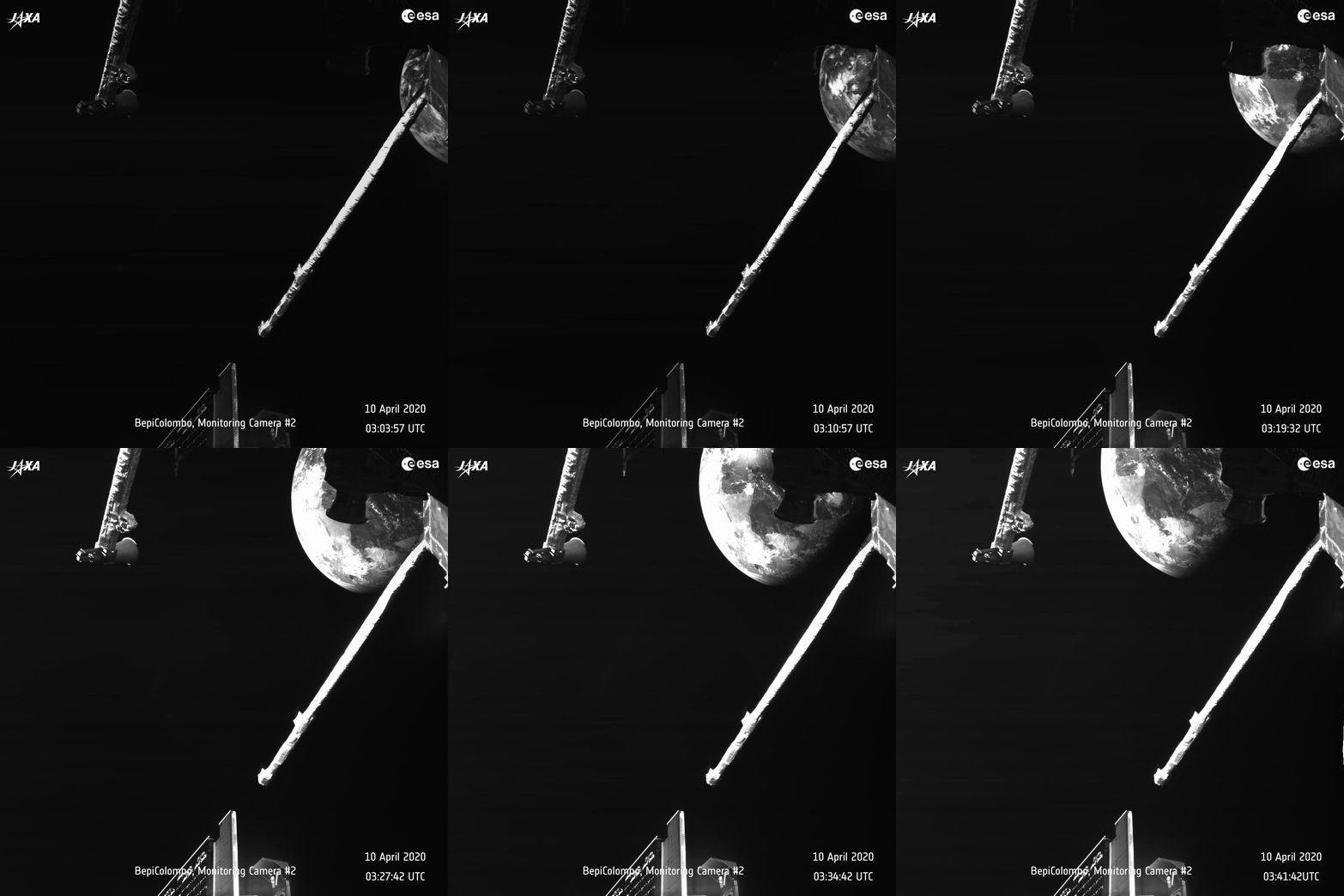
An animation of images captured by cameras on the BepiColombo spacecraft shortly before its closest approach to Earth, on April 10, 2020.
The first of those passes was close to home, as today (April 10), BepiColombo came within 7,877 miles (12,677 kilometers) of Earth.
Fortunately, the spacecraft was well prepared to make the most of the opportunity since, in addition to its more technical scientific instruments, BepiColombo carries three different cameras. Mission personnel are still processing many of the images snapped by the spacecraft, but ESA and JAXA have released both individual images and animated series produced as BepiColombo headed toward Earth.

An image taken by a camera on the BepiColombo spacecraft shortly before its closest approach to Earth, on April 9, 2020.
The cameras are set up to take "selfies," so all the new images show both Earth and bits and pieces of the spacecraft itself. That "spacecraft" is a bit of a misnomer: although BepiColombo is currently traveling as one unit, it consists of three separate units: JAXA's Mercury Magnetospheric Orbiter, ESA's Mercury Planetary Orbiter and ESA's Mercury Transfer Module, which is ferrying the two scientific probes to their destination.

An image taken of the BepiColombo spacecraft flying past Earth on April 10, 2020.
The flyby was also humans' last chance to spot the spacecraft directly: from now on, ESA and JAXA will be relying on communications only. But skywatchers armed with good binoculars or a small telescope, depending on their location and the weather, had the opportunity to wave goodbye to BepiColombo as a bright dot streaking across the sky.
Get the world’s most fascinating discoveries delivered straight to your inbox.
When BepiColombo arrives at Mercury for flybys beginning in 2021 and begins orbital science operations in 2026, it will be humanity's first delegate to the tiny world since 2015, when NASA's Messenger spacecraft purposely crashed into the planet's surface to end its mission.
- Photos of Mercury from NASA's Messenger spacecraft
- BepiColombo in pictures: A Mercury mission by Europe and Japan
- What’s the closest planet to Earth? Not Venus, scientists say
Email Meghan Bartels at [email protected] or follow her @meghanbartels. Follow us on Twitter @Spacedotcom and on Facebook.

OFFER: Save 45% on 'All About Space' 'How it Works' and 'All About History'!
For a limited time, you can take out a digital subscription to any of our best-selling science magazines for just $2.38 per month, or 45% off the standard price for the first three months.
Meghan is a senior writer at Space.com and has more than five years' experience as a science journalist based in New York City. She joined Space.com in July 2018, with previous writing published in outlets including Newsweek and Audubon. Meghan earned an MA in science journalism from New York University and a BA in classics from Georgetown University, and in her free time she enjoys reading and visiting museums. Follow her on Twitter at @meghanbartels.