













Scientists Find Weird Reason Diving Plates Get Stuck 400 Miles Beneath Earth's Surface

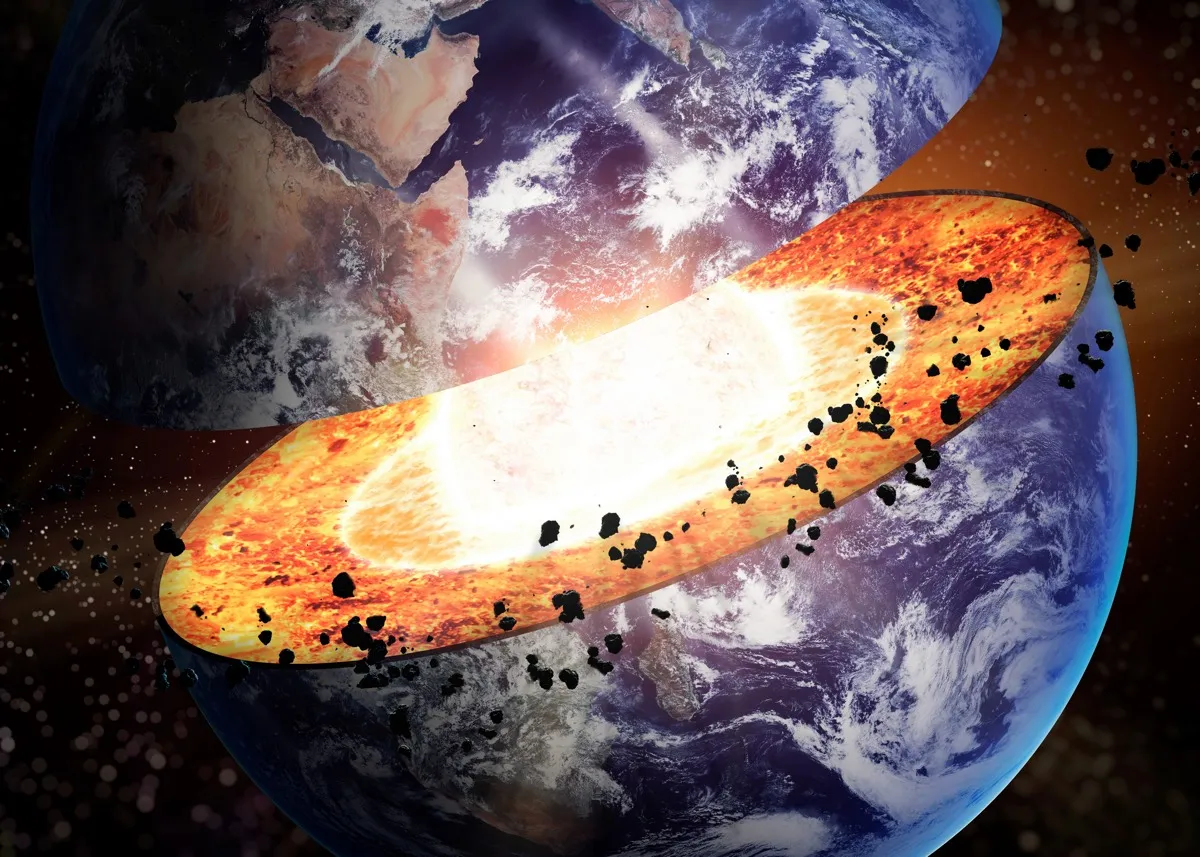
The Earth's mantle acts like a giant churn, circulating cool oceanic crust downward toward the core, where it heats up into a goopy solid and then rises again — a process that powers everything from plate tectonics to volcanism.
But there are some hitches in this system, and new research reveals why: A slippery layer about 416 miles (670 kilometers) deep stops chunks of crust in their tracks, creating "stagnant slabs" in the middle of the mantle, the layer between the Earth's crust and its core. [In Photos: Ocean Hidden Beneath Earth's Surface]
"This deflection of slabs was always puzzling to our understanding of [the mantle]," said Shijie Zhong, a physicist at the University of Colorado Boulder and the co-author of the new study published Oct. 1 in the journal Nature Geoscience.
Stalled out
There is no way to look directly at the mantle, but scientists study its dynamics using seismic waves from earthquakes. By detecting the waves as they propagate through the globe, researchers can construct a picture of the mantle, not unlike how radar can image objects using radio waves.
What happens in the mantle is related to what's going on in the crust. The crust is made up of tectonic plates that ride across the mantle like rafts on a very, very thick sea (the consistency of the crust is similar to that of hot asphalt). In some areas, called subduction zones, one tectonic plate dives under another, grinding chunks of oceanic crust down into the mantle. From seismology, Zhong said, researchers knew that some of these slabs of crust don't always travel the full 1,860 miles (3,000 km) to the core-mantle boundary. Essentially, they get stuck partway down.
Particularly in the western Pacific Ocean, near Japan and at the Mariana Trench, for example, the slabs of crust seem to stall out at around 416 miles (670 km) deep. In these areas, they seem to deflect and travel horizontally as much as 1,243 miles (2,000 km).
The layer of mantle at that particular depth is unusual, Zhong said, because the rock there goes through a sudden density increase, which is the result of the pressure of all the rock pushing down on top of it. In the new study, Zhong and University of Colorado graduate student Wei Mao built a computer model of the mantle's dynamics, including both this density increase and the past 130 million years of continental plate movements.
Get the world’s most fascinating discoveries delivered straight to your inbox.
Model mantle
This more complete model of the mantle naturally produced the same sort of stagnating slabs seen in the real mantle, the researchers found. What seems to be going on, Zhong said, is that the accumulated pressure of the overlying rock at 670 km creates an area of reduced viscosity — in essence, the mantle is more slippery and less gooey.
"That reduced viscosity essentially provides what we call lubrication on the slabs," Zhong said. The chunks of crust are able to slip and slide sideways instead of continuing their downward plunge.
This hitch in the machine is only temporary. The slabs are probably only trapped for 20 million years or so, Zhong said — a blink of the eye in terms of Earth's history. But their dynamics might be important for some of the geological phenomena seen on the surface. For example, volcanic activity in northeastern China, far from the volcanic arc of Japan, could be due, in part, to some of these slab dynamics, Zhong said.
The model doesn't answer all the questions about the stagnating slabs. It's not clear, Zhong said, why the western Pacific seems to give rise to so many of these stagnant slabs, while subduction zones near North and South America currently don't. There are also other mystery spots around the globe, he said.
"In places like New Zealand, there is still some disagreement between our convection model and the observations," he said, "so we need to reconcile those places."
Original article on Live Science.

Stephanie Pappas is a contributing writer for Live Science, covering topics ranging from geoscience to archaeology to the human brain and behavior. She was previously a senior writer for Live Science but is now a freelancer based in Denver, Colorado, and regularly contributes to Scientific American and The Monitor, the monthly magazine of the American Psychological Association. Stephanie received a bachelor's degree in psychology from the University of South Carolina and a graduate certificate in science communication from the University of California, Santa Cruz.