















From the seas to mountain peaks, humans have colonized almost every inch of Earth's surface.
Now, humans may soon be able to routinely venture below the planet's surface, at least if the military has any say in the matter.
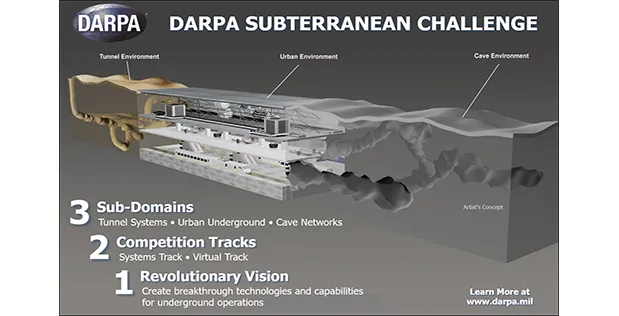
The Defense Advanced Research Projects Agency (DARPA) has announced its latest challenge, called the Subterranean or "SubT" Challenge. The global competition asks entrants to develop systems that can help humans navigate, map and search in underground locations that are normally too perilous to visit.
"One of the main limitations facing war fighters and emergency responders in subterranean environments is a lack of situational awareness; we often don't know what lies beneath us," Timothy Chung, program manager in DARPA's Tactical Technology Office (TTO), said in a statement. "The DARPA Subterranean Challenge aims to provide previously unimaginable situational awareness capabilities for operations underground." [Humanoid Robots to Flying Cars: 10 Coolest DARPA Projects]
Groups all around the world will compete to solve problems that help people navigate in unknown, treacherous subterranean conditions, where time is of the essence, according to the statement.
Teams can compete in one of two tracks: a Systems track, to develop hardware-based solutions for a physical course, or a Virtual track, to develop software to test on a simulated course, DARPA said.
The final competition, which will take place in 2021, will include three challenges that involve navigating in one of three environments: a network of human-made tunnels, a subterranean municipal-transit system and a network of underground natural caves. The final event will challenge teams to navigate networks that include elements of all three environments. The grand-prize winners will take home $2 million. The deadline to apply is Jan. 18, 2018.
Get the world’s most fascinating discoveries delivered straight to your inbox.
The development of robotics, biological and autonomous systems has reached a crucial juncture, with such systems now conceivable, said TTO Director Fred Kennedy.
"Instead of avoiding caves and tunnels, we can use surrogates to map and assess their suitability for use. Through the DARPA Subterranean Challenge, we are inviting the scientific and engineering communities — as well as the public — to use their creativity and resourcefulness to come up with new technologies and concepts to make the inaccessible accessible," Kennedy said in the statement.
Originally published on Live Science.

Tia is the editor-in-chief (premium) and was formerly managing editor and senior writer for Live Science. Her work has appeared in Scientific American, Wired.com, Science News and other outlets. She holds a master's degree in bioengineering from the University of Washington, a graduate certificate in science writing from UC Santa Cruz and a bachelor's degree in mechanical engineering from the University of Texas at Austin. Tia was part of a team at the Milwaukee Journal Sentinel that published the Empty Cradles series on preterm births, which won multiple awards, including the 2012 Casey Medal for Meritorious Journalism.