Read the latest science news and recent scientific discoveries on Live Science, where we've been reporting on groundbreaking advances for over 20 years. Our expert editors, writers and contributors are ready to guide you through today's most important breakthroughs in science with expert analysis, in-depth explainers and interesting articles, covering everything from space, technology, health, animals, planet Earth, and much more.


-
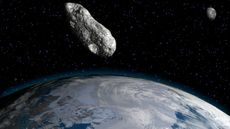 Astronomers confirm a tiny new moon is orbiting Earth, and it'll stick around for the holidays
A tiny asteroid entered Earth's orbit in April and is expected to leave in January. Meet the minimoon 2026 QQ8.
meteoroids -
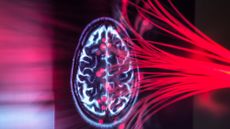 This AI finds patterns in visual brain activity and turns them into pictures
A new AI model, called Brain-IT, can transform brain scans into images and reverse the process, turning images into what they'd look like as brain activity.
artificial-intelligence -
 'Like writing and directing your own movie': Live Science readers share whether they'd learn to lucid dream if they could
Poll Over 300 Live Science readers responded to a recent poll about whether they'd train themselves to lucid dream if they could.
Poll -
 Chinese scientists cool atoms to near absolute zero in record-breaking experiment
Scientists on China's Tiangong space station used a laser trap to cool a clump of atoms to just above absolute zero, setting a new record.
particle-physics -
 A widely used antibiotic for acne and infections is linked to risk of pregnancy loss, new study finds
A common antibiotic may be linked to a higher risk of miscarriage and stillbirth when used early in pregnancy, a new study suggests.
reproductive-health -
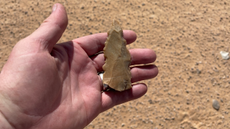 125,000-year-old poisoned stone points discovered on shore of ancient lake in Saudi Arabia
Archaeologists have discovered thousands of stone artifacts in Saudi Arabia, some of which suggest people were using poison-tipped stone tools to hunt large game 125,000 years ago.
middle-east -
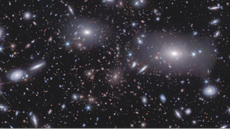 Euclid space telescope unveils first major data release, including map of 900 million galaxies
The powerful Euclid space telescope is making the largest-ever 3D map of the cosmos, and ESA has just shared the first enormous piece of it.
astronomy -
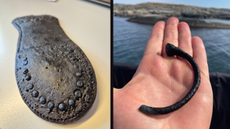 'Slave payments' and 'expensive and exclusive shoe' discovered on 17th-century Danish ship that sank after deadly mutiny
Archaeologists have discovered the shoe of the first governor of the Danish West Indies, recovered from a 17th-century ship that was wrecked after one of the most violent mutinies in Denmark’s history.
archaeology -
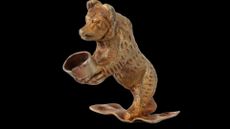 2,200-year-old gold bear figurine and surprising number of bones found in massive burial mound in Kazakhstan
Archaeologists have found a 2,200-year-old golden bear in an Iron Age burial in Kazakhstan that may have held seven people.
archaeology -
 The Grand Canyon is missing over a billion years of rocks. Now scientists know why.
The missing 1.2 billion years of geological history at the Grand Canyon finally has an explanation.
geology -
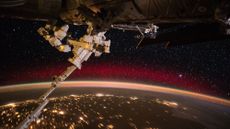 Physicists propose new quantum device to measure how Earth twists space-time
A proposed tabletop quantum sensor could match the precision of the best satellite measurements of frame dragging, a subtle effect predicted by Einstein's general relativity.
particle-physics -
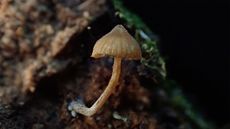 Florida's 'dark magic' mushrooms have a deadly combination of chemicals never seen before
Scientists have discovered that a known mushroom, Galerina indica, contains both psychedelic chemicals and deadly toxins.
chemistry -
 More people could count as obese under newly proposed definition — here's what you need to know
Explainer A new study supports a more nuanced approach to obesity diagnosis. Here's what to know.
Explainer -
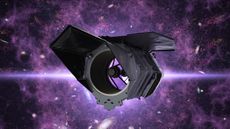 'The possibilities are truly breathtaking': NASA's Roman Space Telescope will take better images and last longer than experts predicted
NASA's Nancy Grace Roman Space Telescope could capture images 30% sharper than — and remain operational for twice as long as — initially expected. Researchers say these "remarkable" developments could greatly enhance the volume and quality of the data they will analyze.
2 Commentsspace-exploration -
 Huawei unveils 'SuperCluster' architecture designed to make 1 million AI chips work as a single computer
The new Peerium architecture aims to power hyper-efficient computers capable of training AI models with up to 40 trillion parameters.
computing -
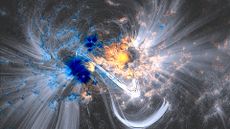 Gravity can reconnect like the sun's magnetic field, a fresh look at Einstein's equations reveals
A fresh look at Einstein's equations suggests that gravity can sometimes snap and reconnect, similar to magnetic field lines on the sun. The findings hint at a new way that gravity and matter can trade energy.
2 Commentsphysics-mathematics -
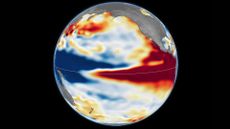 Iran war helps fuel global drop in fossil fuel emissions — but there’s a catch
In the run-up to the COP31 U.N. climate change conference, scientists have revealed that global carbon emissions from fossil fuels are projected to drop by 0.4% this year, driven by growth in installed wind and solar power capacity, as well as oil price hikes caused by the Iran conflict. But climate goals are still unlikely to be met.
climate-change -
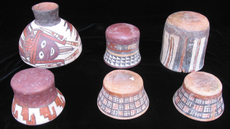 Nazca infant had rare, fatal birth defect that left her with one central eye 1,600 years ago
A DNA analysis has confirmed that a Nazca infant who lived in southern Peru 1,600 years ago had a rare congenital condition called trisomy 13.
americas -
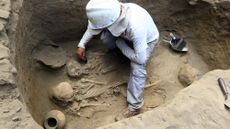 Did human sacrifice help lower violence? New research in Peru leaves intriguing question
In a key coastal area of Peru, violence was low despite the practice of human sacrifice.
americas


