














Hybrid Driving-Flying Robots Could Go Beyond the Flying Car

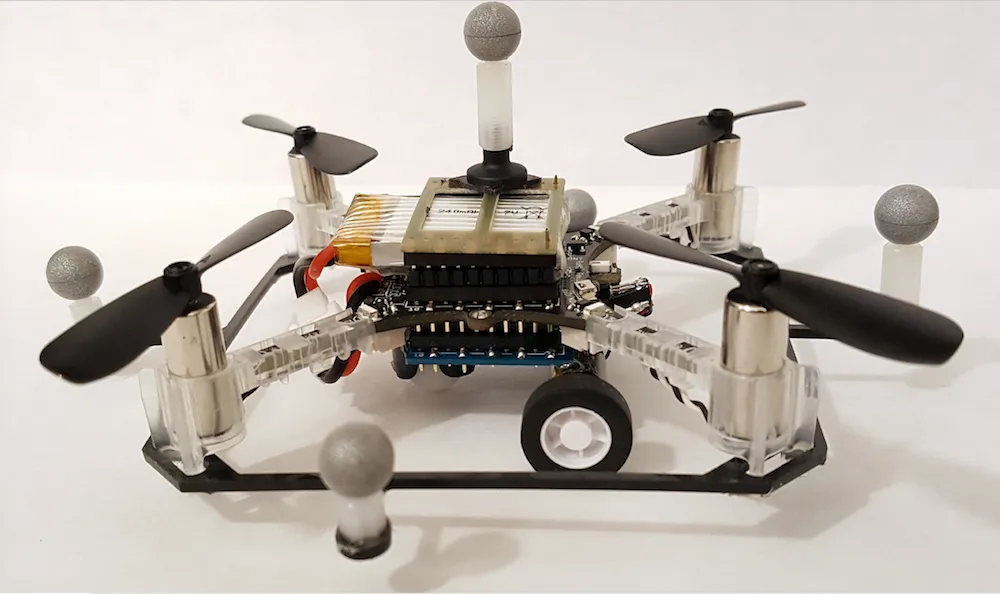
Whether they're swooping in to deliver packages or spotting victims in disaster zones, swarms of flying robots could have a range of important applications in the future, a new study found. The robots can transition from driving to flying without colliding with each other and could offer benefits beyond the traditional flying-car concepts of sci-fi lore, the study said.
The ability to both fly and walk is common in nature. For instance, many birds, insects and other animals can do both.
Robots with similar versatility could fly over impediments on the ground or drive under overhead obstacles. But currently, robots that are good at one mode of transportation are usually bad at others, study lead author Brandon Araki, a roboticist at the Massachusetts Institute of Technology's Computer Science and Artificial Intelligence Laboratory, and his colleagues said in their new study. [The 6 Strangest Robots Ever Created]
The researchers previously developed a robot named the "flying monkey" that could run and fly, as well as grasp items. However, the researchers had to program the paths the flying monkey would take; in other words, it could not find safe routes by itself.
Now, these scientists have developed flying cars that can both fly and drive through a simulated city-like setting that has parking spots, landing pads and no-fly zones. Moreover, these drones can move autonomously without colliding with each other, the researchers said. "Our vehicles can find their own safe paths," Araki told Live Science.
The researchers took eight four-rotor "quadcopter" drones and put two small motors with wheels on the bottom of each drone, to make them capable of driving. In simulations, the robots could fly for about 295 feet (90 meters) or drive for 826 feet (252 meters) before their batteries ran out.
The roboticists developed algorithms that ensured the robots did not collide with one another. In tests in a miniature town made using everyday materials such as pieces of fabric for roads and cardboard boxes for buildings, all drones successfully navigated from a starting point to an ending point on collision-free paths.
Get the world’s most fascinating discoveries delivered straight to your inbox.
Adding the driving apparatus to each drone added weight and so slightly reduced battery life, decreasing the maximum distances the drones could fly by about 14 percent, the researchers said. Still, the scientists noted that driving remained more efficient than flying, offsetting the relatively small loss in efficiency in flying due to the added weight.
"The most important implication of our research is that vehicles that combine flying and driving have the potential to be both much more efficient and much more useful than vehicles that can only drive or only fly," Araki said.
The scientists cautioned that fleets of automated flying taxis are likely not coming anytime soon. "Our current system of drones certainly isn't robust enough to actually carry people right now," Araki said. Still, these experiments with quadcopters help explore "various ideas related to flying cars," he said.
The scientists detailed their findings on June 1 at the Institute of Electrical and Electronics Engineers' International Conference on Robotics and Automation in Singapore.
Original article on Live Science.
