













Getting a Head: 'Superduck' Dinosaur Shows How Dino Crests Evolved

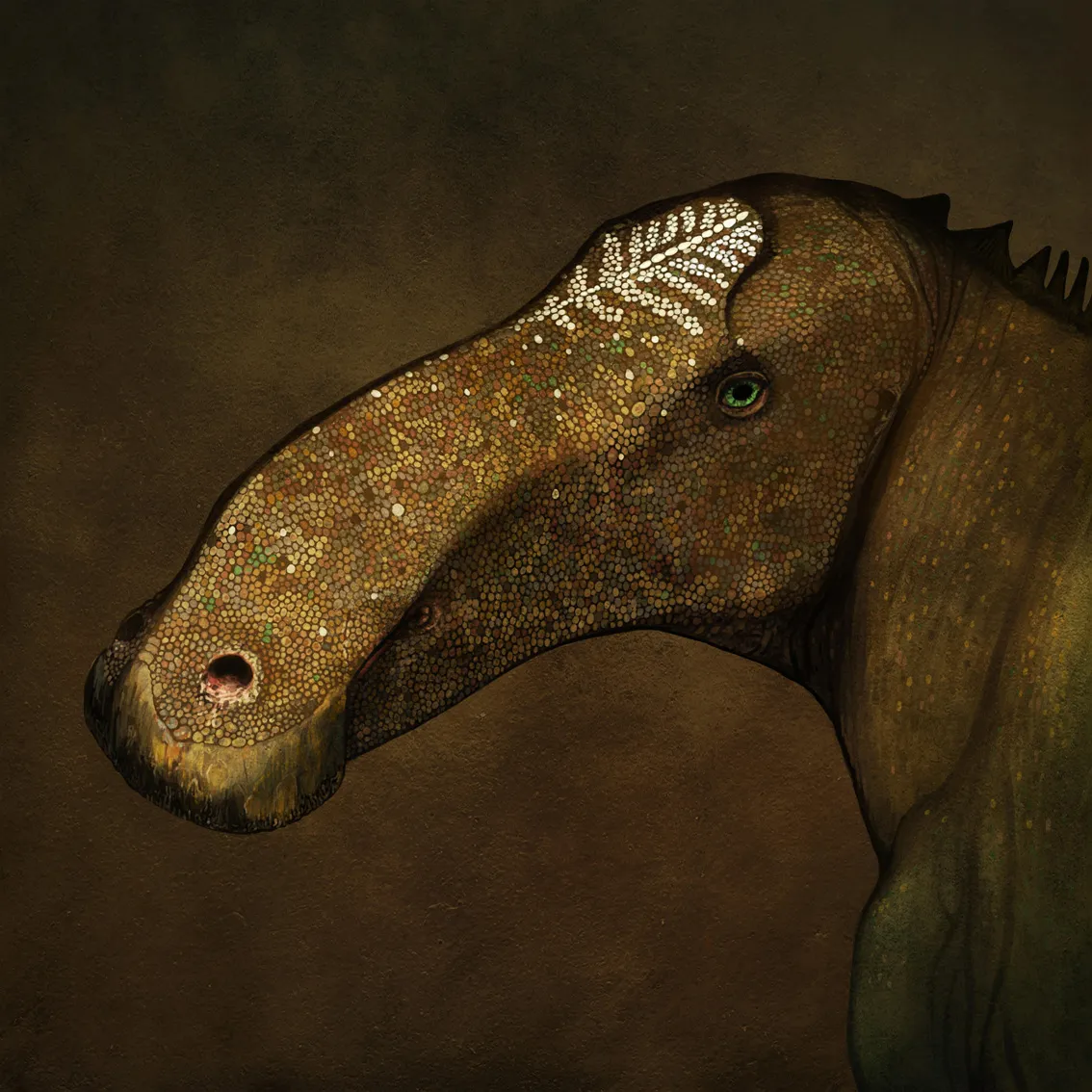
A newly classified duck-billed dinosaur species snagged the nickname "superduck" due to its giant pelvis. But a small feature on its skull is a much bigger deal to paleontologists because it helps to define headgear evolution in hadrosaurs, a group of herbivorous duck-billed dinosaurs.
The new dinosaur's name is a tongue twister: Probrachylophosaurus bergei (pro-BRACK-ee-loe-fa-SORE-us ber-GAY.) It would have been about 30 feet (9 meters) long and weighed around 5 tons (4,500 kilograms). The crest atop its head may have barely cleared its brow, but it identifies the hadrosaur as a link between a predecessor species with a flat skull and later relatives with more dramatic paddle-shaped crests that reached the backs of their heads. [See Photos: Digging Up "Superduck," a New Hadrosaur]
Getting a head
Piecing together this dinosaur took several decades. Paleontologists discovered leg and pelvis bones in Montana's Judith River Formation, a rich source of dinosaur fossils, in 1981. Though scientists knew the bones belonged to a 79-million-year-old hadrosaur, they couldn't determine if the remains represented a new species.
"Typically, we need the skull to know what species we have," Elizabeth Freedman Fowler, curator of paleontology at the Great Plains Dinosaur Museum and an adjunct professor at Montana State University, told Live Science. "For most closely related animals, the variations are all going to be up in the skull," said Freedman Fowler, who co-authored the new study detailing the findings.
"Not like anything we'd ever seen before"
But scientists didn't have that critical piece until 2007, when weather and erosion exposed pieces of the skull at the site where paleontologists first recovered the pelvis and leg bones. Freedman Fowler and her colleagues were digging up hadrosaur fossils in a different location when they got the call from Fowler's mentor, paleontologist Jack Horner. The quarry holding the skull bones was vulnerable to fossil poaching, and Freedman Fowler knew they had to recover the fossils for analysis before they were stolen.
Get the world’s most fascinating discoveries delivered straight to your inbox.
As soon as the scientists cleaned up the bones in the lab, they realized the skull was special. "It had this really strange, small crest, not like anything we'd ever seen before," Freedman Fowler told Live Science. [Photos: Discovering a Duck-Billed Dinosaur Baby]
The newfound skull most resembled those of hadrosaurs Acristavus and Brachylophosaurus, but its diminutive crest set it apart from both.Acristavus, the earlier hadrosaur, had a flat skull with no crest (its name, in fact, means "noncrested ancestor"). The later hadrosaur, Brachylophosaurus, had a crest extending toward the back of its head. Freedman Fowler and her team suspected that the small-crested dinosaur was a new intermediary species.
Cute crest
To make sure their find wasn't just an immature big-crested Brachylophosaurus specimen, the scientists cut open a leg bone to count the growth rings and find out how old the dinosaur was when it died. Once they discovered that their new hadrosaur was more mature than the oldest known Brachylophosaurus specimen, they knew they had found a unique species. They named it Probrachylophosaurus, as it predated its larger-crested cousin by 1.5 million years.
Hadrosaurs, arguably the most endearing dinosaurs of the Late Cretaceous period, sported a range of crests that could be hollow or solid, resembling roosters' combs, tapirs' trunks or poorly modeled ashtrays. No one knows for sure what purpose their headgear served, but it may have been used for mating displays, or even to produce unique vocalizations.
The tiny crest topping Probrachylophosaurus probably served as some kind of species identification, Freedman Fowler said. "We think that they were display features for recognizing members of their own species and recognizing how mature they were," Freedman Fowler said. Because the crest was so small, it would have been hard to see it from a distance, so there may have been something distinctive about its coloration, she added.
Filling in the gaps
The Judith River Formation is far from tapped out — Freedman Fowler asserts that many more Late Cretaceous fossils are yet to be discovered there, including more transitional species like the new hadrosaur. Every new discovery, she pointed out, creates connections between formerly isolated species, bringing dinosaur relationships more clearly into focus.
"We're finding new specimens, we're finding new species and they're filling in these gaps, and so we can really look at the paths of evolution between species, and really know who's connected in the direct lineage," Freedman Fowler said.
The finding was detailed online Nov. 11 in the journal PLOS ONE.
Follow Mindy Weisberger on Twitter and Google+. Follow us @livescience, Facebook & Google+. Original article on LiveScience.

Mindy Weisberger is a science journalist and author of "Rise of the Zombie Bugs: The Surprising Science of Parasitic Mind-Control" (Hopkins Press). She formerly edited for Scholastic and was a channel editor and senior writer for Live Science. She has reported on general science, covering climate change, paleontology, biology and space. Mindy studied film at Columbia University; prior to LS, she produced, wrote and directed media for the American Museum of Natural History in NYC. Her videos about dinosaurs, astrophysics, biodiversity and evolution appear in museums and science centers worldwide, earning awards such as the CINE Golden Eagle and the Communicator Award of Excellence. Her writing has also appeared in Scientific American, The Washington Post, How It Works Magazine and CNN.