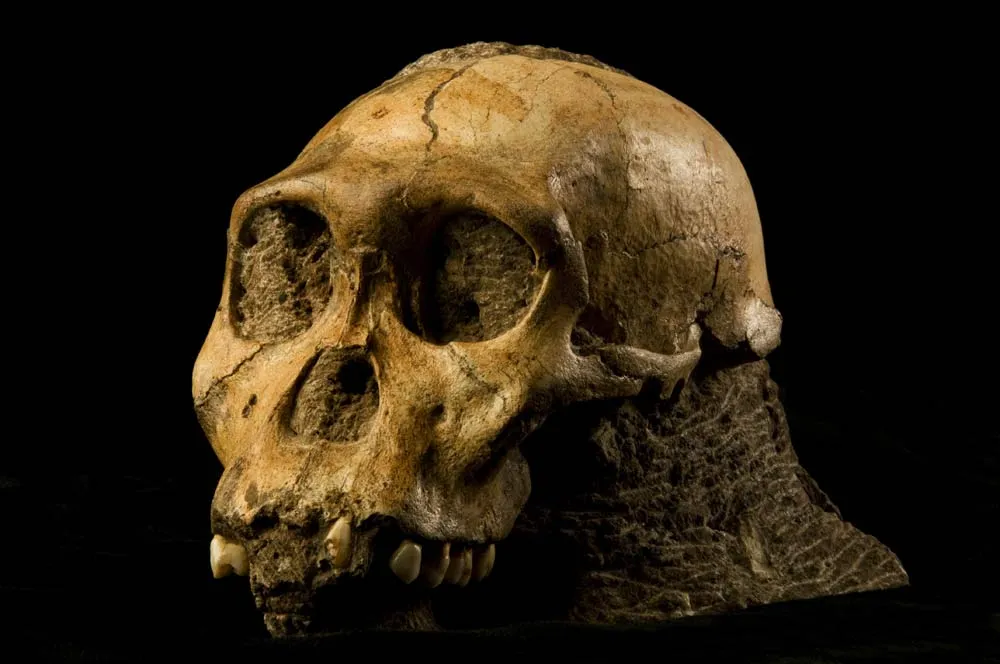
Recent controversies about human evolution — such as what the ancestor of the human lineage might have been, whether the mysterious "hobbit" was a different species and whether ancient humans were all one species — could find answers in new analyses of human fossils, researchers say.
This research, based on statistical analyses of a newly compiled data set of ancient human fossils, supports the proposal that the recently unearthed species Australopithecus sediba may be the ancestor of the human lineage, that the hobbit was a different species and not just a deformed modern human, and that early humans were made up of two species, not one, scientists added.
Although modern humans are the only surviving members of the human family tree, others once inhabited the Earth. However, deducing the relationships between modern humans and these extinct hominins — humans and related species dating back to the split from the chimpanzee lineage — is difficult because fossils of ancient hominins are rare. [See Images of Our Closest Human Ancestor]
Latest Videos From
"There are lots of competing ideas and incomplete data," said study co-author Mark Collard, a biological anthropologist at Simon Fraser University in Burnaby, British Columbia.
Hominin mysteries
One controversy centers around 1.97-million-year-old bones unearthed in South Africa that scientists revealed in 2010. These fossils belong to a species the researchers named Australopithecus sediba, a kind of australopith — the hominins that preceded humans, and the first to walk on two feet. Au. sediba possessed a unique combination of features seen in both australopiths and early humans, which led the investigators to suggest that this hominin might be the ancestor of the human family tree. However, other researchers challenged this link, suggesting that Au. sediba probably arose from Australopithecus africanus, another possible contender for the ancestor of the human lineage.
Another dispute focuses on the so-called "hobbits," 18,000-year-old human fossils first discovered on the remote Indonesian island of Flores in 2003. The squat, 3-foot (1 meter) height of these specimens led to the hobbit nickname. Although many scientists have suggested that hobbits belonged to a unique branch of the human lineage they call Homo floresiensis, other researchers have argued it was unlikely another species of human survived so close to the present day, and that hobbits were really modern humans with microcephaly, a condition that leads to an abnormally small head, a small body and some mental retardation.
Yet another debate in human evolution has to do with the suggestion that the earliest, now-extinct human lineages, once thought to be multiple species, might actually have been one species. Prior research analyzed bones excavated from Dmanisi, a medieval hilltop town in the Republic of Georgia. The analysis found that these 1.85-million-year-old bones — the oldest hominin remains outside Africa — were very diverse. This finding led researchers investigating Dmanisi to suggest that early, diverse humans fossils might not represent several human species but rather variants of a single lineage. Others have suggested the bones at Dmanisi represent two or more human species. [Photos: Amazing Human Ancestor Fossils from Dmanisi]
A whole lot of data
To shed light on these controversies in human evolution, Collard and his colleagues compiled a data set of 380 skull and dental features for all 20 widely accepted hominin species.
"It's the biggest data set of its kind to have been compiled," Collard said. "Creating the data set was a massive job, and it should serve as a basis for lots of future studies. The fact that it includes both early and late hominins means that it should provide a much more robust picture of hominin relationships than any data set used in the last 30 years."
Next, the scientists statistically analyzed this data spanning the entire 7-million-year-old history of human evolution to test which theory in each controversy might be more or less likely to be true. "We are very excited by this new approach and hope that our colleagues see the merit of adopting this method," Collard said.
Their models are consistent with Au. sediba being the ancestor of the human lineage. They also found that Au. sediba may be at least 300,000 to 500,000 years older than scientists had thought, suggesting that researchers should look for older specimens.
"We only have Au. sediba remains from one site in South Africa, so it's unlikely that our current collection of fossils adequately represents its time range," Collard said. "I think we can be pretty certain it does not, in fact."
The new models also clearly reject the idea that the hobbits were merely deformed modern humans; the hobbits bear no close resemblance to modern humans, deformed or not. "They show that there's no way the hobbits can be modern humans, which means that we can move on as a community and start to consider other important questions about the floresiensis hominins," Collard said.
As for whether early humans were one species or many, Collard said he was surprised that the models suggested two hominin species might have existed at Dmanisi.
"The two-species hypothesis is not widely accepted," Collard said. "In fact, people have found evidence that is consistent with that hypothesis in the past and decided to go with the more conservative hypothesis that there is just one species present."
"We need to take the two-species hypothesis more seriously and find ways of competing it against the one-species hypothesis," Collard added.
Collard expected his findings would themselves prove controversial. "Paleoanthropologists are notoriously argumentative," he said.
The scientists detail their findings online July 22 in the journal Proceedings of the Royal Society B.
Follow us @livescience, Facebook& Google+. Original article on Live Science.