













'O' My: Ring-Shaped Cloud Spotted Over the Pacific (Photo)

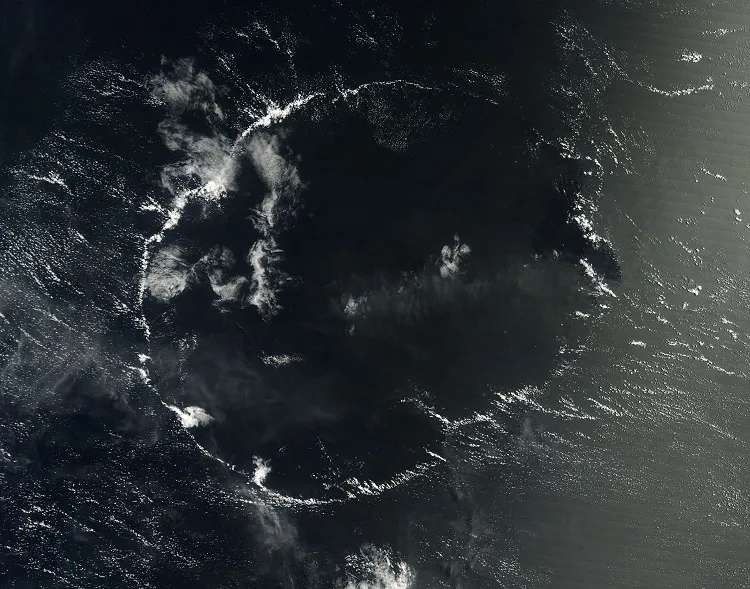
Clouds come in all shapes and sizes — they can look like tubes, waves, faces, top hats and even spaceships. But a NASA satellite recently captured an image of a cloud that is almost a perfect circle.
The agency's Terra satellite spotted the O-shaped cloud formation on Sept. 3, as it floated over the Pacific Ocean to the southwest from the Hawaiian Islands. NASA's Earth Observatory released the image on Sept. 27.
This high-flying "O" is made of convective clouds that form when temperature changes make air patches rise and fall. Meteorologists classify convective clouds as open-cell or closed-cell formations. Both types form when clumps of warm air rise. However, closed-cell formations resemble honeycombs, whereas open-cell formations look like O's. [In Photos: Crazy Cloud Patterns]
Closed-cell clouds form when warm air rises and then sinks around the edges. Open-cell clouds, like the one in this image, form the opposite way. The ring shape forms because cold air sinks in the middle and warm air rises around it.
A few different atmospheric conditions can make ring-shaped clouds form, but meteorologists think this particular cloud formed when the sun heated air as it drifted over a small patch of warm ocean water. As the air warmed, clumps of light rain clouds formed. The rain would have cooled down the air under the clouds. The cold air likely created a downdraft, and as the cold air sank, it pushed warm air up around it, creating the ring-shaped cloud formation.
O-shaped clouds are common, but meteorologists didn't know they existed until weather satellites began snapping pictures of them, according to a blog post written by retired meteorologist Lee Grenci. Ground instruments and airplanes couldn't parse out enough detail among dense cloud networks to spot the rings. The first published documentation of an O-shaped convective cloud came from NASA's TIROS-1 weather satellite that launched in 1961.
The newly released cloud photo is part of the Earth Observatory's catalog of satellite images of the ABCs. The projectis collecting pictures of clouds, smoke, ice, islands and even phytoplankton blooms that resemble letters. For example, the project has collected a V-shaped smoke plume that rose from a wildfire in Canada in 2012. The Earth Observatory is still looking for high-quality photos of natural formations that resemble the letters B, G, F and K.
Get the world’s most fascinating discoveries delivered straight to your inbox.
Anyone can browse the NASA satellite collection of images, called Worldview, to hunt for letter-shaped images. Participants can link to potential candidate images in the comments section of this post from the Earth Observatory.
Follow Kelly Dickerson on Twitter. Follow us @livescience, Facebook & Google+. Original article on Live Science.
