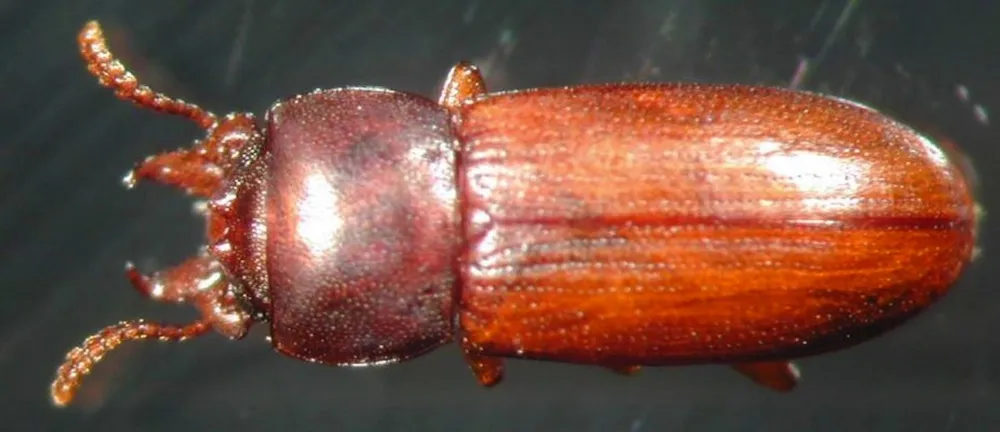
When it comes to choosing a mate in the beetle world, females prefer males that are better lovers than fighters, a new study finds.
Female horned flour beetles favored males that courted the females the most, rather than those with the largest jaws, a sign of fighting prowess. The findings suggest that strength in battle and popularity with the ladies don't always go hand-in-hand.
"The most attractive males, those most preferred by females, were not the highly competitive males with large mandibles," study co-author Dave Hosken, an evolutionary biologist at the Centre for Ecology and Conservation at the University of Exeter's Penryn Campus, in England, said in a statement. "Instead, females prefer to mate with males that court more." [Busted! 6 Gender Myths in the Bedroom & Beyond]
The mode of natural selection known as sexual selection usually depends on female mate choice or male-male competition. But these criteria don't necessarily overlap.
Male and female horned flour beetles.
(Image credit: Dave Hosken)
Male horned beetles (Gnatocerus cornutus) have massive lower jaws called mandibles, which the insects use in combat with rival males. In a direct competition, males with bigger mandibles are more likely to get the girl. But when female beetles have a say, they seem to care more about romance than heftier jaws.
In a study published April 29 in the journal Proceedings of the Royal Society B, Hosken and his team studied mating in hundreds of horned beetles collected in Miyazaki City, Japan.
Horned beetle courtship is a romantic affair. The male beetle orients himself behind his mate, mounts her and starts tapping her back repeatedly while rubbing his lower legs and body against her. If he's successful, the female will respond by extending her egg-laying organ, or ovipositor. Genital coupling and brief copulation follow.
Sign up for the Live Science daily newsletter now
Get the world’s most fascinating discoveries delivered straight to your inbox.
The researchers placed male and female beetles together and measured how long it took them to start mating. Scientists measured courtship ability by the number of courtship bouts per second. They measured male attractiveness by the length of time between the beetles' introduction and mating. (The shorter the time, the more the gal was thought to prefer her mate.)
After many trials, the team found that female beetles were quicker to mate with males that courted them more, whereas male mandible size made no difference. Courtship ability and mandible size are not physically or genetically linked, the scientists said.
The researchers also looked into whether a female's choice of mate came with an evolutionary benefit or cost to her or her offspring. Mating with more romantic males carried no advantage, but mating with beefy-jawed guys came with a cost: the resulting daughters had bodies with less space for eggs. Thus, female beetles may benefit by choosing mates by courtship ability rather than jaw size, the researchers said.
Tanya was a staff writer for Live Science from 2013 to 2015, covering a wide array of topics, ranging from neuroscience to robotics to strange/cute animals. She received a graduate certificate in science communication from the University of California, Santa Cruz, and a bachelor of science in biomedical engineering from Brown University. She has previously written for Science News, Wired, The Santa Cruz Sentinel, the radio show Big Picture Science and other places. Tanya has lived on a tropical island, witnessed volcanic eruptions and flown in zero gravity (without losing her lunch!). To find out what her latest project is, you can visit her website.