















Termite Bite Is Fastest in the World

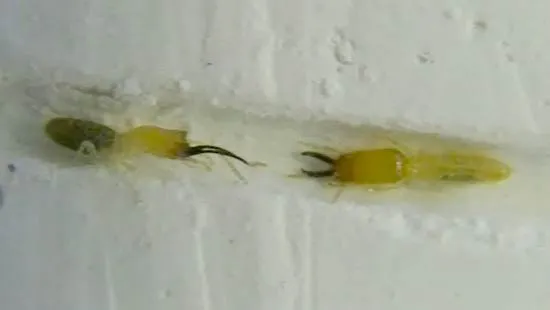
Panamanian termites have the fastest draw not only in the West, but in the whole world: They can clamp their jaws down on an invader at nearly 157 mph (70 meters per second), killing their enemy with a single blow.
Researchers studying the termites needed a high speed video camera running at 40,000 frames per second to capture a mandible strike in action. (Mandible is the biological word for jaw or biting mouthpart.)
"Many insects move much faster than a human eye can see, so we knew that we needed high speed cameras to capture their behavior, but we weren't expecting anything this fast," said study team member Marc Seid, a postdoctoral researcher at the Smithsonian Tropical Research Institute.
The Panamanian termite's chomp-down is the fastest "mandible strike" recorded. The termites have to employ such a speedy strike to defend themselves, because their small size makes it harder to generate enough force to inflict damage on a foe.
"To create a large impact force with a light object you need to reach very high velocities before impact," said study team member Jeremy Niven, also a postdoctoral researcher at STRI.
Because a termite soldier faces down enemies inside a narrow tunnel and has little room to parry and little time to waste, this death blow proves to be incredibly efficient, though it works only over short distances.
The force for the blow is stored by deforming the jaws, which are held pressed against one another until the strike is triggered. This strategy of storing up energy from the muscles to produce fast movements also is employed by locusts, trap-jaw ants and froghoppers.
Get the world’s most fascinating discoveries delivered straight to your inbox.
"The termites need to store energy to generate enough destructive force. They appear to store the energy in their mandibles but we still don't know how they do this — that's the next question," Niven said.
"Ultimately, we're interested in the evolution of termite soldiers' brains and how they employ different types of defensive weaponry," Seid said.
The work, detailed in the Nov. 25 issue of the journal Current Biology, was conducted at the Smithsonian's neurobiology lab in Panama.
