













Tornadoes in Winter?

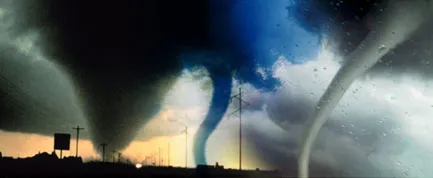
A cluster of tornadoes killed at least eight people and injured several others in Oklahoma last night, according to news reports.
Additional severe weather is expected today in parts of Mississippi, Louisiana, Arkansas, Missouri and Tennessee.
Is this unusual?
Actually, twisters can strike any time of year, in many parts of the country, and frighteningly often at night.
Though they're most common in Tornado Alley during springtime, when warm, moist air from the Gulf of Mexico moves north and clashes with cooler air to create colossal twisters, local conditions can spawn tornadoes even in Michigan during October.
Deadlier in winter
No time of year is entirely free from tornado risk. Like spring, fall is a transitional period when masses of warm and cool air are more likely to collide and create the thunderstorms that can trigger twisters. During summer, tornadoes can also form within hurricanes, which can turn a relatively benign outer arm of a hurricane into a locally devastating event.
Get the world’s most fascinating discoveries delivered straight to your inbox.
Winter tornadoes can be particularly deadly, not because they're stronger, but because they tend to move faster.
Tornadoes in the winter and early spring are often associated with strong, frontal systems that form in the Central States and move east, according to the National Severe Storms Laboratory.
"The big problem is that the tornadoes themselves tend to be moving faster," said NSSL researcher Harold Brooks in a National Geographic News article last year.
{{ video="00_tornado_main" title="Tornado Chasers Face a Monster" caption="Researchers pursue a monster wedge tornado across the plains of Manitoba." }}
Around the world
Tornadoes are possible in a wider range of places than some people realize.
While the United States leads the way with more than 1,000 tornadoes a year, twisters are known to touch down in every continent except Antarctica.
Texas leads the nation with an average of 125 tornadoes every year, and Florida has more per square mile than anywhere else. But a handful of twisters strike several out-of-the-Alley states, including Maine (2 per year), Arizona (3) and California (5).
Another worthwhile caution to those living in tornado country: While 27 percent of tornadoes in the United States strike at night, 39 percent of tornado fatalities and 42 percent of killer tornado events occur at night. The reason, a recent study found: People are likely to be sleeping and not hear warnings; trained tornado spotters can't see nighttime twisters and so one forecasting tool is lost.
- Video - Tornado Chasers - Wow!
- Tornado News, Information and Images
- Gallery: Tornadoes

Robert is an independent health and science journalist and writer based in Phoenix, Arizona. He is a former editor-in-chief of Live Science with over 20 years of experience as a reporter and editor. He has worked on websites such as Space.com and Tom's Guide, and is a contributor on Medium, covering how we age and how to optimize the mind and body through time. He has a journalism degree from Humboldt State University in California.