













Diagram of the Human Skeletal System (Infographic)

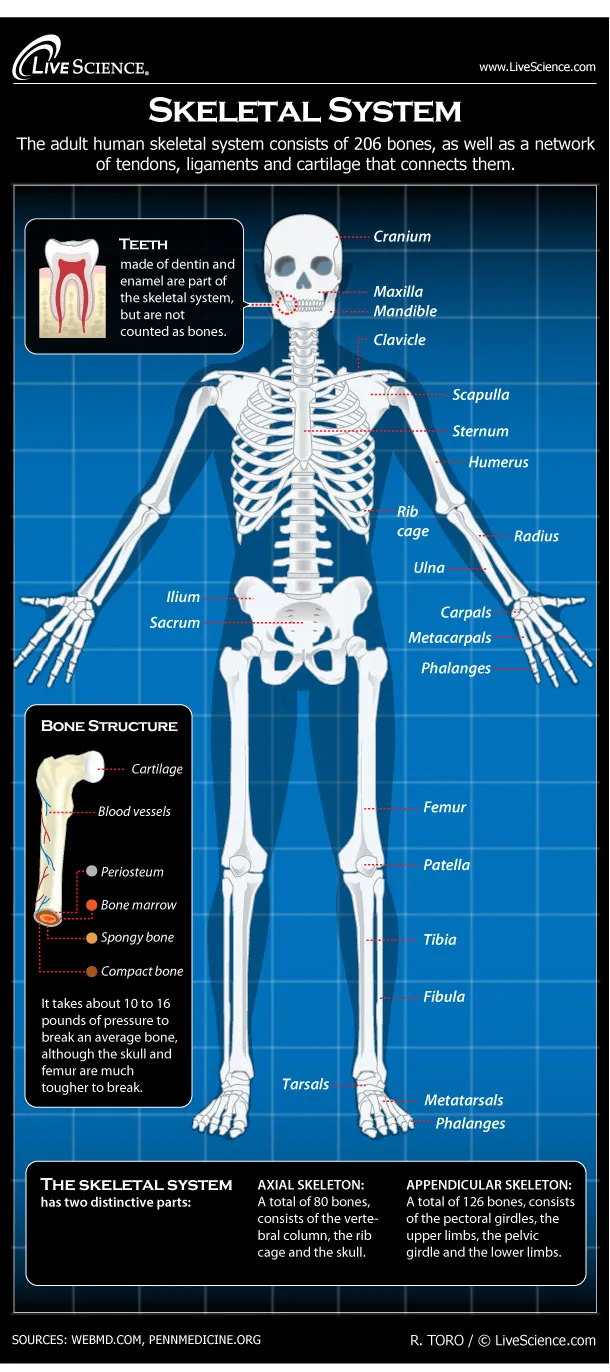
The adult human skeletal system consists of 206 bones, as well as a network of tendons, ligaments and cartilage that connects them.
Teeth are made of dentin and enamel and are part of the skeletal system but are not counted as bones.
A bone’s structure includes cartilage, blood vessels, and internal structure. The periostenum is a membrane that lines the outside of bones. Inside the bone is the endostenum membrane, bone marrow and the dense “compact,” or “cortical,” bone.
It takes about 10 to 16 pounds of pressure to break the average bone, although the skull and femur are much tougher to break.
The skeletal system has two distinct parts. The axial skeleton totals 80 bones, consisting of the vertebral column, the rib cage and the skull.
The appendicular skeleton totals 126 bones, consisting of the pectoral girdles, the upper limbs, the pelvic girdle and the lower limbs.
Animals with a skeleton (vertebrates) are a tiny minority as 98 percent of all animals are invertebrates, which means “without backbone.”
Get the world’s most fascinating discoveries delivered straight to your inbox.
Osteoporosis is a disease that cases loss of bone tissue. Bones lose calcium and become thin and brittle.
Scoliosis is a disorder that causes a “C” or “S” shaped curve of the spine.
Arthritis is the term for a group of more than 100 diseases that can damage joints, joint capsules and surrounding tissue in many parts of the body.
Related:
