















Major Breakup Threatens Antarctic Ice Shelf

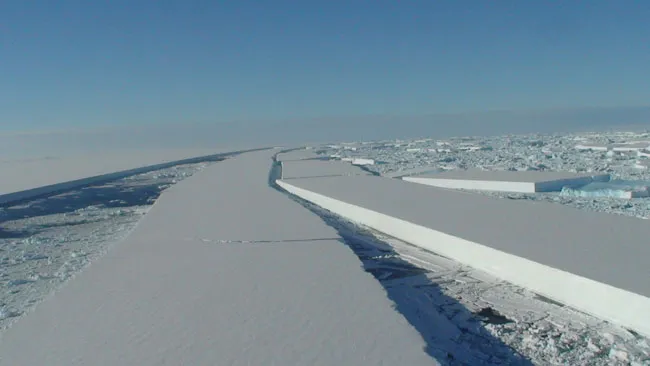
A large chunk of one of Antarctica's ice shelves broke off at the end of May, new satellite images show, marking the second major breakup of the shelf this year and the first documented episode to occur in winter. The European Space Agency's Envisat satellite captured images of an area of ice about 62 square miles (160 square kilometers) breaking off of the Wilkins Ice Shelf from May 30 to 31. The Wilkins Ice Shelf is a broad plate of floating ice south of South America on the Antarctic Peninsula. It connects two islands, Charcot and Latady. In February 2008, an even larger area of about 154 square miles (400 square km) broke off from the ice shelf, narrowing the connection between the islands to a 3.7-mile (6 km) wide strip of ice. After the most recent breakup, the connection was whittled down to just 1.7 miles (2.7 km). This narrow strip is all that is protecting thousands more kilometers of the ice shelf from further breakup. The Antarctic Peninsula has experienced more warming than any other part of the southernmost continent; in the past 50 years, it has experienced 4.5 degrees Fahrenheit (2.5 degrees Celsius) of warming. The warming has been so drastic, because the peninsula is sandwiched between a region with substantially rising air temperatures and a warming ocean. In the past 20 years, seven ice shelves along the peninsula have retreated or disintegrated, including the spectacular 2002 breakup of the Larsen B Ice Shelf . Scientists monitoring the Wilkins Ice Shelf don't think the current breakup has finished. "The remaining plate has an arched feature at its narrowest position, making it very likely that the connection will break completely in the coming days," said Matthias Braun of Bonn University and Angelika Humbert of Münster University, both in Germany, in a statement. The satellite monitoring of Antarctic ice shelves is part of the International Polar Year (IPY) 2007-2008 worldwide research effort.
- Video: Under Antarctic Ice
- Video: Learn How Ice Melts
- Images: Ice of the Antarctic
Get the world’s most fascinating discoveries delivered straight to your inbox.

Andrea Thompson is an associate editor at Scientific American, where she covers sustainability, energy and the environment. Prior to that, she was a senior writer covering climate science at Climate Central and a reporter and editor at Live Science, where she primarily covered Earth science and the environment. She holds a graduate degree in science health and environmental reporting from New York University, as well as a bachelor of science and and masters of science in atmospheric chemistry from the Georgia Institute of Technology.