













Robot Wing to Reveal Hummingbird Hover Tricks

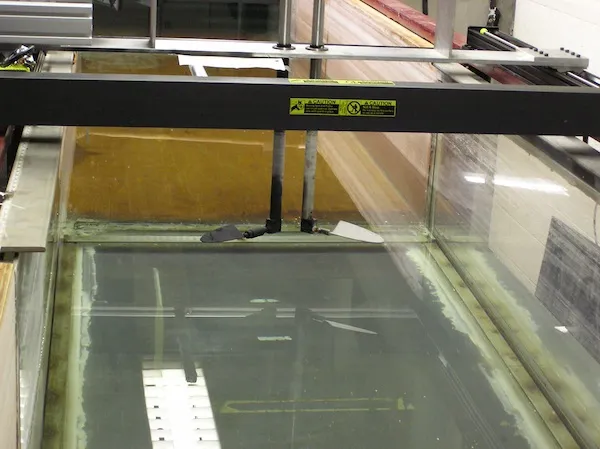
B.J. Balakumar's robotic hummingbird wing isn't as pretty as the real thing. It lacks jewel-like colors and the iridescent glint of hummingbird feathers. But what the unadorned metal wing does have is the ability to help researchers understand how the tiny fliers manage to dart, hover and dive even in gusty winds.
The work is still in the preliminary stages, Balakumar, a researcher in the Extreme Fluids Lab at Los Alamos National Laboratory, told LiveScience. However, the researchers hope that the findings will eventually be used in robotics.
The smallest hummingbirds weigh barely more than a penny, and the largest weigh in at just 0.7 ounces (20 grams). Despite their mini stature, hummingbirds are among the world's largest hovering animals.
Researchers have long known that hummingbirds don't fly like other birds. Instead of flapping their wings up and down, hummingbirds oscillate their wings in a figure-eight pattern. The oscillation produces lift on both the downstroke and the upstroke. When hovering, hummingbirds generate extra lift by creating a vortex of air on the leading edge of their wings.
These wing vortices are very unstable, meaning they should vanish at the teensiest nudge, Balakumar said. But the hummingbirds have a clever way around that problem.
"Their wings create the vortex with a high angle of attack on the downstroke," Balakumar said in a statement. "Then they flip their wings around on the upstroke, so as they shed one vortex, they create another on the other side of the wing, thereby managing to maintain high lift forces."
But a gust of wind could upset this delicate balance. Balakumar and his team built their robotic hummingbird wing to find out how hummingbirds compensate for breezy conditions. By exposing the wing to winds in a controlled laboratory environment, Balakumar and his team hope to identify the mathematical algorithms that will allow them to transfer the feat to flying robots. Such stable hovering machines would be useful for surveillance and other applications, the researchers report.
Get the world’s most fascinating discoveries delivered straight to your inbox.
The researchers describe their robotic wing device today (Nov. 21) at the American Physical Society Division of Fluid Dynamics meeting in Long Beach, Calif.

Stephanie Pappas is a contributing writer for Live Science, covering topics ranging from geoscience to archaeology to the human brain and behavior. She was previously a senior writer for Live Science but is now a freelancer based in Denver, Colorado, and regularly contributes to Scientific American and The Monitor, the monthly magazine of the American Psychological Association. Stephanie received a bachelor's degree in psychology from the University of South Carolina and a graduate certificate in science communication from the University of California, Santa Cruz.