















Antarctic Ice Shelf All But Lost

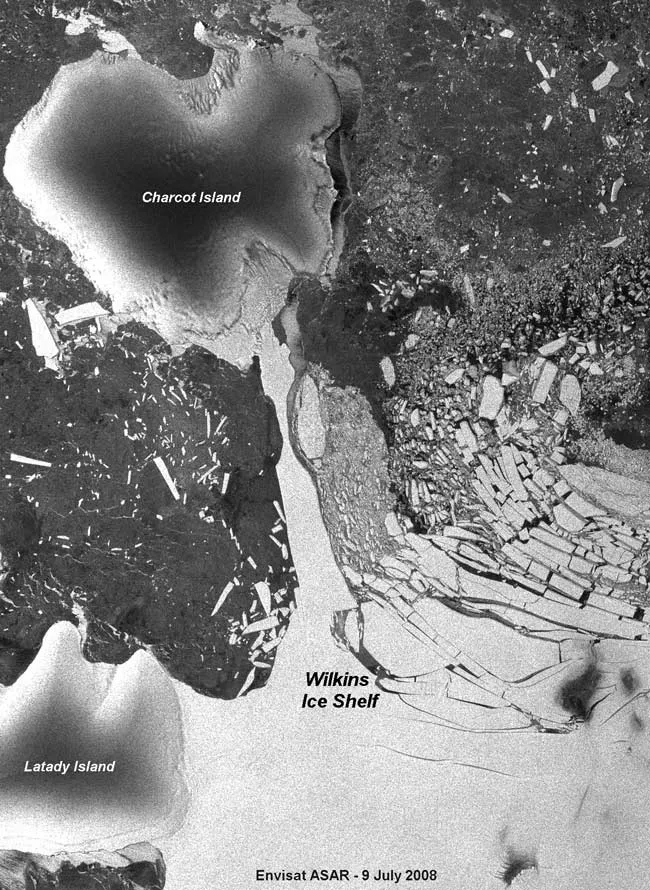
A vast shelf of ice in Antarctica is hanging on to the continent by a thread and is not expected to survive, scientists announced today.
The Wilkins Ice Shelf is experiencing further disintegration that could collapse an ice bridge connecting the shelf to Charcot Island. Since the connection to the island helps to stabilize the ice shelf, it is likely the breakup of the bridge will put the remainder of the ice shelf at risk, the researchers said.
The disintegration is evident in images from the European Space Agency's Envisat satellite.
The Wilkins Ice Shelf, a broad plate of floating ice south of South America on the Antarctic Peninsula that is connected to Charcot and Latady Islands, had been stable for most of the last century before it began retreating in the 1990s. A major breakup was spotted in May, the second this year.
This third significant breakup is puzzling because it occurred in the Southern Hemispheric winter. It's also behaving differently than previous breakups.
"The scale of rifting in the newly-removed areas seems larger, and the pieces are moving out as large bergs and not toppled, finely-divided ice melange," said Ted Scambos from the U.S. National Snow and Ice Data Center.
The Antarctic Peninsula's atmosphere has experienced more warming than any other part of the southern-most continent; in the past 50 years, it has experienced 4.5 degrees Fahrenheit (2.5 degrees Celsius) of warming. The warming has been so drastic because the peninsula is sandwiched between a region with substantially rising air temperatures and a warming ocean.
Get the world’s most fascinating discoveries delivered straight to your inbox.
But warm water seems to be at least partly to blame for the recent disintegration, Scambos said.
In the past 20 years, seven ice shelves along the peninsula have retreated or come apart, including the spectacular 2002 breakup of the Larsen B Ice Shelf. The entire Wilkins shelf, before the recent breakups, covered about 6,180 square miles (16,000 square kilometers — about the size of Northern Ireland).
"Wilkins Ice Shelf is the most recent in a long, and growing, list of ice shelves on the Antarctic Peninsula that are responding to the rapid warming that has occurred in this area over the last fifty years," said David Vaughan of the British Antarctic Survey. "Current events are showing that we were being too conservative when we made the prediction in the early 1990s that Wilkins Ice Shelf would be lost within thirty years - the truth is it is going more quickly than we guessed."
Meanwhile at the top of the world, melting has become so rapid that scientists say the North Pole could be ice-free this summer.
- 101 Amazing Earth Facts
- Video: Learn How Ice Melts
- Images: Ice of the Antarctic
