















Wolf Bones Beat Tree Rings as Climate Records

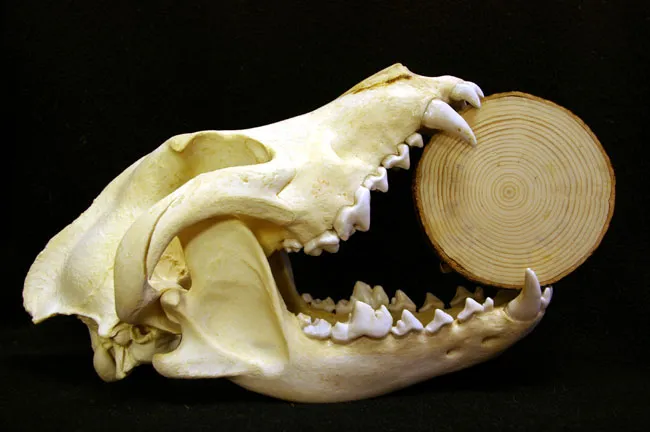
The bones of wolves could provide a better record than tree rings of environmental changes in Earth’s climate, a new study shows.
Reliable human records of Earth's climate only extend back for a hundred years or so, therefore scientists also rely on other methods, such as tree rings and air bubbles trapped in glacial ice, to look for trends in the changes in the composition of Earth's atmosphere.
But these sources also have "noise" problems due to natural variability and random events that affect the chemistry of the atmosphere.
Bones less noisy
Seeking to compare alternative approaches, scientists at Michigan Technological University speculated that the bones of certain predators would reveal the same trends in atmospheric changes without picking up the same noise because carnivores often sit at or near the top of food chains.
"Wolves consume many prey animals—a minimum of 150 to 200 moose contribute to an Isle Royale wolf's diet over the course of its lifetime—and the prey consume a whole lot of plants," said study leader Joseph Bump, a graduate student at Michigan Tech. "Just by being who they are, wolves and other top predators increase the sample size, because they do the sampling for us."
The chemical fingerprint of climate change, in bones and other substances, results from the change in the ratio of carbon-12 and its isotope carbon-13 that occurs from the burning of fossil fuels. Carbon-12 is always more abundant in the atmosphere, but it increases relative to its isotope from fossil fuels, so more has accumulated in organisms in recent years.
Get the world’s most fascinating discoveries delivered straight to your inbox.
Bump and his colleagues studied the bones of moose and wolves to see how the carbon ratio has changed over time. Some of the bones date to 1958 and were taken from Isle Royale National Park on Lake Superior. The researchers also looked at 30,000-year-old bones from the extinct dire wolf, collected from the La Brea Tar Pits in Los Angeles.
The results of the study, funded by the National Science Foundation, the Environtmental Protection Agency, then National Park Service and Earthwatch, are detailed in the Aug. 7 online edition of the journal Proceedings of the Royal Society-B.
Clearer fingerprint
The wolf bones from both sites provided a much clearer record of environmental change than either bones take from the moose and bison or from plants.
"Since the widespread combustion of fossil fuels, we have put a human fingerprint on atmospheric carbon dioxide," Bump said. "That fingerprint shows up in trees, and it shows up in animals that eat trees, but it shows up with the least variation in the top predators."
Bump hopes that this new line of evidence will help scientists establish a firmer climate record, since the bones of predators dating back hundreds of thousands of years are available in museums worldwide.
"Instrumental records of environmental variables are only available for about the past few hundred years so this may help us understand paleo-environmental change better," Bump said. "And if we can understand ancient environments better, then our ability to predict future change is improved."
- What's Your Environmental Footprint?
- Top 10 Surprising Results of Global Warming
- Images: Glaciers Before and After

Andrea Thompson is an associate editor at Scientific American, where she covers sustainability, energy and the environment. Prior to that, she was a senior writer covering climate science at Climate Central and a reporter and editor at Live Science, where she primarily covered Earth science and the environment. She holds a graduate degree in science health and environmental reporting from New York University, as well as a bachelor of science and and masters of science in atmospheric chemistry from the Georgia Institute of Technology.