















Antarctic Icebergs Are 'Hotspots' for Marine Life

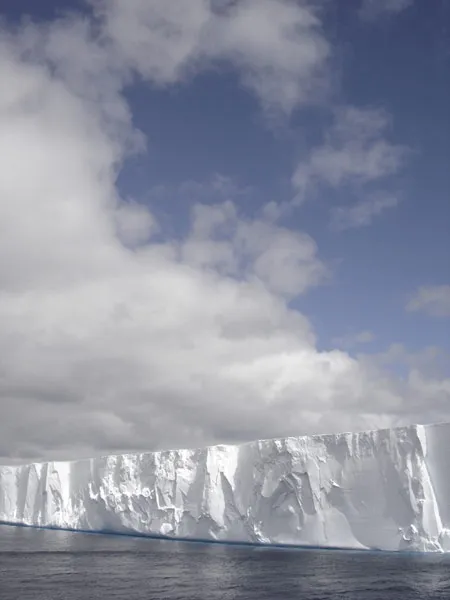
The ever-increasing number of free-floating icebergs breaking off Antarctica due to Earth’s warming temperatures are serving as “hotspots” for life, with seabirds swooping above and complex webs of marine life teeming below, a new study shows.
Global warming is showing its most dramatic effect at Earth’s poles so far, and the rising temperatures are causing Antarctic ice shelves to shrink and split apart into thousands of icebergs that drift out to sea.
Researchers examined two of these icebergs drifting in the Weddell Sea, an arm of the Southern Atlantic Ocean that cuts into Antarctica southeast of South America’s Cape Horn.
They found that the floating icebergs transport material from the continent and release it further out at sea as they melt. This material produces a “halo effect” of increased biological activity for a radius of more than two miles around the icebergs.
The team used a small remotely operated vehicle (ROV) to explore the undersides of the icebergs and venture into underwater caves. The researchers could then identify and count the animals in the images the ROV sent back; they found significant increases in phytoplankton, krill (a staple food for whales and seals) and seabirds.
The findings are detailed in the June 22 issue of the journal Science.
The thriving iceberg communities could act as a new source of organic carbon, as well as a new carbon sink, as phytoplankton take up carbon dioxide from the atmosphere for photosynthesis, then die and sink to the ocean’s bottom where the carbon can be stored for many years.
Get the world’s most fascinating discoveries delivered straight to your inbox.
“While the melting of Antarctic ice shelves is contributing to rising sea levels and other climate change dynamics in complex ways, this additional role of removing carbon from the atmosphere may have implications for global climate models that need to be further studied,” said study team leader Ken Smith of the Monterey Bay Aquarium Research Institute.
- Video: Greatest Warming Seen at High Latitudes
- Top 10 Surprising Results of Global Warming
- Timeline: The Frightening Future of Earth

Andrea Thompson is an associate editor at Scientific American, where she covers sustainability, energy and the environment. Prior to that, she was a senior writer covering climate science at Climate Central and a reporter and editor at Live Science, where she primarily covered Earth science and the environment. She holds a graduate degree in science health and environmental reporting from New York University, as well as a bachelor of science and and masters of science in atmospheric chemistry from the Georgia Institute of Technology.