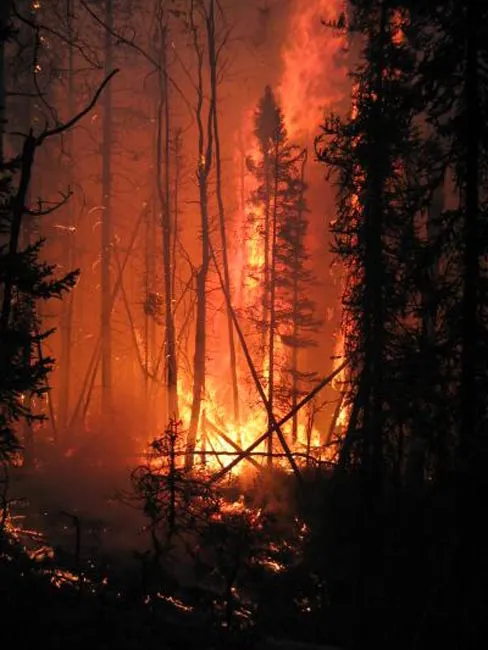
Severe Alaskan wildfires have released much more carbon than was stored by the region's forests over the past 10 years, researchers report today. They warned that the pattern could lead to a "runaway climate change scenario" where larger, more intense fires release more greenhouse gases that, in turn, lead to more warming.
The northern wildfires burn peatlands that consist of decaying plant litter, moss and organic matter in the soil, said Merritt Turetsky, an ecologist at the University of Guelph in Canada and lead author of a new study. Such fires have a huge impact given that the peatlands contain much of the world's soil carbon – about as much carbon as is found in the atmosphere or in the total of terrestrial biomass (plants and animals).
"These findings are worrisome, because about half the world's soil carbon is locked in northern permafrost and peatland soils," Turetsky explained. "This is carbon that has accumulated in ecosystems a little bit at a time for thousands of years, but is being released very rapidly through increased burning."
Latest Videos From
The fire-chasing researchers found that burned area has doubled in Alaska's interior over the last decade. They traveled to almost 200 forest and peatland burn sites so that they could measure how much biomass had gone up in smoke and flames, and also examined fire records dating back to the 1950s.
Climate change in Alaska has already led to coastlines crumbling under the combined factors of declining sea ice and warming oceans. Adding fire to the mix means that the northern regions may increasingly contribute to global warming, even as they suffer from erosion and the threatened extinction of polar bears and other local species.
"[These changes include] longer snow-free seasons, changes in vegetation, loss of ice and permafrost, and now fire, which is shifting these systems from a global carbon sink toward a carbon source," said Jennifer Harden, a U.S. Geological Survey scientist and co-author on the study.
More severe Alaskan wildfires can also raise health issues for humans and other animals, because fire emissions contain mercury and particulate matter that can cause respiratory problems.
"We are hoping people will recognize the seriousness of climate change for northern regions and people living in them," Turetsky said. "Wildfire is going to play a more and more important role in shaping the north."
Such findings have strong implications for countries currently meeting in Cancun, Mexico to hash out a new approach to mitigating and adapting to climate change, Turetsky pointed out. The full study is detailed in the Dec. 5 issue of the journal Nature Geoscience.

 Live Science Plus