 Live Science Plus






Say What?! Whales Shout over Noise Pollution
You are now subscribed
Your newsletter sign-up was successful
Want to add more newsletters?

Delivered Daily
Daily Newsletter
Sign up for the latest discoveries, groundbreaking research and fascinating breakthroughs that impact you and the wider world direct to your inbox.

Once a week
Life's Little Mysteries
Feed your curiosity with an exclusive mystery every week, solved with science and delivered direct to your inbox before it's seen anywhere else.

Once a week
How It Works
Sign up to our free science & technology newsletter for your weekly fix of fascinating articles, quick quizzes, amazing images, and more
Delivered daily
Space.com Newsletter
Breaking space news, the latest updates on rocket launches, skywatching events and more!

Once a month
Watch This Space
Sign up to our monthly entertainment newsletter to keep up with all our coverage of the latest sci-fi and space movies, tv shows, games and books.

Once a week
Night Sky This Week
Discover this week's must-see night sky events, moon phases, and stunning astrophotos. Sign up for our skywatching newsletter and explore the universe with us!
Join the club
Get full access to premium articles, exclusive features and a growing list of member rewards.
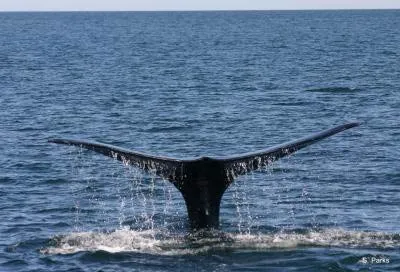
Just like a New Yorker shouting to be heard in a crowded deli, whales must shout to be heard in ever noisier ocean waters, a new study suggests.
North American right whales increase the volume of their calls as environmental noise increases, but at a certain point, it may become too costly, the study reveals.
"The impacts of increases in ocean noise from human activities are a concern for the conservation of marine animals like right whales," said acoustics researcher and study team member Susan Parks of Penn State University. "The ability to change vocalizations to compensate for environmental noise is critical for successful communication in an increasingly noisy ocean."
Noise pollution in the ocean, mostly from shipping, is doubling every decade, scientists say. More noise means the whales' communication range for feeding or mating, which normally covers thousands of miles, will shrink and stress levels on individual animals may rise.
Right whales are large baleen whales that often approach close to shore. They are rich in blubber, slow-swimming and remain afloat after death. Consequently, whalers nearly hunted these whales to extinction until whaling was banned in the early 20th century. Right whales are now monitored to determine the health and size of the global population. The northern and southern right whales — named for the hemispheres in which they live — are on the endangered species list.
Whales produce sounds called upcalls, sometimes called contact calls, when they are alone or in the process of joining with other whales. An upcall begins low and rises in pitch, and is the most frequent call produced by right whales.
"Right whale upcalls are used extensively for passive acoustic monitoring in conservation efforts to protect this endangered species," Parks said.
Right whales increase the amplitude, or the energy in their calls, directly as background noise increases without changing the calls' frequency, the study suggests. This means that right whales should still be able to understand their friends' calls over the ocean noise.
Changing calling patterns can, however, incur costs. Louder calls take more energy, and the information in them could be garbled. The calls could also alert predators, the scientists said.
The study is detailed in the July 6 edition of the journal Biology Letters.
- 10 Species You Can Kiss Goodbye
- Dangers in the Deep: 10 Scariest Sea Creatures
- Why Whales Sing

