















Coyote scrambles onto Alcatraz Island after perilous, never-before-seen swim
Experts have reacted to a viral video of a coyote swimming to Alcatraz Island in what is a surprising first for the San Francisco Bay Area.


Prisoners on Alcatraz once risked the perilous waters in San Francisco Bay to escape the island's high-security prison. Now, a wily coyote has been filmed doing the opposite: swimming to Alcatraz Island for the first time.
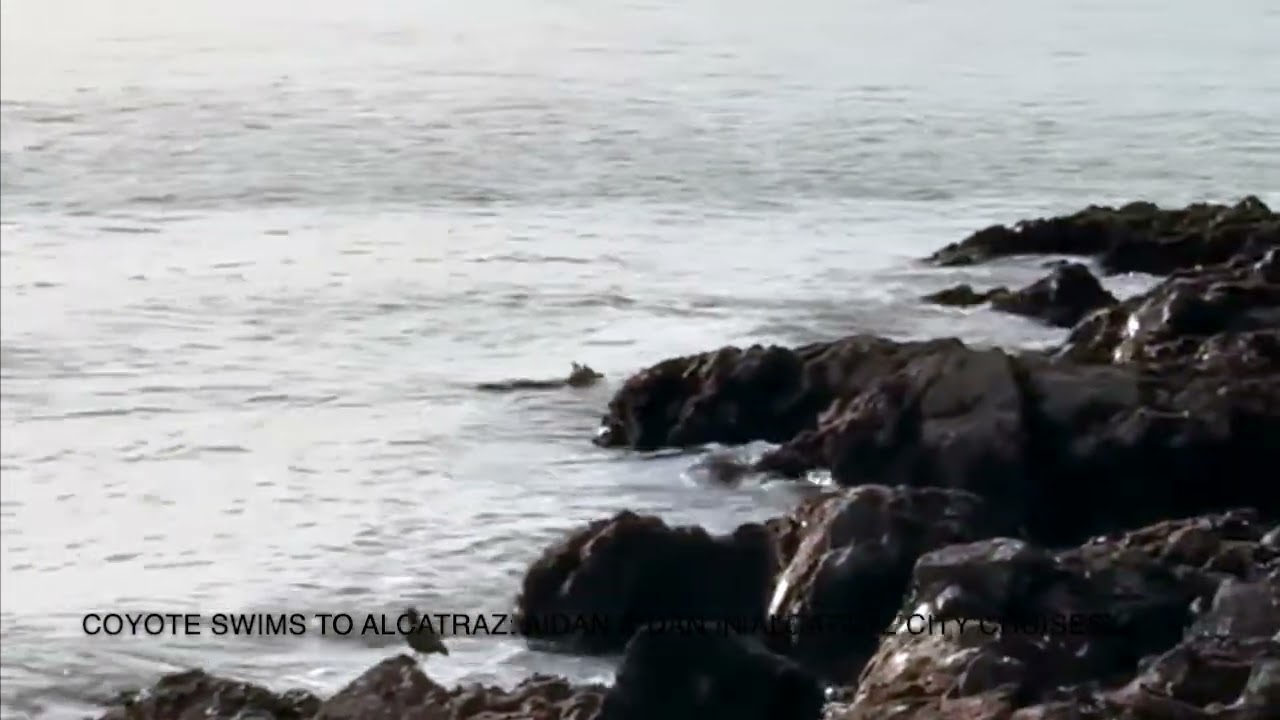
Videos posted to social media show the coyote (Canis latrans) paddling to the southern edge of Alcatraz Island as the sun sets over the bay. The coyote then struggles onto the island's rocky shoreline, visibly shaking and fatigued.
Stanley Gehrt, a professor of wildlife ecology at The Ohio State University and author of "Coyotes Among Us," said he was shocked and astonished at the footage.
"There's a reason why people have had a difficult time making that swim," Gehrt told Live Science.
The videos were captured by an unidentified person visiting the island on Jan. 11. They then shared the footage with Aidan Moore, a guest relations employee for Alcatraz City Cruises, who alerted park rangers, San Francisco news website SFGATE reported.
"Coyotes can be commonly seen throughout our San Francisco and Marin parklands but never before on Alcatraz," Julian Espinoza, a spokesperson for the Golden Gate National Recreation Area, told SFGATE. "This was the first time our park biologists observed anything like this."
Coyotes are intelligent and versatile creatures that are known to swim. Gehrt said he has seen coyotes swimming across lakes in the Chicago region as part of his long-term research program, the Urban Coyote Research Project.
Get the world’s most fascinating discoveries delivered straight to your inbox.
"In some cases, they prefer to swim across a lake rather than run around it," Gehrt said.
However, Gehrt typically only sees coyotes swim a few hundred yards in relatively calm lake conditions, which are nothing like the waters surrounding Alcatraz. The island sits in the middle of a cold estuary with strong currents — one of the reasons Alcatraz was seen as a good spot for its now-decommissioned prison.

The prison on Alcatraz Island closed in 1963 and it's now a popular tourist destination.
Some prisoners are presumed to have drowned trying to escape the island, which is more than a mile (1.6 kilometers) from the mainland, and while humans do make the swim recreationally today, they do so with the benefit of wetsuits, training and guides.
It's uncertain how the coyote came upon Alcatraz Island. The videos begin with the animal already in the water with no sign of where it originated. However, Gehrt thinks the coyote must have had a tough journey. "Once it emerged from the water, it certainly looked like it had been swimming for a very long time," he said. "The animals I've seen come out of the water from their swims don't look as distraught as that or as tired and worn out, so it clearly was a pretty extensive swim."
Coyotes have previously been filmed swimming to Angel Island, another island in the bay, which coyotes have inhabited since 2017, KCRA 3 television station previously reported. Angel Island is closer to a mainland shore than Alcatraz. However, Angel Island is north of Alcatraz, so while it's closer to the mainland north of the Golden Gate Bridge, a coyote on Angel Island would have to swim farther to reach Alcatraz than a coyote on the San Francisco mainland south of the Golden Gate Bridge.
SFGATE reported that the Alcatraz City Cruises' boat captain had told Moore of unusual currents in the bay, likely the result of runoff from recent storms. It's possible that the coyote may have been swept up during a shorter swim and ended up near Alcatraz.
Gehrt said that coyotes don't always go into the water voluntarily. They sometimes use it as a means of escape from humans and other coyotes, which are very territorial. However, Gehrt also speculated that this coyote may have been motivated by opportunity, including the potential for food resources and territory.
Coyotes were once confined to the prairies and deserts of central and western North America. But in the 1800s, humans facilitated their expansion by creating more open habitats through logging, agricultural development, and by hunting their competitors — wolves and cougars.
As humans took over more and more land, coyotes became regular city slickers. Their flexible nature and diet now helps them thrive in cities like San Francisco, where they favor fragments of woody and shrubby habitat, as well as parks and golf courses.
Christine Wilkinson, a conservation scientist who has studied Bay Area coyotes for the University of California, Santa Cruz and the California Academy of Sciences, told SFGATE that the coyote in the video was likely trying to establish its own territory.
Wilkinson suspects that the coyote came from a pack in the Coit Tower, which is on the mainland south of Alcatraz, and where there is little green space for coyotes. Furthermore, coyotes wanting to disperse south of Coit Tower would face Interstate 280 and the risk of being struck by a vehicle, so taking to the water might have seemed like a safer option.
Coyotes typically look for new territory in the fall and early winter, but it's not unheard of for this to happen in January, Wilkinson said. The coyotes are also now in mating season, which runs from January to March.
There haven't been any sightings reported since the swimming coyote was filmed arriving on Alcatraz. Wilkinson told SFGATE that she thought the animal looked "pretty weak" but added that coyotes are "incredibly resilient." Wilkinson also noted that the island has plenty of food for a coyote, including eggs, chicks, rats and mice.
Coyotes live in small family groups, made up of an alpha male, an alpha female and their close relatives. Solitary coyotes are typically young individuals, between around 6 months and 2 years old, of either sex, that are looking to find another group or establish their own territory, according to the Urban Coyote Research Project. Gehrt has recorded a coyote traveling more than 150 miles (240 km) across the southern part of Ohio as part of its natural dispersal, which included crossing the Ohio River.
"It speaks to the animal's ability to overcome a number of different challenges and their ability to explore and take advantage of whatever opportunities they can find," Gehrt said.

Patrick Pester is the trending news writer at Live Science. His work has appeared on other science websites, such as BBC Science Focus and Scientific American. Patrick retrained as a journalist after spending his early career working in zoos and wildlife conservation. He was awarded the Master's Excellence Scholarship to study at Cardiff University where he completed a master's degree in international journalism. He also has a second master's degree in biodiversity, evolution and conservation in action from Middlesex University London. When he isn't writing news, Patrick investigates the sale of human remains.
You must confirm your public display name before commenting
Please logout and then login again, you will then be prompted to enter your display name.