 Live Science Plus





You are now subscribed
Your newsletter sign-up was successful
Want to add more newsletters?

Delivered Daily
Daily Newsletter
Sign up for the latest discoveries, groundbreaking research and fascinating breakthroughs that impact you and the wider world direct to your inbox.

Once a week
Life's Little Mysteries
Feed your curiosity with an exclusive mystery every week, solved with science and delivered direct to your inbox before it's seen anywhere else.

Once a week
How It Works
Sign up to our free science & technology newsletter for your weekly fix of fascinating articles, quick quizzes, amazing images, and more

Delivered daily
Space.com Newsletter
Breaking space news, the latest updates on rocket launches, skywatching events and more!

Once a month
Watch This Space
Sign up to our monthly entertainment newsletter to keep up with all our coverage of the latest sci-fi and space movies, tv shows, games and books.

Once a week
Night Sky This Week
Discover this week's must-see night sky events, moon phases, and stunning astrophotos. Sign up for our skywatching newsletter and explore the universe with us!
Join the club
Get full access to premium articles, exclusive features and a growing list of member rewards.
More brains doesn't necessarily equal more smarts, a new comparison of animal noggins reveals.
Tiny insects could be as intelligent as much bigger animals, despite only having a brain the size of a pinhead, researchers argue in the Nov. 17 issue of the journal Current Biology.
The scientists found that past studies suggest larger animals may need bigger brains simply because there is more to control — for example they need to move bigger muscles and therefore need more and bigger nerves to move them, the authors say. But that may not equate to higher thought.
"In bigger brains we often don't find more complexity, just an endless repetition of the same neural circuits over and over. This might add detail to remembered images or sounds, but not add any degree of complexity," said Lars Chittka, a professor of sensory and behavioral ecology at Queen Mary, University of London. "To use a computer analogy, bigger brains might in many cases be bigger hard drives, not necessarily better processors."
Their argument agrees with some past research, which found that a burst in human intelligence millions of years ago may not be due to brain size alone. (Interestingly, the human brain is shrinking as we continue to evolve, other researchers say.)
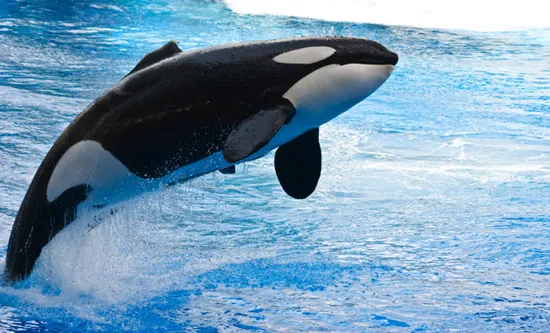
Across the animal kingdom, differences in brain size are extreme: A whale's brain can weigh nearly 20 pounds (9 kg), and contain over 200 billion nerve cells, while human brains vary between 2.75 pounds and 3.2 pounds (1.25 kg and 1.45 kg), with an estimated 85 billion nerve cells. A honeybee's brain, on the other hand, weighs only 1 milligram and contains fewer than a million nerve cells.
Chittka and his colleague Jeremy Niven of the University of Cambridge repeatedly found studies showing insects are capable of some intelligent behaviors. Honeybees, for example, can count, categorize similar objects like dogs or human faces, understand "same" and "different," and differentiate between shapes that are symmetrical and asymmetrical, the scientists write.
While some increases in brain size do affect an animal's capability for intelligent behavior, many size differences only exist in a specific brain region. This is often seen in animals with highly developed senses, such as sight or hearing, or an ability to make very precise movements.
The authors suggest that "advanced" thinking requires a very limited number of neurons. Computer modeling shows that even consciousness can be generated with tiny neural circuits, which could in theory easily fit into an insect brain, they write.
In fact, these models suggest that counting could be achieved with only a few hundred nerve cells and only a few thousand could be enough to generate consciousness.
- Top 10 Greatest Mysteries in Science
- The Most Popular Myths in Science
- Why Are Human Brains So Big?

