













Kinky Wolf Spiders Engage in Ménage à Trois to Avoid Cannibalism

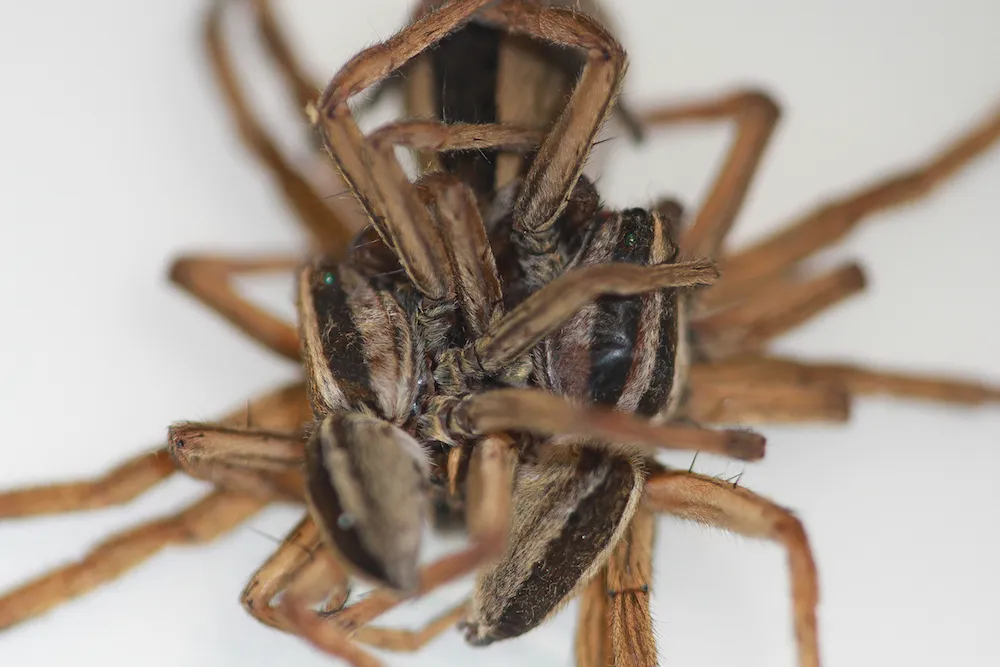
One autumn night while searching for spiders in his backyard, Matthew Persons came across something unexpected: a wolf spider ménage à trois.
Persons took note of the 24-legged threesome, but didn't think much of it. Then, on another night, he found a second three-spider union. And then another.
"By the third time I saw it, it's like, 'I've got to take detailed study of this,'" said Persons, a professor of biology and ecology at Susquehanna University in Selinsgrove, Pennsylvania. "Because they were in my yard, I scooped them up and brought them onto my dining room table and proceeded to take photos and document their positions for the next 4 hours." [Photos: That's a Lot of Legs! Wolf Spiders Caught Having Threesomes]
The findings are the first cases on record of one female and two male wolf spiders (Rabidosa punctulata) in a three-way lovefest, a feat that's possible because the females have paired reproductive organs. But this ménage à trois wasn't purely for pleasure. It likely had evolutionary benefits, at least for the interloping male, Persons said.

Threesomes may be evolutionarily advantageous for male wolf spiders. Courtship increases the arachnids' risk of being cannibalized, and it also makes males vulnerable to predators and other male spiders while they're wooing potential mates. Joining a threesome late in the game likely reduces all three risks, said Matthew Persons, a professor of biology and ecology at Susquehanna University in Selinsgrove, Pennsylvania.
During typical courtship, male wolf spiders use a combination of visual display and vibratory communication to woo potential mates. If the female is unimpressed, she may cannibalistically devour the suitor. However, if another male successfully courts a female, there's nothing stopping an additional male from sneaking up and joining the party… and spreading his seed.
Perhaps ménage à trois is a means for lone male "third wheels" to avoid being cannibalistically eaten, Persons said.
The love-triad strategy actually has a number of benefits, he said. For starters, interloping males likely conserve energy by skipping courtship behaviors. Moreover, courtship displays can attract predators, so cautious interlopers may reduce their risk of being eaten by letting another male do the hard work of being showy, Persons said.
Get the world’s most fascinating discoveries delivered straight to your inbox.
In addition, threesomes likely reduce the male-on-male sparring and grappling that often occurs when male spiders compete for mates, Persons said.
However, a ménage à trois also has downsides, he said. The act itself likely takes a lot of energy and probably reduces sperm transfer: "In my direct observations, males showed … sparring, missed insertions, attempts at … insertions into the other male's venter [underside] and attempts to displace the other male during insemination," Persons wrote in the study. One male (the second to the lovefest) even lost a leg while mating, but it wasn't clear which of its two partners was responsible for the injury, Persons said.
Perhaps, then, it's no surprise that all of this tussling likely leads to prolonged mating sessions — a factor that usually increases the female spider's lust for cannibalism, Persons said. Wolf spiders usually spend between 25 minutes and 1.5 hours mating, but one of the observed threesomes lasted at least 4 hours, Persons said.
Unfortunately, lengthy threesomes may catch the attention of spider-hungry predators, he noted.
Persons and his colleagues plan to continue studying spider threesomes, including their prevalence, he said. The new findings will be published the August issue of the Journal of Arachnology.
Original article on Live Science.

Laura is the managing editor at Live Science. She also runs the archaeology section and the Life's Little Mysteries series. Her work has appeared in The New York Times, Scholastic, Popular Science and Spectrum, a site on autism research. She has won multiple awards from the Society of Professional Journalists and the Washington Newspaper Publishers Association for her reporting at a weekly newspaper near Seattle. Laura holds a bachelor's degree in English literature and psychology from Washington University in St. Louis and a master's degree in science writing from NYU.