















Photos: That's a Lot of Legs! Wolf Spiders Caught Having Threesomes

Kinky spiders

Courtship is hard work for a male wolf spider. But some sneaky male arachnids skip the wooing process and instead wait for another male spider to start the deed before climbing on, turning the duo into a threesome. [Read the full story on the wolf spider ménage à trois]
Tricky courtship

Male wolf spiders of the species Rabidosa punctulata are under a lot of pressure during mating season. The male usually courts the female through a combination of visual display and vibrations that are akin to a courtship song.
If the female rejects the courtship offer, she may eat the male. What's more, if the female accepts the male but copulation takes too long, she may still cannibalize the poor dude.
24-leg pile

However, male wolf spiders can take another route to doing the deed. Some males wait for another male to court the female and begin mating. Then, the lone male — let's call him the "third wheel" — will join the amorous tango and turn the situation into a ménage à trois.
Spider tower
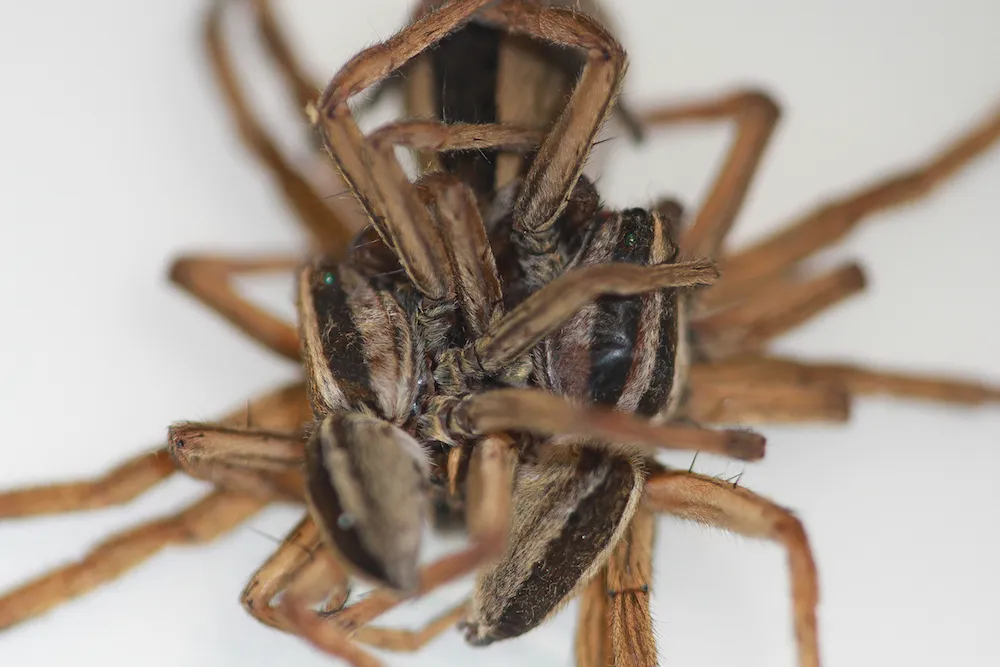
Female spiders have paired reproductive organs, so it's possible for two males to mate with a single female at one time.
Evolutionary advantage
Threesomes may be evolutionarily advantageous for male wolf spiders. Courtship increases the arachnids' risk of being cannibalized, and it also makes males vulnerable to predators and other male spiders while they're wooing potential mates.
Joining a threesome late in the game likely reduces all three risks, said Matthew Persons, a professor of biology and ecology at Susquehanna University in Selinsgrove, Pennsylvania
Threesome blues

Threesomes aren't all fun and games. If the ménage à trois takes too long (one observed session took at least 4 hours), the female spider may still try to cannibalize the males.
"The longer the mating duration, the higher the probability that they get eaten afterward," Persons told Live Science.
Moreover, in one instance, a male spider lost its leg during copulation, and it wasn't clear whether it was the female or the other male that inflicted the damage, Persons said.
Spiderlings

If the mating session is successful, the female will hatch a new generation of spiderlings. In this photo, a different species of wolf spider in the same genus (Rabidosa rabida) carries between 150 and 200 spiderlings on her abdomen.
It's possible for a spider cluster to have two fathers. "Mixed paternity is possible, even likely, but you would need to do paternity testing to know for sure," Persons said.
Mother wolf spiders usually care for their spiderlings for about two weeks after they hatch. [Read the full story on the wolf spider ménage à trois]
Get the world’s most fascinating discoveries delivered straight to your inbox.

Laura is the managing editor at Live Science. She also runs the archaeology section and the Life's Little Mysteries series. Her work has appeared in The New York Times, Scholastic, Popular Science and Spectrum, a site on autism research. She has won multiple awards from the Society of Professional Journalists and the Washington Newspaper Publishers Association for her reporting at a weekly newspaper near Seattle. Laura holds a bachelor's degree in English literature and psychology from Washington University in St. Louis and a master's degree in science writing from NYU.