 Live Science Plus





You are now subscribed
Your newsletter sign-up was successful
Want to add more newsletters?

Delivered Daily
Daily Newsletter
Sign up for the latest discoveries, groundbreaking research and fascinating breakthroughs that impact you and the wider world direct to your inbox.

Once a week
Life's Little Mysteries
Feed your curiosity with an exclusive mystery every week, solved with science and delivered direct to your inbox before it's seen anywhere else.

Once a week
How It Works
Sign up to our free science & technology newsletter for your weekly fix of fascinating articles, quick quizzes, amazing images, and more

Delivered daily
Space.com Newsletter
Breaking space news, the latest updates on rocket launches, skywatching events and more!

Once a month
Watch This Space
Sign up to our monthly entertainment newsletter to keep up with all our coverage of the latest sci-fi and space movies, tv shows, games and books.

Once a week
Night Sky This Week
Discover this week's must-see night sky events, moon phases, and stunning astrophotos. Sign up for our skywatching newsletter and explore the universe with us!
Join the club
Get full access to premium articles, exclusive features and a growing list of member rewards.
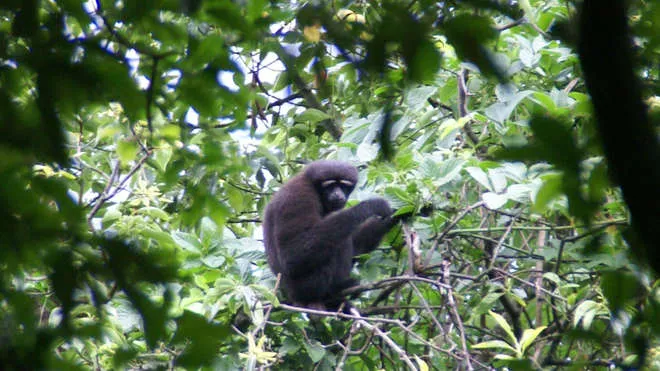
In a galaxy not so far way, there's a new Skywalker in town. A new gibbon species was discovered in southwest Asia, and scientists have named it for the famous "Star Wars" character.
The species' "Star Wars"-inspired name is connected both to the gibbon's high treetop home, and the mysticism that surrounded the primate in Chinese history, according to scientists at the Zoological Society of London (ZSL), which collaborated on the new research.
The primate joins two other species in the genus of hoolock gibbons: the western (Hoolock hoolock) and eastern hoolock (H. leuconedys) gibbons, which are geographically separated by the Chindwin River. The Skywalker hoolock gibbons' home in the forests of the Gaoligong mountains was previously thought to be the habitat of another population of H. leuconedys. However, scientists determined that the gibbons living to the east of the Irawaddy-Nmai Hka rivers are a distinct species. [See More Animals With "Star Wars"-Inspired Names]
In studying the genetic characteristics of wild gibbons and museum specimens, the researchers determined distinct differences between the Skywalker hoolock and H. leuconedys. For instance, the Skywalker gibbons' eyebrows are thinner and farther apart, and the shape of their skulls and teeth differentiate them from the other hoolock gibbons.
Samuel Turvey, a senior research fellow at ZSL and co-author of the study, said the exciting discovery of the new species is laced with sadness. Along with calling for the animals to be recognized as a new species, the researchers have prompted the International Union for Conservation of Nature (IUCN) to list the Skywalker gibbon as endangered.
"The Skywalker hoolock gibbon … faces the same grave and imminent risk to its survival as many other small ape species in southern China and Southeast Asia due to habitat loss and hunting," Turvey said in a statement. "Increased awareness of the remarkable ecosystem of the Gaoligong mountains and improved conservation is essential, to ensure we have time to get fully acquainted with this exciting new species before it's too late."
The new discovery of the Skywalker hoolock gibbon was described in a paper published online Tuesday (Jan. 10) in the American Journal of Primatology.
A number of other species have been named for the classic "Star Wars" movie series, from a "Chewbacca beetle" to a Jedi ant. In a separate study, the skull appendages of an extinct relative of the giraffe reminded scientists of Queen Padmé Amidala's headgear, so the researchers named the extinct animal Xenokeryx amidalae.

Original article on Live Science.

