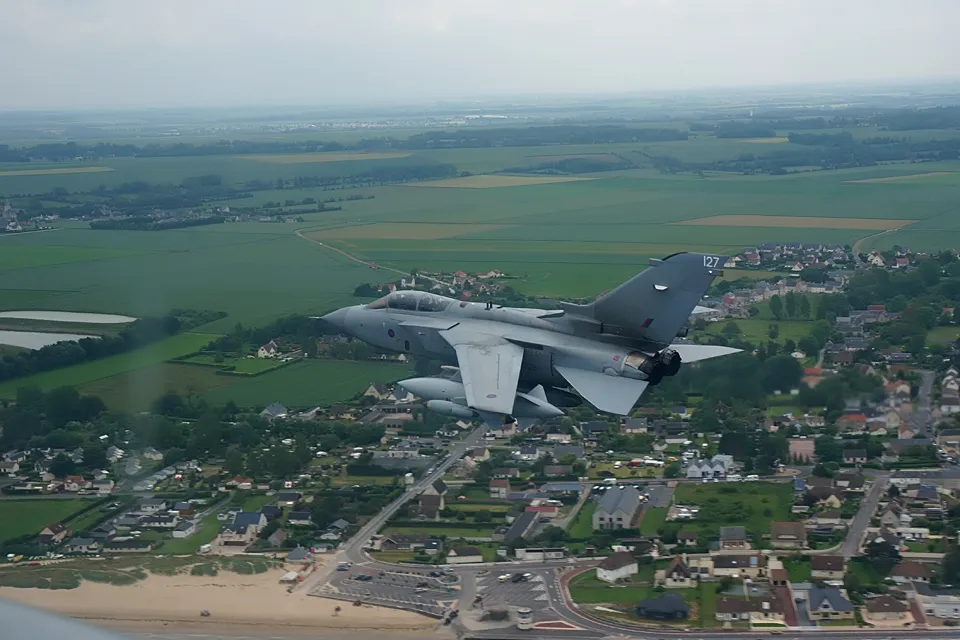
In honor of this month's 70th anniversary of the D-Day invasion, pilots from Britain's Royal Air Force recreated the first images taken of the fateful landings on the beaches of Normandy by their counterparts during World War II.
Two Tornado jets used modern technology to recreate the images of the French beaches Gold, Juno, Utah and Sword, where the Allies landed on June 6, 1944. On that day, Air Commodore Andrew Geddes, flying a 2 (AC) Squadron Mustang, snapped the first pictures of the D-Day landings. Two other aircraft, piloted by Flight Lieutenant R. H. G. Weighill and Flying Officer H. J. Shute, were also flying overhead at the moment when the Allies first landed on the Normandy beaches, according to the U.K. Ministry of Defence.
The squadron flew 36 sorties, or single-aircraft missions, on D-Day in order to monitor for naval bombardment. Almost 70 years later, RAF Wing Commander Jez Holmes flew one of the Tornados over France. [See the Royal Air Force's recreated D-Day images]
Top: RAPTOR electro-optical image from a modern-day Tornado GR4 and bottom: F-24 photographic mosaic created from a Mustang sortie in 1944 during the D-Day landings.
"After imaging the D-Day beaches from 20,000 feet (6,100 meters) using the same type of reconnaissance pod that we were flying with in Afghanistan only a fortnight ago, we flew down the beaches at 1,000 feet (300 meters), replicating Air Commodore Geddes' flight," Holmes told the U.K. Ministry of Defence. "It is difficult to imagine the apocalyptic vision that [Commodore Geddes] was faced with."
A wartime Mustang aircraft from 2 (Army Cooperation) Squadron in flight (library image).
During World War II, the British squadron took these images using large, bulky cameras attached to the bottom of the aircraft. More than 30 flights would have been required to produce a panorama of the beaches of Normandy. Today, these images can be captured in a single flight, according to the Ministry of Defence.
Today, Tornado jets are equipped with a suite of precision-guided weapons and some of the best reconnaissance sensors, including the RAPTOR (short for reconnaissance airborne pod for Tornado), which can read the time on the face of London's iconic Big Ben clock from the Isle of Wight, located nearly 100 miles (160 kilometers) away.
The 70th anniversary of D-Day falls on Friday, June 6.
Sign up for the Live Science daily newsletter now
Get the world’s most fascinating discoveries delivered straight to your inbox.
Tanya was a staff writer for Live Science from 2013 to 2015, covering a wide array of topics, ranging from neuroscience to robotics to strange/cute animals. She received a graduate certificate in science communication from the University of California, Santa Cruz, and a bachelor of science in biomedical engineering from Brown University. She has previously written for Science News, Wired, The Santa Cruz Sentinel, the radio show Big Picture Science and other places. Tanya has lived on a tropical island, witnessed volcanic eruptions and flown in zero gravity (without losing her lunch!). To find out what her latest project is, you can visit her website.