













In Photos: Human Skeleton Sheds Light on First Americans

Watery skeleton

A near-complete human skeleton has been discovered, buried alongside saber-toothed cats, pumas and bobcats, at the bottom of Hoyo Negro, deep beneath the jungles of the eastern Yucatan Peninsula. Here, divers Nava and Susan Bird transport the Hoyo Negro skull to an underwater turntable so that it can be photographed in order to create a 3D model.
[Read the full story on this 'missing link' skeleton]
Cave find
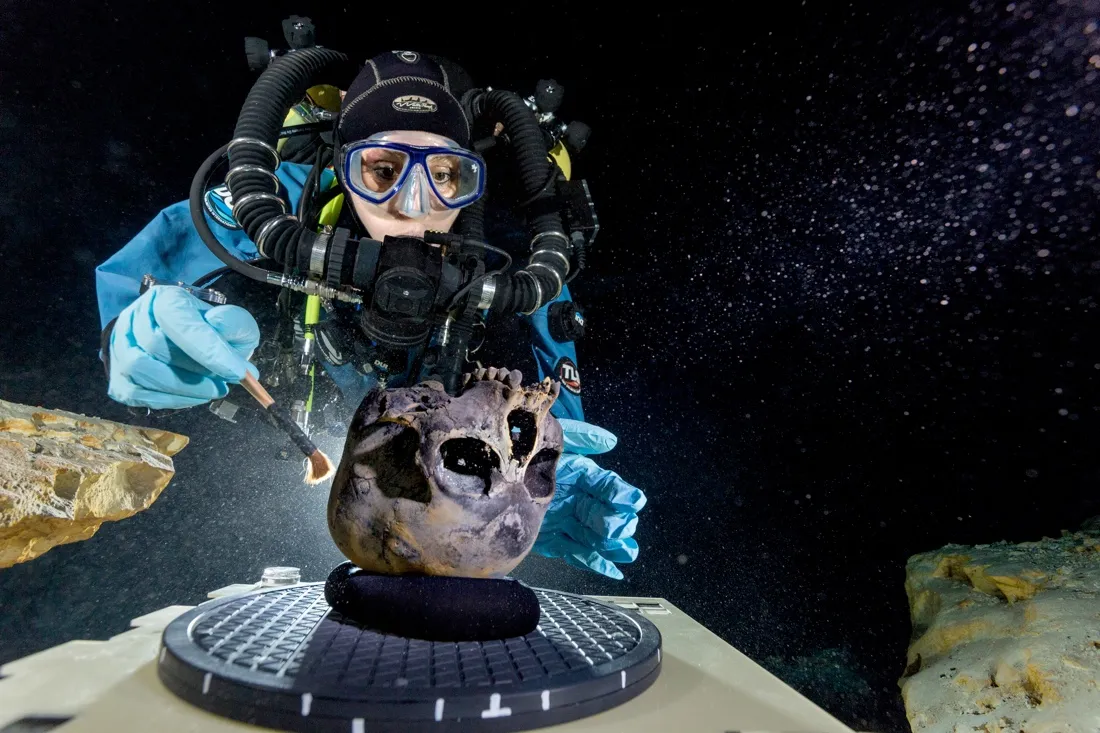
Diver Susan Bird working at the bottom of Hoyo Negro, a large dome-shaped underwater cave on Mexico's Yucatan Peninsula. She carefully brushes the human skull found at the site while her team members take detailed photographs.

Ancient teen girl

Divers Susan Bird and Alberto Nava search the walls of Hoyo Negro, an underwater cave on Mexico's Yucatan Peninsula where the remains of "Naia," a 12,000- to 13,000-year-old teenage girl, were found.
Naia Skull

Cave diver Alexandro Alvarez inspects the newly discovered skull of Naia, the nearly complete human skeleton of a teen girl who fell into a Yucatan sinkhole some 12,000 to 13,000 years ago. Studying her DNA, researchers are learning about the origins of the first people to inhabit the Americas along with their connection to native people today. [Read the full story on this 'missing link' skeleton]
Hoyo Negro

The skull of Naia, the teen girl who died 12,000 to 13,000 years ago, on the floor of Hoyo Negro, an underwater cave on Mexico's Yucatan Peninsula, as it appeared in December 2011, having rolled into a near-upright position.
Skull and Arm

The skull of Naia, the teen girl who died 12,000 to 13,000 years ago, on the floor of Hoyo Negro, an underwater cave on Mexico's Yucatan Peninsula, as it was discovered in 2007, resting against the left humerus (upper armbone).
Get the world’s most fascinating discoveries delivered straight to your inbox.
Shasta ground sloth

Alberto Nava at 145-foot depth in the underwater cave Hoyo Negro (on the Yucatan Peninsula), inspecting a forelimb of an extinct Shasta ground sloth, one of two sloth species found in the cave. The Shasta ground sloth has not previously been found so far south in the Americas.
In a new light

A broad view of Hoyo Negro, an underwater cave on Mexico's Yucatan Peninsula where the near-complete human skeleton of a teen girl was found, shot from the floor near the south edge, showing the immensity of the chamber and the complexity of the boulder-strewn bottom. One access tunnel can be seen near the ceiling at top left. (This photo was taken by the "painting with light" method on a 30 second exposure.)
Teen molar

The upper right third molar of Naia (the skeleton of a teen girl who died 12,000 to 13,000 years ago), which was used for both radiocarbon dating and DNA extraction. The tooth is held by ancient genetics expert Brian Kemp of Washington State University, who led the genetic research on the skeleton.
