















Unusual Coral Reef Thrives in Acidified Waters

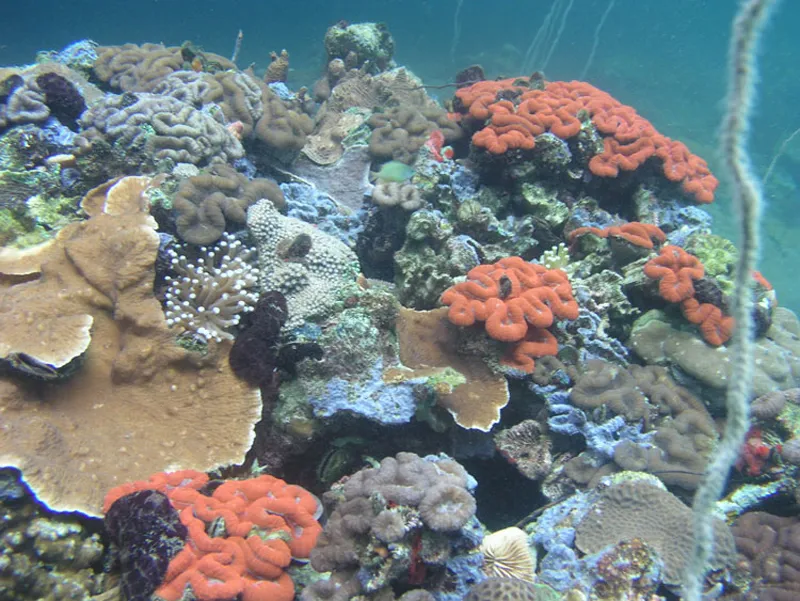
The growing acidity of the world's oceans is a worrying threat to coral reefs, which support an amazing array of marine life, and are generally harmed as ocean acidity rises. But a vibrant reef in the western Pacific Ocean is bucking this trend: Researchers have found that the coral there thrives, rather than suffers, in locally acidic conditions.
Coral reefs grow by extracting calcium and carbonate ions from seawater and combining them to form calcium carbonate, the same hard mineral found in clam and snail shells. Both calcium and carbonate are generally abundant in seawater; however, as water becomes more acidic, carbonate levels drop and organisms struggle to gather enough to form their outer skeletons.
Given this basic chemistry, researchers at the Woods Hole Oceanographic Institution (WHOI) were recently surprised to find a healthy, expansive coral reef ecosystem in the western Pacific islands of Palau thriving in acidity levels that laboratory studies have shown to slow or even stunt growth in other corals. [Photos: Underwater Google Street View Reveals Stunning Corals]
"I was shocked to see how high the levels of acidity were," study co-author Katie Shamberger told LiveScience.
Contrary to what previous field and laboratory findings have suggested for reefs elsewhere, the researchers found the diversity and expansiveness of the reef was greater than neighboring reefs with lower levels of acidity, Shamberger, who at the time of the discovery was working with WHOI but now works at Texas A&M University, said.
The researchers do not know how or why these corals survive so well in these seemingly sour conditions, but think that some unique combination of chemical and biological factors override the negative influence of the acidity, Shamberger said.
While the findings are compelling, they don't necessarily spark hope for other corals around the world that appear to be suffering from human-induced ocean acidification — the process by which carbon dioxide from fossil fuel emissions dissolves in seawater and forms carbonic acid. This process occurs at different rates around the world depending on physical and chemical conditions, and is generally more severe in colder regions because carbon dioxide dissolves more easily in cold water.
Get the world’s most fascinating discoveries delivered straight to your inbox.
Through a series of chemical analyses, the team found that natural processes within the reef system, including shell building (which takes carbonate out of the water column) and respiration (which adds carbon dioxide to the water column), could account for the levels of acidity measured, without bringing human-induced acidification into the equation at all. They believe that, rather than absorbing fossil fuel emissions, the region has maintained its acidity as a result of the isolating nature of the landmasses surrounding the reef.
"It is a maze of small islands with bays and inlets that the water winds through, and it takes a long time for that water to flush out," Shamberger said. "So water ends up sitting for a lot longer than it would for more exposed reefs offshore."
The researchers think that these acidic conditions have existed for thousands of years, potentially giving organisms a chance to evolve or adapt. Human-induced acidification, on the other hand, has occurred at a much faster rate and has not necessarily allowed affected reefs to adjust in the same way, Shamberger said. Still, the degree to which the Palau reef has genetically changed over time to adjust to the changes remains unclear, she noted.
The team next hopes to identify the biological and/or chemical explanation for the coral's success in this particular region. They also plan to examine the rate at which other calcifying organisms make their shells, to determine the condition of the ecosystem as a whole compared to less acidic systems.
The study findings were detailed last week in the journal Geophysical Research Letters.
Follow Laura Poppick on Twitter. Follow us @livescience, Facebook & Google+. Original article on LiveScience.
