 Live Science Plus





You are now subscribed
Your newsletter sign-up was successful
Want to add more newsletters?

Delivered Daily
Daily Newsletter
Sign up for the latest discoveries, groundbreaking research and fascinating breakthroughs that impact you and the wider world direct to your inbox.

Once a week
Life's Little Mysteries
Feed your curiosity with an exclusive mystery every week, solved with science and delivered direct to your inbox before it's seen anywhere else.

Once a week
How It Works
Sign up to our free science & technology newsletter for your weekly fix of fascinating articles, quick quizzes, amazing images, and more

Delivered daily
Space.com Newsletter
Breaking space news, the latest updates on rocket launches, skywatching events and more!
Once a month
Watch This Space
Sign up to our monthly entertainment newsletter to keep up with all our coverage of the latest sci-fi and space movies, tv shows, games and books.
Once a week
Night Sky This Week
Discover this week's must-see night sky events, moon phases, and stunning astrophotos. Sign up for our skywatching newsletter and explore the universe with us!
Join the club
Get full access to premium articles, exclusive features and a growing list of member rewards.
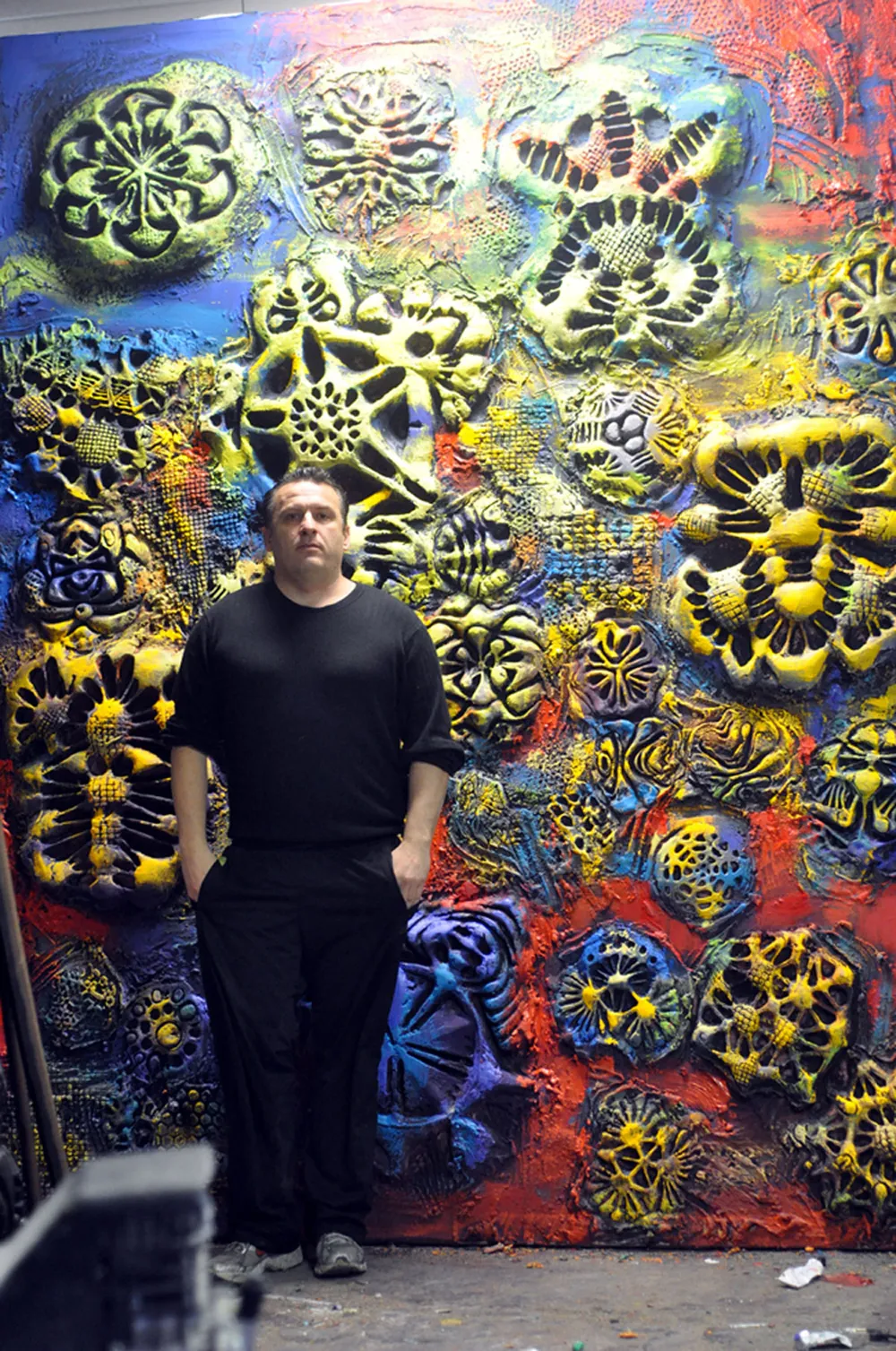
3D printing is turning up in all sorts of places these days, and recently, it's been gaining traction in the art world, with one artist using the printers to create giant paintings with loads of texture.
"My paintings address both the visual perception and the tactile," said Ioan Florea, whose artwork is currently on display in Indiana. When people see Florea's paintings, their first reaction is to get close and touch them, he added.
Because his paintings are big, Florea uses ultralight materials. "With regular materials, one of my paintings would be 600 pounds, but I try to keep them to 100 pounds," Florea told LiveScience.
In his paintings, Florea likes to explore contrasts. He takes inspiration from nanotechnology — the world of things hundreds of thousands of times smaller than a human hair, but creates his work on 10-by-8 foot canvases. Geometric and organic shapes form another contrast.

Florea originally hails from Transylvania, not far from Dracula's castle. As a child, he would collect animal bones in the woods and draw them. He was fascinated with their 3D shapes, he said. Later, he arranged animal vertebrae into an abstract alphabet. He tried making them with paint, experimenting with many techniques to get the texture he wanted on a canvas. He was waiting for the right technique, and then along came 3D printers, he said.
Florea's paintings are being featured in an exhibition at the South Bend Museum of Art in Indiana from now until May 2015, and at Southern Illinois University in Carbondale in September.
Florea has also developed a fast-drying oil paint, which he said is considered one of the best worldwide. Artists developed their own paints during the Renaissance, Florea said, but later during the Industrial Revolution paint was developed for buildings, cars and other purposes.
"Today there are thousands of pigments and materials," Florea said, adding that he thinks everything can be used in art. In that way, art truly does reflect society, he said.
Follow Tanya Lewis on Twitter and Google+. Follow us @livescience, Facebook & Google+. Original article on LiveScience.com.

