Two new species of coral have been found on the West Coast of the United States and Canada. One of the species was discovered in a tide pool on the outskirts of San Diego, while the other was found by divers near the coast of British Columbia.
Both are types of octocorals, so named because each mouth of these corals has eight tentacles around it, said Gary Williams, a researcher at the California Academy of Sciences, who described the species in the journal ZooKeys.
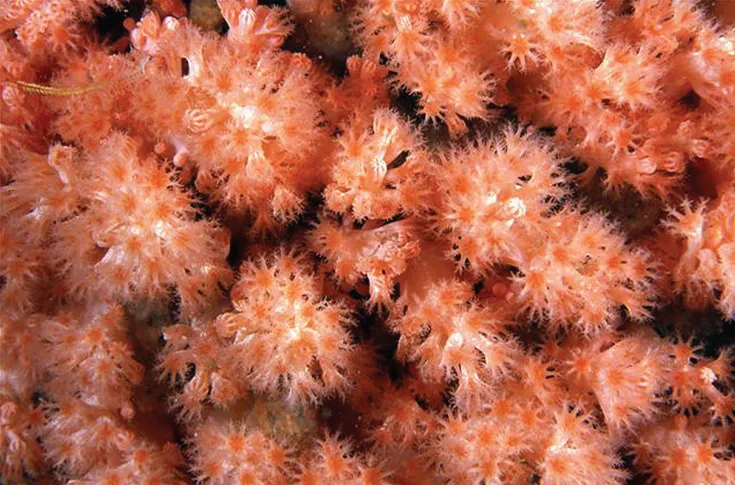
The San Diego coral is named Cryptophyton jedsmithi, and was found by a collaborator of Williams' who scraped it off the top of a tide pool overhang near San Diego. Cryptophyton means "hidden creature," and is an apt appellation for these animals, which look like a brown film and can't easily be found unless you're really looking, Williams told LiveScience's OurAmazingPlanet. It lives in the intertidal zone, meaning it isn't covered by water at low tide. When the water comes back, orange polyps arise to feed on algae and other particles in the water, he said.
The second new coral species was found in British Columbia in about 40 feet (12 meters) of water. For years, divers misidentified it as an unrelated type. This was corrected when marine naturalist and educator Andy Lamb sent specimens to Williams, who dubbed it Gersemia lambi, or "Lamb's soft coral."
This coral, Cryptophyton jedsmithi, was found on the top of a tide pool overhang near San Diego.
(Image credit: Gary Williams / ZooKeys)
"This thing is quite beautiful — it covers rocks and has big orange lobes," Williams said. "When polyps come out, they look pinkish with an orange center, and look like flowers."
The findings show that these areas — one well-explored by divers and the other just outside a major city — are not as well-known as previously thought. "These aren't places you'd think that there are still discoveries waiting to be made," Williams said.
There are a wide variety of soft corals, which live in just about every environment of the ocean, from the Antarctic to the Arctic and down to depths of up to 20,000 feet (6,260 meters) below the sea surface, Williams said. In fact, nearly two-thirds of all corals are soft corals, a group that includes sea fans and sea pens, he added. Many species of sea pens resemble quill pens, hence the name.
Sign up for the Live Science daily newsletter now
Get the world’s most fascinating discoveries delivered straight to your inbox.
Douglas Main loves the weird and wonderful world of science, digging into amazing Planet Earth discoveries and wacky animal findings (from marsupials mating themselves to death to zombie worms to tear-drinking butterflies) for Live Science. Follow Doug on Google+.