 Live Science Plus






Elusive Pandas Caught on Camera in China Habitat
You are now subscribed
Your newsletter sign-up was successful
Want to add more newsletters?

Delivered Daily
Daily Newsletter
Sign up for the latest discoveries, groundbreaking research and fascinating breakthroughs that impact you and the wider world direct to your inbox.

Once a week
Life's Little Mysteries
Feed your curiosity with an exclusive mystery every week, solved with science and delivered direct to your inbox before it's seen anywhere else.

Once a week
How It Works
Sign up to our free science & technology newsletter for your weekly fix of fascinating articles, quick quizzes, amazing images, and more

Delivered daily
Space.com Newsletter
Breaking space news, the latest updates on rocket launches, skywatching events and more!

Once a month
Watch This Space
Sign up to our monthly entertainment newsletter to keep up with all our coverage of the latest sci-fi and space movies, tv shows, games and books.

Once a week
Night Sky This Week
Discover this week's must-see night sky events, moon phases, and stunning astrophotos. Sign up for our skywatching newsletter and explore the universe with us!
Join the club
Get full access to premium articles, exclusive features and a growing list of member rewards.
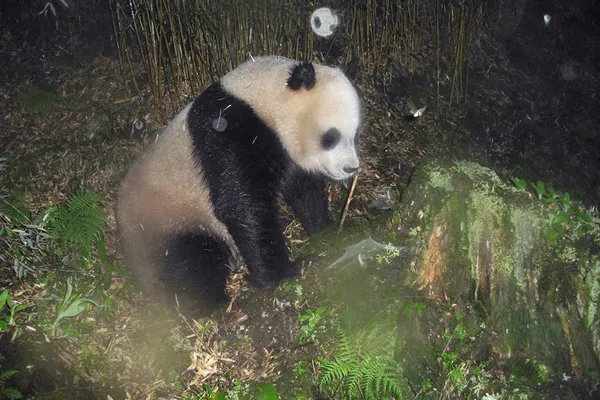
New hidden camera footage from the giant panda's home offers a peek into the secret lives of China's wild creatures.
The newly released images and videos from the World Wildlife Fund (WWF) show the famously endangered bears, as well as some of their neighbors — red pandas, leopard cats and macaques among them — exploring their natural habitat.
The footage comes from more than 100 automated infrared camera traps set up in nature reserves in the Sichuan region. The images were obtained "where there was little external disturbance and therefore they truly reflect the conditions of those species in the wild," Jiang Zeyin, species program officer at WWF-China, said in a statement. [Wild Panda Caught on Camera]
But the camera traps may not have caught all of the animals unawares. In one video clip of a group of Tibetan stump-tailed macaques, one of the monkeys curiously sticks its face in front of the camera and looks as if it's inspecting the lens.
Footage of wild giant pandas is of particular interest because there are thought to be just 1,600 of the lumbering, black-and-white bears left in China. The cameras also captured other threatened species, including tree-loving Asiatic black bears, which are hunted for their skins, paws and even gall bladders for use in certain Asian medical traditions. Brilliantly colored birds like golden pheasants and temminck's tragopans posed for pictures, too, as did yellow-throated martens, golden-haired takins and wild boars.
Conservationists contend that efforts to protect so-called umbrella species or flagship species like giant pandas can give a boost to other species that share its habitat. WWF officials said the diversity of animals in the footage is an encouraging sign that current efforts are working.
"The images demonstrate that through the conservation of the giant panda, a flagship umbrella species, we can also protect other threatened wildlife from the same habitat and preserve biological diversity," Fan Zhiyong, director of the WWF species program in China, said in a statement.

China has more than 10 flagship species, including Amur tigers, musk deer and the Yangtze finless porpoise, according to WWF. All told, China is considered one of the "mega-biodiversity" countries with more than 6,500 species of vertebrates.
"The overall biodiversity in China is in decline despite partial improvement in some places," Fan added. "The main threat has been the habitat loss and fragmentation due to invasive human activities."
The conservation organization released the footage to mark the International Day for Biological Diversity (May 22), first designated by the United Nations two decades ago. Biodiversity can refer to variability of life within a species' gene pool, an ecosystem, and, on a much larger scale, the entire planet. Conservationists often strive to preserve high biodiversity, which is considered a signature of a healthy ecosystem.
Follow Megan Gannon on Twitter and Google+. Follow us @livescience, Facebook& Google+. Original article on LiveScience.com..

