 Live Science Plus






Deadly Moore Tornado Tops the Scale at EF-5
You are now subscribed
Your newsletter sign-up was successful
Want to add more newsletters?

Delivered Daily
Daily Newsletter
Sign up for the latest discoveries, groundbreaking research and fascinating breakthroughs that impact you and the wider world direct to your inbox.

Once a week
Life's Little Mysteries
Feed your curiosity with an exclusive mystery every week, solved with science and delivered direct to your inbox before it's seen anywhere else.

Once a week
How It Works
Sign up to our free science & technology newsletter for your weekly fix of fascinating articles, quick quizzes, amazing images, and more

Delivered daily
Space.com Newsletter
Breaking space news, the latest updates on rocket launches, skywatching events and more!

Once a month
Watch This Space
Sign up to our monthly entertainment newsletter to keep up with all our coverage of the latest sci-fi and space movies, tv shows, games and books.

Once a week
Night Sky This Week
Discover this week's must-see night sky events, moon phases, and stunning astrophotos. Sign up for our skywatching newsletter and explore the universe with us!
Join the club
Get full access to premium articles, exclusive features and a growing list of member rewards.
Complete and utter destruction in some parts of Moore, Okla., in the wake of yesterday's deadly tornado confirms the twister was a rare EF-5 — the top of the tornado rating scale, the National Weather Service announced today (May 21).
Storm survey crews reached the hardest-hit neighborhoods of Moore this afternoon as lightning and hail continued to batter the devastated city. The survey process is subjective, but team members rely on a checklist of 28 tornado damage indicators to estimate wind speeds and the degree of damage.
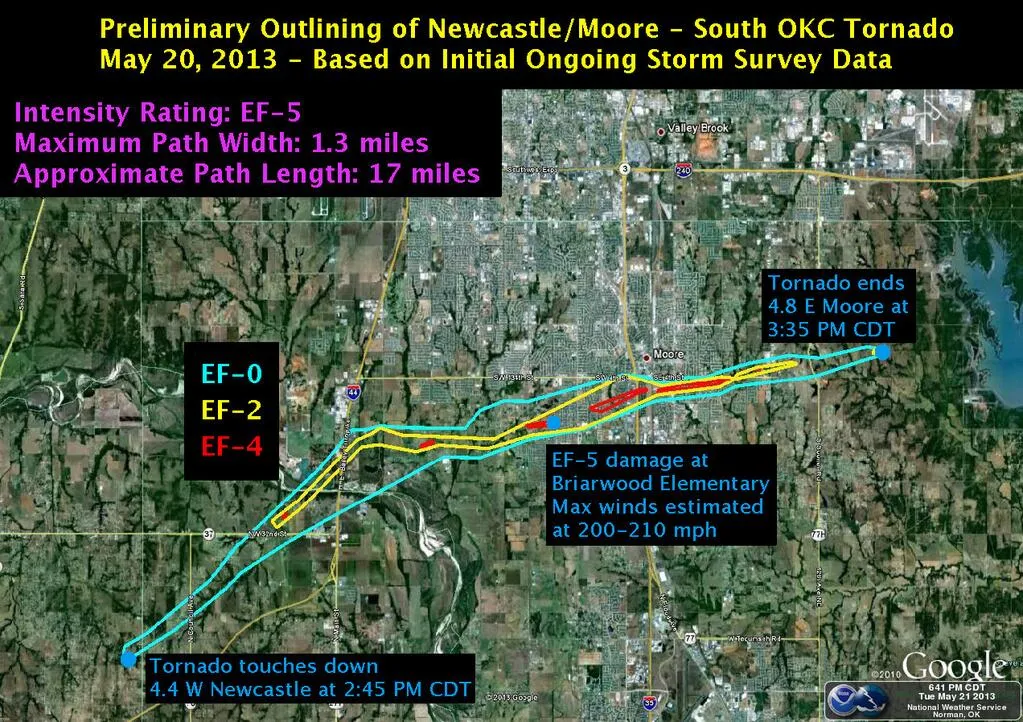
The National Weather Service's (NWS) four survey teams also found several areas of damage rated as EF-4 along the tornado’s path, according to the Facebook page of the NWS office in Norman, Okla. The preliminary ranking could still be revised in the coming days, as crews continue to assess the damage.
Tornadoes are ranked on the Enhanced Fujita Scale. An EF-0 rating is reserved for minor damage, and an EF-5 is considered the most severe, with winds topping 200 mph (322 km/h).
The Moore tornado excavated a path up to 1.3 miles (2 kilometers) wide along a 17-mile-long (27 km) stretch of central Oklahoma, the NWS said. The twister touched down 4.4 miles (7.1 km) east of Newcastle at 2:45 p.m. CDT and ended 4.8 miles (7.7 km) east of Moore, a southern suburb of Oklahoma City, at 3:35 p.m. CDT. [Image Gallery: Moore Tornado]
At first, the tornado caused little damage on the ground. But the storm ramped up quickly, intensifying to EF-4 levels in about 10 minutes and in just about 4 miles (6.4 km), the NWS said. The storm produced EF-4 scale damage, with winds of up to 200 mph (322 km/h) by Interstate 44 near Moore.
There have been 58 F5 or EF-5 tornadoes in the United States since 1950, according to the NWS. The rating scale was updated in 2007 to more closely align wind speeds with storm damage.
The United States has more than 1,000 tornadoes every year, and only 0.1 percent of those ever reach EF-5 strength, according to the National Climatic Data Center.
"In any given year, you will have maybe a dozen EF-4s and maybe one EF-5," said Bob Henson, a meteorologist and science writer for the National Center for Atmospheric Research in Boulder, Colo.
Editor's note: This story was updated to reflect that 0.1 percent of tornadoes each year reach EF-5 strength.
Email Becky Oskin or follow her @beckyoskin. Follow us @OAPlanet, Facebook & Google+. Original article on LiveScience's OurAmazingPlanet.

