













Even Modest Volcanic Eruptions May Mask Global Warming Effects

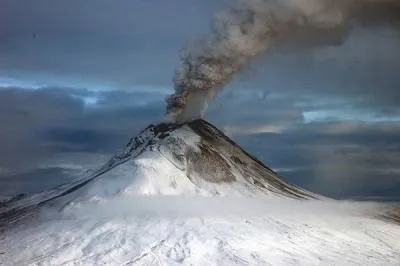
Volcanic eruptions, even small and moderate ones, might counter some of the effects of global warming, new research suggests.
The planet didn't heat up as much as scientists expected it to from 2000 to 2010 (though it was still the warmest decade on record), and a new study finds that chemical compounds spewed during modest eruptions around the globe could be behind the trend.
When sulfur dioxide emitted by a volcano rises up to the stratospheric aerosol layer of the atmosphere, it undergoes chemical reactions, forming particles that reflect sunlight back into space instead of letting it get to the surface of the planet. This has a cooling effect on Earth that can help mitigate the impacts of heat-trapping greenhouse gasses.
Scientists observed an increase in these sun-scattering aerosols in the atmosphere from 2000 to 2010. Some studies suggested that emissions from rapidly developing countries in Asia could be largely to blame — India and China, for example, are thought to have ramped up their sulfur dioxide output by about 60 percent over the decade through coal burning. But other studies pointed to volcanoes, which are also an important source of sulfur dioxide.
The authors of the new study used computer simulations to see which changes in the stratospheric aerosol layer could be attributed to coal burning in Asia and worldwide volcanic emissions from 2000 to 2010. The results suggested that moderate volcanic eruptions were behind the increases of aerosols in the atmosphere.
"This new study indicates it is emissions from small to moderate volcanoes that have been slowing the warming of the planet," Ryan Neely, who led the research as part of his doctoral thesis at the University of Colorado, Boulder, said in a statement.
The findings imply scientists should pay more attention to these types of eruptions when studying changes in Earth's climate, said study researcher Brian Toon, a professor at CU-Boulder, though he cautioned that in the long run, volcanoes won't be able to counterbalance global warming.
Get the world’s most fascinating discoveries delivered straight to your inbox.
"Overall these eruptions are not going to counter the greenhouse effect," Toon said in a statement. "Emissions of volcanic gases go up and down, helping to cool or heat the planet, while greenhouse gas emissions from human activity just continue to go up."
Toon added that larger volcanoes can have a much bigger effect. For example, Mount Pinatubo, a volcano in the Philippines that erupted in 1991, ejected so much sulfur dioxide into the stratosphere that the planet cooled by 1 degree Fahrenheit (0.55 degrees Celsius) and stayed slightly cooler for more than two years.
The new research was detailed online in the journal Geophysical Research Letters.
Follow LiveScience on Twitter @livescience. We're also on Facebook & Google+.
