 Live Science Plus





You are now subscribed
Your newsletter sign-up was successful
Want to add more newsletters?

Delivered Daily
Daily Newsletter
Sign up for the latest discoveries, groundbreaking research and fascinating breakthroughs that impact you and the wider world direct to your inbox.

Once a week
Life's Little Mysteries
Feed your curiosity with an exclusive mystery every week, solved with science and delivered direct to your inbox before it's seen anywhere else.

Once a week
How It Works
Sign up to our free science & technology newsletter for your weekly fix of fascinating articles, quick quizzes, amazing images, and more
Delivered daily
Space.com Newsletter
Breaking space news, the latest updates on rocket launches, skywatching events and more!
Once a month
Watch This Space
Sign up to our monthly entertainment newsletter to keep up with all our coverage of the latest sci-fi and space movies, tv shows, games and books.

Once a week
Night Sky This Week
Discover this week's must-see night sky events, moon phases, and stunning astrophotos. Sign up for our skywatching newsletter and explore the universe with us!
Join the club
Get full access to premium articles, exclusive features and a growing list of member rewards.
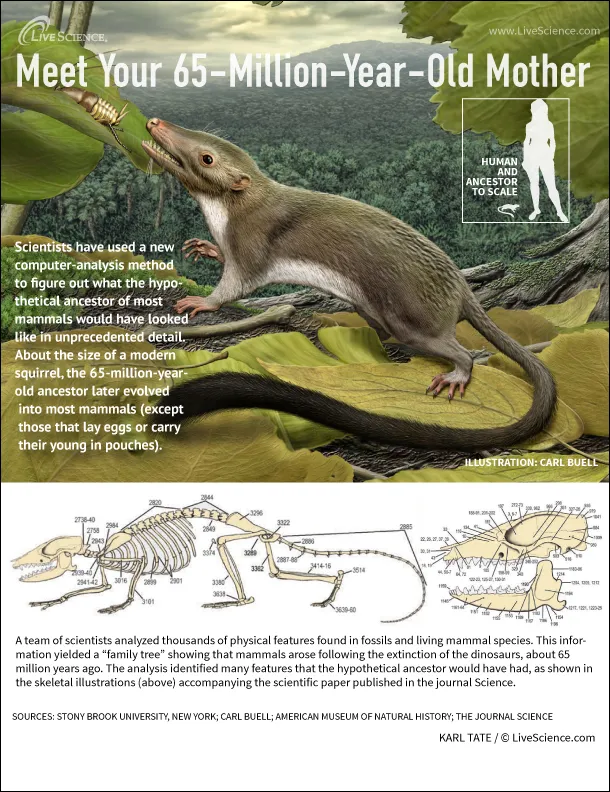
Scientists have used a new computer-analysis method to figure out in unprecedented detail what the hypothetical ancestor of most mammals would have looked like. About the size of a modern squirrel, the 65-million-year-old ancestor later evolved into most mammals (except those that lay eggs or carry their young in pouches).
A team of scientists analyzed thousands of physical features found in fossils and living mammal species. This information yielded a “family tree” showing that mammals arose following the extinction of the dinosaurs, about 65 million years ago. The study was so detailed, even tiny details were revealed such as the shape of the brain and inner ear bones.
The study showed that the ancestor probably existed about 200,000 to 400,000 years following the event that caused the extinction of non-avian dinosaurs, about 65 million years before today.
The team of scientists used a computer program called MorphoBank to generate about 2,500 anatomical characteristics, or “characters,” to describe the ancient animal. Members of the team located all over the globe collaborated through a website to combine both DNA and morphological data.
Read full story: First Ancestor of All Placental Mammals Revealed

