














Cannon Retrieved from Blackbeard's Pirate Ship
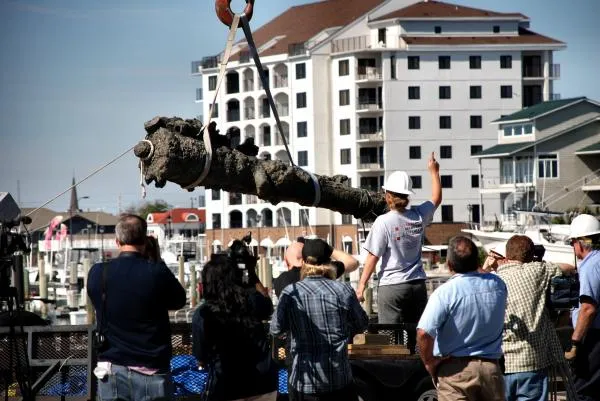
A team of diving archaeologists completed their mission today (Oct. 26) to retrieve a cannon from Blackbeard's pirate ship.
The Queen Anne's Revenge sank off the coast of North Carolina in 1718 when Blackbeard (Edward Teach) ran it into the ground while entering an inlet.
The cannon, known as C13, is 8 feet (2.4 meters) long and weighs 2,000 pounds (900 kilograms).
One of the largest of the ship's 40 guns, cannon C23, was the real prize of the mission, but the team wasn't able to work it free, said Fay Mitchell, spokesperson for the . On the ocean floor, C23 was surrounded by a kettle, wooden deadeyes, a pewter plate, cannonballs and a number of unidentified objects, and the team wasn't able to remove the cannon in time to raise it to the surface. [See Images of Blackbeard's cannon.]
Bringing C13 to the surface was still a big win for the team, which had to deal with a long weather delay mid-mission.
"It was a wonderful day for the dive," Mitchell told OurAmazingPlanet. "Our team had great luck."
The raising of the cannon, which is covered in concrete-like accretions of sand and barnacles, attracted a throng of onlookers. Despite the frenzy, the cannon was safely retired and moved to be put on display in front of the North Carolina Maritime Museum in Beaufort, N.C.
Get the world’s most fascinating discoveries delivered straight to your inbox.
Cracking through the accretions will take years, and the cannon will send at least 3 to 5 years under the care of conservationists at Eastern Carolina University. The team will study any artifacts that are stuck to the cannon.
The team has already found many other shipwreck artifacts, including what may be a shackle for a leg iron that held captives or enslaved Africans (the French ship was called Le Concorde when it was a slave trading ship). The team also found a small brass lid that fits on top of nesting weights. Nesting weights were used as counterbalances to weigh medicine or other powder onboard the ship. Archaeologists have discovered a nearly complete set of the nesting weights, minus the lids, at the site.
Using the North Carolina Marine Fisheries' Research Vessel Shell Point as the principal recovery vessel, the team began their 4-week mission on Oct. 3. After a week-long delay due to bad weather, the team has continued their excavation, documentation and recovery of artifacts.