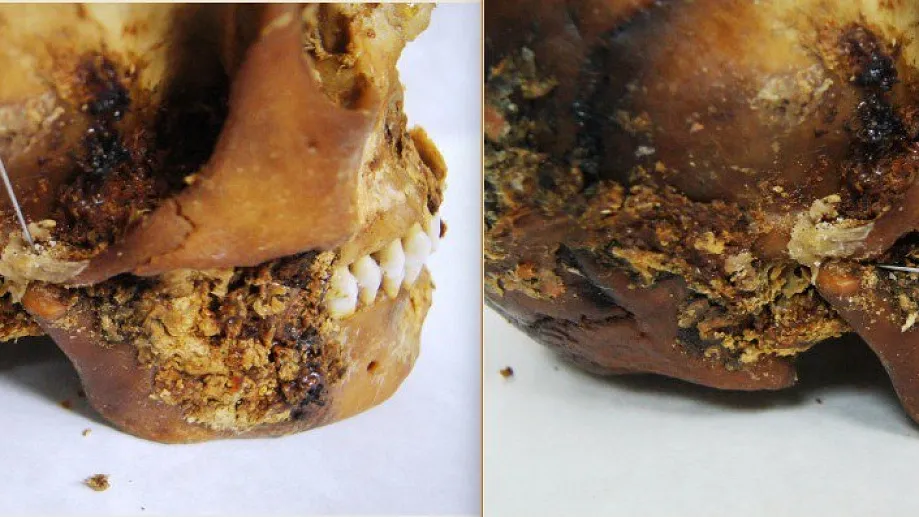
Around 2,500 years ago in Siberia, a young woman experienced a serious head injury, underwent surgery to reconstruct her jaw, and received a primitive prosthetic during the procedure, CT scans of the woman's mummified remains reveal.
"It is possible that we have discovered evidence of such a surgical procedure for the first time," Dr. Andrey Letyagin, a radiologist at the Siberian Branch of the Russian Academy of Sciences, said in a translated statement, since "we had not previously encountered [it] in the scientific literature."
Using CT scans to nondestructively study a permafrost-preserved mummy allowed the researchers to not only "diagnose the injury but also reconstruct the results of a complex surgical intervention performed in ancient times," Vladimir Kanygin, head of the Laboratory of Nuclear and Innovative Medicine at Novosibirsk State University in Russia, said in the statement, "transforming a single find into detailed evidence of the Pazyryk culture's high level of medical knowledge."
The Pazyryk culture, a nomadic Iron Age group related to the Scythians, flourished on the Ukok Plateau in the Altai Republic in southern Siberia. Pazyryk graves are well known for their outstanding preservation of organic remains in the permafrost, including the "Princess of Ukok," whose fantastical animal tattoos were perfectly preserved for more than 2,000 years.
In 1994, archaeologists with the Russian Academy of Sciences excavated a small cemetery consisting of five low mounds on the Ukok Plateau. One mound held the undisturbed burial of a woman who was around 25 to 30 years old when she died. She was lying on a wooden cot and was wearing a wig. But because her burial lacked significant artifacts and only a part of her head was mummified, her burial was not fully investigated at the time.
"This mummified patch of skin on the buried woman's skull made anthropological research impossible, but we wanted to learn as much as possible about her," Natalia Polosmak, an archaeologist at the Siberian Branch of the Russian Academy of Sciences, said in the statement. "The opportunity to study it on a CT scanner was a fortunate opportunity, which I took advantage of."
The CT scans of the woman's skull revealed a head injury had destroyed her right temporomandibular joint (TMJ). The injury would have prevented the woman from speaking and eating normally. Given that the Pazyryk people routinely rode horses, the woman may have sustained the injury as she fell off while galloping, according to the statement.
Sign up for the Live Science daily newsletter now
Get the world’s most fascinating discoveries delivered straight to your inbox.
A CT scan of the left side of the mummy's jaw, revealing worn teeth and bone loss.
(Image credit: NSU Press Service)
Discovery of a "primitive prosthetic" device
Although the woman's injury was not unusual, the unique treatment for the damage to her bones and ligaments surprised the researchers. They found thin canals drilled into the two bones that made up the woman's right TMJ, as well as horsehair or animal tendon in the canals holding the joint together.
"This primitive prosthetic held the articular surfaces together and allowed the patient to move her jaw," Letyagin said. "The joint functioned, but she still couldn't chew food on the injured side, likely due to severe pain."
Several aspects of the woman's skull revealed that she lived for several months — or even years — following the surgery. New bone tissue had grown around the canals in her right TMJ, and the teeth in the left side of her jaw were worn and chipped, suggesting she compensated for the right-sided injury by chewing exclusively on her left.
The Pazyryk people knew how to perform basic skull surgery in the days before anesthesia; evidence of trepanation in the form of holes in the skull has been found in several mummies. They also had a deep understanding of human anatomy and dissection, according to the statement, which was necessary for their tradition of mummifying bodies. But the woman's TMJ surgery is a rare example of their skills.
Although this woman was buried in a simple manner, without significant artifacts, the successful operation on her jaw "indicates that her life was valued," Polosmak said. "This new study provides further important confirmation that the Pazyryk people were able to perform complex surgical procedures to save the lives of their fellow tribesmen."
Kristina Killgrove is a staff writer at Live Science with a focus on archaeology and paleoanthropology news. Her articles have also appeared in venues such as Forbes, Smithsonian, and Mental Floss. Kristina holds a Ph.D. in biological anthropology and an M.A. in classical archaeology from the University of North Carolina, as well as a B.A. in Latin from the University of Virginia, and she was formerly a university professor and researcher. She has received awards from the Society for American Archaeology and the American Anthropological Association for her science writing.
You must confirm your public display name before commenting
Please logout and then login again, you will then be prompted to enter your display name.