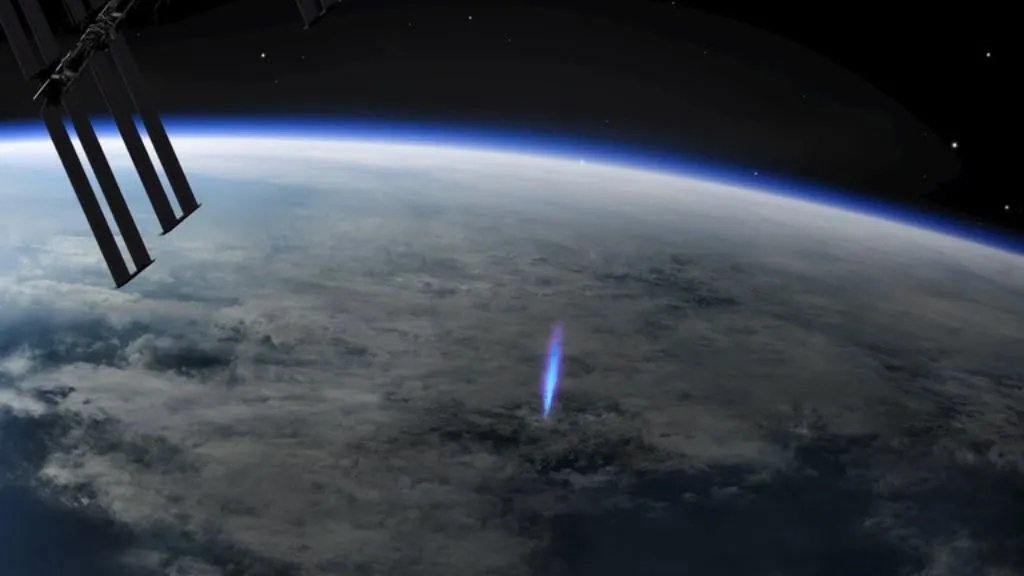
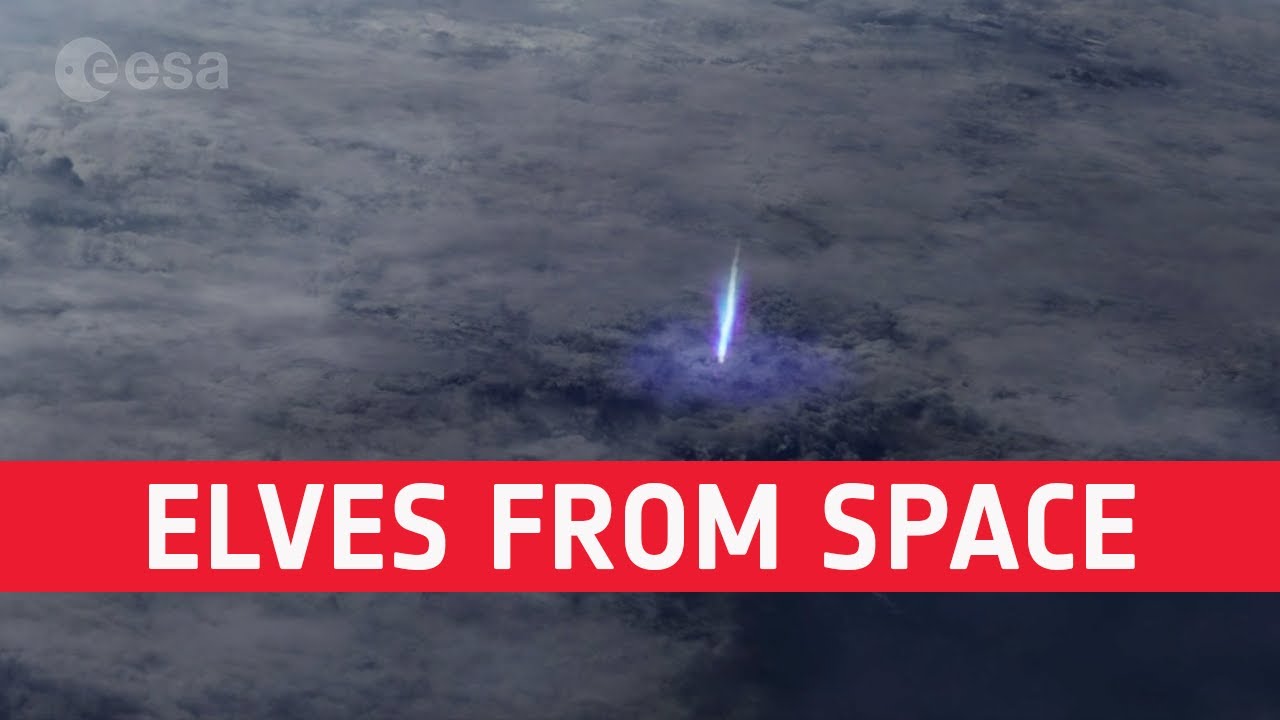
Scientists on the International Space Station spotted a bright-blue lightning bolt shooting upward from thunderclouds.
Blue jets can be difficult to spot from the ground, since the electrical discharges erupt from the tops of thunderclouds. But from space, scientists can peer down at this cerulean lightshow from above. On Feb. 26, 2019, instruments aboard the space station captured a blue jet shooting out of a thunderstorm cell near Nauru, a small island in the central Pacific Ocean. The scientists described the event in a new report, published Jan. 20 in the journal Nature.
The scientists first saw five intense flashes of blue light, each lasting about 10 to 20 milliseconds. The blue jet then fanned out from the cloud in a narrow cone shape that stretched into the stratosphere, the atmospheric layer that extends from about 6 to 31 miles (10 to 50 kilometers) above the Earth's surface.
Related: Photos of elves and blue jets: See Earth's weirdest lightning
Blue jets seem to appear when the positively-charged upper region of a cloud interacts with the negatively charged boundary between the cloud and the air above, according to the report. The blue jet appears as a result of this "electric breakdown," where the opposing charges swap places in the cloud and briefly equalize, releasing static electricity. However, the properties of blue jets and the altitude to which they extend above clouds "are not well characterized," the authors noted, so this study adds to our understanding of the dramatic phenomenon.
Four of the flashes preceding the blue jet came with a small pulse of ultraviolet light (UV), the scientists noted. They identified these emissions as so-called "elves," another phenomenon seen in the upper atmosphere.
"Elves" — an acronym that stands for Emissions of Light and Very Low Frequency Perturbations due to Electromagnetic Pulse Sources — are light emissions that appear as rapidly expanding rings in the ionosphere, a layer of charged particles that extends from roughly 35 miles to 620 miles (60 to 1,000 km) above the planet surface. Elves occur when radio waves push electrons through the ionosphere, causing them to accelerate and collide with other charged particles, releasing energy as light, the authors wrote.
The team observed the flashes, elves and blue jet using the European Space Agency's Atmosphere-Space Interactions Monitor (ASIM), a collection of optical cameras, photometers, X-ray detectors and gamma-ray detectors attached to a module on the space station.
"This paper is an impressive highlight of the many new phenomena ASIM is observing above thunderstorms," Astrid Orr, physical sciences coordinator for human and robotic spaceflight with the European Space Agency (ESA), said in a statement. Experts also suspect that upper atmosphere phenomena, like blue jets, may affect the concentrations of greenhouse gases in the atmosphere, since the ozone layer sits within the stratosphere where they occur, according to the ESA statement.
Originally published on Live Science.