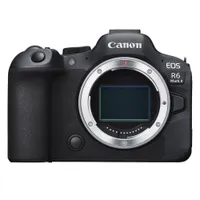
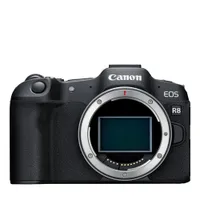
While reviewing the Canon EOS R6 II, we also had the Canon EOS R8 in hand. Armed with a wildlife lens almost as big as our optics writer, we were keen to see how these two cameras stacked up in the field. On paper, they share a lot of the same talents, but out in the field, the difference is like night and day. The R6 II felt smooth and dependable, while the R8’s sluggish buffer and limited controls were enough to make us want to fling it across the nature reserve (we didn’t, of course).
These two cameras prove that specs aren’t everything. Handling, ergonomics and layout can make or break your shooting experience. With the Canon EOS R6 II and Canon EOS R8, the proof isn’t necessarily in the pudding; the proof is in how enjoyable the process of making the pudding is.
At first glance, the two cameras share many similarities. They have the same 24MP resolution and Digic X processor, the fully articulating screen is the same size and resolution, and they share the same 40 fps burst rate. From looking at specs alone, you’d think the R8 would be made for wildlife photography.
The first is the buffer. The R8’s buffer fills quickly and clears too slowly for fast-paced wildlife action — even when we were using a Lexar Gold Series 1800x UHS-II SDXC memory card with a 210MB/s write speed.
When using the mechanical shutter, the buffer is “unlimited” — but only at 6 fps in RAW. If, however, you’re shooting with the electronic shutter, you’ll get 54 RAW or 98 cRAW files at 40 fps. That sounds fine in theory, but in drive mode, we found that the buffer fills up incredibly fast and takes a long time to clear. In the real world, this could potentially mean missing “the shot” — the exact moment your subject takes flight or makes that perfect leap. We often had to stop shooting altogether to wait for the buffer to clear.
The R6 II, on the other hand, can hold roughly 75 RAW images or 190 JPEGs before slowing down at 40 fps. More importantly, you can easily keep shooting in high-speed continuous mode even while the buffer clears. Technically, you can do this on the R8 too, but it’s so much slower in practice that it feels like you’re waiting forever for the camera to catch up. For wildlife photography, where timing is everything, that’s a huge difference.
Sign up for the Live Science daily newsletter now
Get the world’s most fascinating discoveries delivered straight to your inbox.
Image 1 of 1
If you can stretch your budget, we recommend the Canon EOS R6 II.
(Image credit: Kimberley Lane)
The second major difference is the button layout. The R6 II has three dials — one at the front, one on the top and one on the back. The R8 only has two. It sounds like a small detail, but when you’re out photographing wildlife, it matters a lot.
If you’re photographing crepuscular animals (active at dawn or dusk) or shooting in changing light conditions, you’re constantly adjusting your aperture, shutter speed and ISO as the light changes. On the R8, with only two dials, you’d need to dive into the menu to change the ISO manually unless you leave it on auto. That’s fine for beginners who mostly shoot in aperture or shutter priority, but it’s clunky for anyone wanting full manual control.
The R6 II makes these adjustments seamless — you can change exposure settings instinctively without taking your eye off the viewfinder. When wildlife moments happen fast, those extra seconds count.
Additionally, the Canon EOS R8 doesn’t have image stabilization. That’s not a total dealbreaker — most of Canon’s wildlife lenses have optical stabilization — but it’s still a disadvantage compared to the R6 II.
The R8 isn’t a bad camera — far from it — but it’s not built for the wild. For beginners who are happy to stay within the auto and priority camera modes, or if you just want to take photos of your pets, it’s a great little camera body. But when you take it into a wildlife setting, its limitations become obvious.
The R6 II, however, was a dream to use for wildlife photography, and, considering it’s only around $400-$600 more expensive than the R8, we think it’s worth stretching your budget to get the R6 II if you want to take your photography more seriously. It’s a camera you can grow with, and will serve you well long after you’ve moved past the beginner stage. Plus, with the recent announcement of the R6 III, the R6 II might come down in price over the next couple of months and we're already seeing a Black Friday and Cyber Monday deal on the Canon EOS R6 Mark II over at Walmart, which is better than Amazon.
In short, the R8 gets you started. The R6 II keeps you shooting.
Kimberley Lane, E-commerce writer for Live Science, has tested a wide range of optical equipment, reviewing camera gear from Sony, Canon, OM System and more. With over 6 years of photography experience, her skills span across landscape and seascape photography, wildlife, astrophotography and portrait work. Her photos have been featured in a number of national magazines, including Digital Camera World and Cosmopolitan. She has also contributed to our sister site Space.com and Tech Radar, and she regularly uses binoculars and telescopes to stargaze in the dark skies of South Wales.
You must confirm your public display name before commenting
Please logout and then login again, you will then be prompted to enter your display name.