













James Webb Space Telescope is 'science and magic rolled together,' says iconic astronomer Maggie Aderin-Pocock
Maggie Aderin-Pocock tells us about the power of the James Webb Space Telescope and how she inspires disadvantaged students to enter STEM.


Maggie Aderin-Pocock never imagined she'd become one of the United Kingdom's most famous scientists. Best known for co-hosting the BBC's astronomy TV program "The Sky at Night," the space scientist and broadcaster rose from unlikely circumstances to pursue her dreams.
Growing up with dyslexia in government housing in London, Aderin-Pocock went on to study physics and later mechanical engineering at Imperial College London. She then worked on space technology projects that include satellite monitoring of climate change and a key scientific instrument aboard the James Webb Space Telescope (JWST) called the Near-infrared spectrograph (NIRSpec), which measures the light from distant cosmic objects to discover the elements and molecules they’re made of.
Now, Aderin-Pocock has written a new book on the telescope, Webb's Universe: The Space Telescope Images That Reveal Our Cosmic History, that she hopes will encourage more children to enter careers in science, technology, engineering and mathematics (STEM). Live Science spoke with her at the Royal Institution in London to discuss the iconic telescope, her work, and inspiring a new generation of scientists.
Ben Turner: Do you remember the moment you knew you wanted to study space for a living? Was it even one moment of realization, or a slow burn?
Maggie Aderin-Pocock: I can't remember a time when I wasn't interested in space, and I think that's because I was born in 1968. The moon landing was in 1969, so I was brought up in that hubbub of excitement where everything was about going to the moon and people exploring the moon — so that was the baseline.
I went to 13 different schools when I was growing up, and four different primary schools, so my education was quite broken up. I say that to some kids and they look at me in horror: "How naughty were you?!" Because my parents broke up when I was about four, sometimes I was with my mum, sometimes with my dad, and that's why I went to lots of different schools.
I felt quite disenfranchised from school. Although working in space and in science was my dream, I remember telling one teacher that I wanted to be a space scientist and they looked at me and said: "Why don't you go into nursing?" So I kept the dream close to my chest, and it was only after university that I started thinking it was a possibility.
Get the world’s most fascinating discoveries delivered straight to your inbox.

Astronomer Maggie Aderin-Pocock at the BFI & Radio Times TV Festival in London, England, in 2017.
BT: Let's talk about your work. We've had a number of telescopes which have studied the cosmos in amazing detail. What's so exciting about the JWST?
MAP: Yes, we've had amazing telescopes like Hubble — that's still working after more than 30 years out there. Hubble answered many questions, such as the scale of the universe, with the Hubble Deep Field. It looked at what we thought was empty space for 10 whole days, a really long exposure, and found that it was teeming with galaxies from the early universe.
That's what Hubble gave us, but we wanted to explore the universe in a different way. The James Webb telescope is different from Hubble and many of the other telescopes because it's an infrared telescope — it picks up heat energy. This is why it sits 1.5 million kilometers [0.9 million miles] away from Earth, looking away from the sun and the Earth into deep, dark space.
Infrared light can penetrate clouds and dust and debris which visible light cannot. And with its very large telescope mirror, [JWST] gives us high resolution. Resolution is the key, because with good resolution, it means that two objects that in a smaller telescope would look like a fuzzy blob appear as two distinct objects. So you get a better image quality of the universe.
BT: So why is infrared penetration important? What can we see using infrared that we couldn't with visible light?
MAP: Young stars are born in clouds of dust and gas called nebulae, and infrared light can pass through that dust and gas where visible light would be impeded by it.
Also, the universe is expanding after the Big Bang. That means that wavelengths of light get elongated, and when they get stretched out they go from the visible to infrared light. So when you're looking back to the early universe, because of this universal expansion, looking at infrared light means you can go closer to the beginning of the universe. It enables us to see things further back in time than Hubble was ever able to do.

An artist's illustration of the James Webb Space Telescope.
BT: You had some personal involvement with the JWST, what was it?
So I always need to put a caveat in, because I was one of 10,000 scientists across the world that worked on James Webb — many scientists can claim that they worked on James Webb. But yes, I was one of them, and I worked on an instrument called NIRSpec.
James Webb is a space telescope, it has a heat shield, gray sheets that protect it from infrared radiation coming from the sun and Earth. It also has a mirror, the light gathering power of the telescope. On board, there are four instruments and NIRSpec is one of them.
I've worked on a number of different spectrometers, on Earth and in space. What a spectrometer [like NIRSpec] does is it takes the light gathered by the telescope and then stretches that light into its component colors, it's like making a rainbow in the lab.
Spectrometers produce a thing called absorption bands, and we can analyze different elements or molecules being emitted by astronomical bodies. It enables you to do remote chemistry by studying that spectrum. It gives us all sorts of information about galaxies of stars and we can use that to get a better understanding of what's going on.
BT: And spectrometry can also be used for studying exoplanets as well, right?
MAP: Yes! Often by using something called the transit method. When a planet passes in front of a star it dims by a certain amount, but in some cases a tiny fraction of that starlight can pass through the atmosphere of the planet. By analyzing that starlight using spectroscopy, we can work out what chemicals are in the atmosphere of a planet trillions of kilometers away. It's science and magic rolled together.
BT: I guess it is just a modern form of what magic was.
MAP: I was saying this in an interview earlier — to me, science is just magic that we haven't explained yet.
BT: Your book is jammed full of stunning images alongside beautiful descriptions of them. I know this is probably an impossible question, but if you had to pick any favorite images, which would they be?
MAP: I was looking at the book earlier, and one would have to be the Pillars of Creation. It's when you hear of the scale of it, our entire solar system can fit inside those pillars. It's hard to conceive how big and glorious they are.
They're also something that we've looked at through time. Since we've had photography, we've had grainy black and white pictures of the Pillars of Creation. Then, when Hubble went up, it took images in visible light. Now, we're looking at the infrared version. It's like tripping the light fantastic — if you look at different parts of the electromagnetic spectrum, you can see different aspects. It's a region of space where young stars are born, and by studying it using different types of light you can understand it in different ways.
BT: Every time a big telescope debuts we're reminded of the importance of astronomy. It's a field that has played a central role in human history for thousands of years, being essential for things like navigation and agriculture. How does it affect our lives in the modern day?
MAP: I work as a space scientist, I've worked on the James Webb Space Telescope, but most of the work I do is on observational satellites. These help us to understand climate change and disasters happening on Earth.
But people don't say why do we study history, or why do we do philosophy or art? One day we might get an answer to whether we're alone in the universe. That's a question that's fundamental in every culture across the world. And we're using the means we have to try to discover this.
Now in some ways, I think looking out there is still useful because we're going to leave our planet in about 4 billion years: when the sun expands into a red giant and gobbles up Mercury, Venus and the Earth. I think our destiny is out in space, so getting a better understanding of it, how it works, what dark matter is, how we tackle radiation, is all useful in and of itself.
But putting all of that aside, just having that knowledge is important. Growing up, I thought that astronomy was done by white guys in togas — it was the Greeks, it was the Romans, these are the guys that did astronomy. But that's getting it totally wrong, every culture has looked up and wondered. I think it's something fundamental in all of us, and so it makes sense that we continue doing it today.
BT: Do you have any lesser known examples of ancient cultures' astronomical observations to mind?
MAP: A few years ago I wrote a book about stargazing. We talk about the 88 constellations of the night sky; that's very Greek- and Roman-influenced.
But if you go down to places like Australia or Chile in South America, the nights are so clear that aboriginal cultures looked up into clouds of dust embedded in the Milky Way galaxies and made constellations out of those. There's one called the emu; you have to tilt your head a bit but you can see it: it's an emu. It just shows that, depending on your perspective, what you're seeing will influence how you'll interpret the stars.
The other thing is that the oldest stone circle isn't even Stonehenge, and it actually sits on African soil. It's called Nabta Playa in Namibia and it's about 7,000 years old, so 2,000 years older than Stonehenge. If we go further back, in Aberdeenshire, Scotland, [in Warren Field] there are a series of pits and each one corresponds to the phase of the moon — these are 10,000 years old. And yet they dug them because astronomy was important to them.

The Emu Constellation captured above Killcare Beach in Australia.
BT: You spoke earlier about the social barriers you had to overcome to make your career happen. What advice would you give to young people, especially those from disadvantaged backgrounds, who are interested in becoming scientists — or achieving their dreams generally?
MAP: When I go out and speak to kids, I tell them to reach for the stars. No matter what your stars are — my stars actually happen to be stars — find where your passion lies. Because if you work somewhere that you love, it's not really work, it's joy.
I would also tell them to have a big, crazy dream. Success isn't about not failing, I've fallen over a number of times: things have gone wrong; I haven't got the right job I wanted; I haven't got the exam results I wanted. But because I had this big, crazy dream of getting into space, it means that I picked myself up, I lamented the fact that I failed, but then I went on.
BT: Let's say someone reads this and is inspired to give astronomy a go, what are the kinds of questions they could be answering with their future work?
MAP: I think whether we're alone in the universe.
We can now find exoplanets going around distant stars and look at their atmospheres, so in the future we'll be sending probes out there.
At the moment it seems like a crazy dream scenario, traveling from our solar system to the one next door [Proxima Centauri], which is 4.28 light-years away. That's 40 trillion kilometers [24 trillion miles], a journey that would take 76,000 years traveling at 60 kilometers per second. That's going pretty fast — still 76,000 years!
I'd love it if they found a way to send probes out faster and travel those distances quicker. That and finding ways of getting us out there… I'm throwing that one out to the kids. When you find the solution, come and tell me!
Editor's note: This interview has been edited and condensed for clarity.
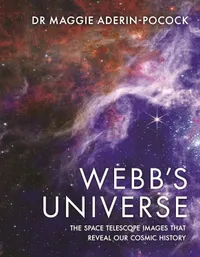
Webb's Universe: The Space Telescope Images That Reveal Our Cosmic History $40 on Amazon
If you enjoyed this interview with Maggie Aderin-Pocock, you can read more about how the James Webb Space Telescope is changing our outlook on the universe in her new book. It's crammed with stunning images and detailed descriptions of some of the most fascinating features of our cosmos.

Ben Turner is a U.K. based writer and editor at Live Science. He covers physics and astronomy, tech and climate change. He graduated from University College London with a degree in particle physics before training as a journalist. When he's not writing, Ben enjoys reading literature, playing the guitar and embarrassing himself with chess.