















Tiny 'hearts' self-assemble in lab dishes and even beat like the real thing


Under the watchful eyes of scientists, stem cells in lab dishes assembled themselves into tiny heart "organoids," roughly the size of sesame seeds, and began "beating" like real miniature hearts.
To guide the stem cells into these structures, the research team exposed the cells to a suite of proteins and small molecules that are known to be involved in early human heart development in the womb, according to a new study, published Thursday (May 20) in the journal Cell. These proteins and molecules docked onto receptors on the cell surface and set off a chain reaction, causing the stem cells to differentiate into several different cell types found within the heart.
After one week of development, the cells sorted themselves into hollow, chamber-like structures, analogous to the left ventricle of the heart, the team found. What's more, the walls of the chambers began to contract rhythmically, mimicking a human heartbeat.
Related: 11 body parts grown in the lab
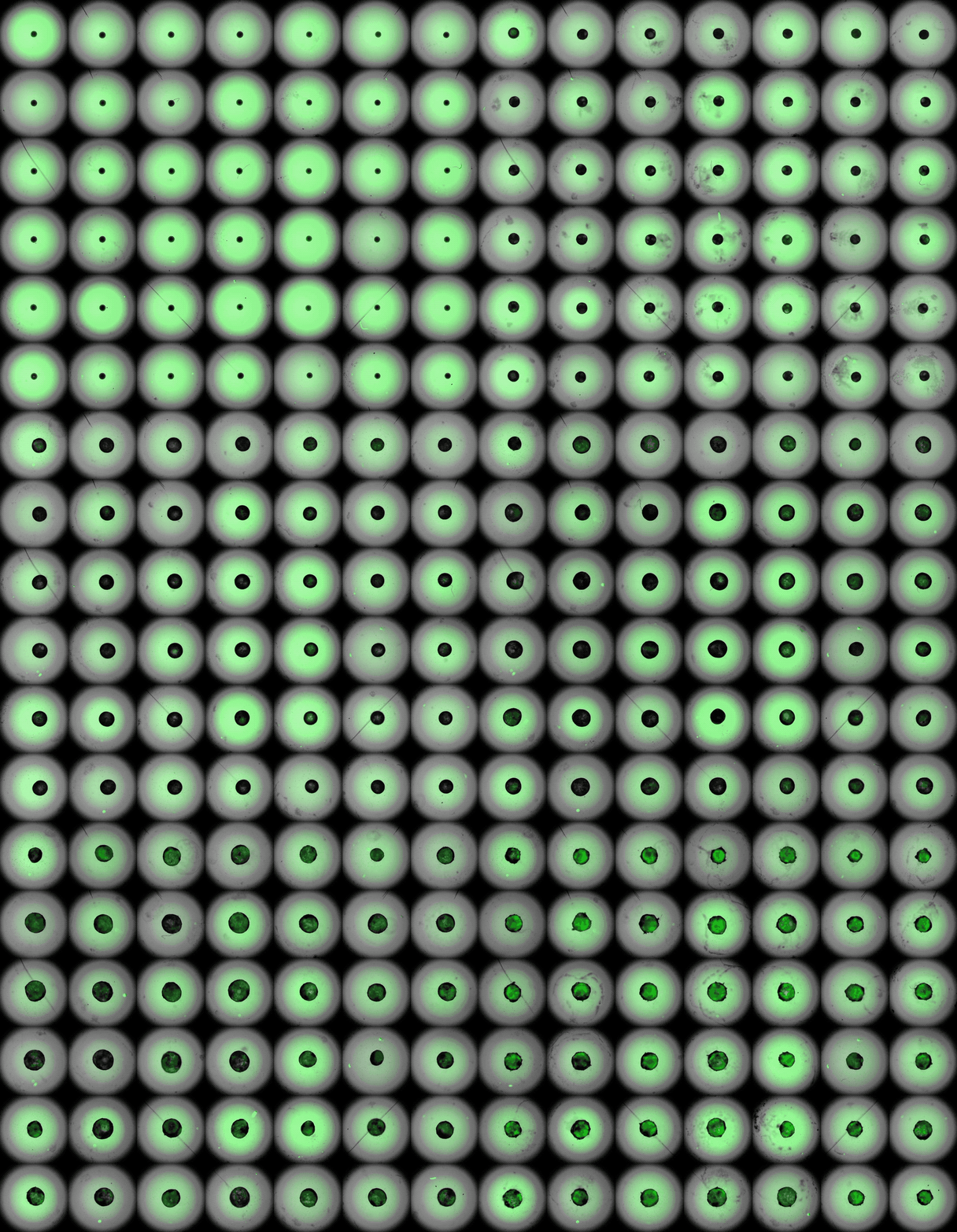
This accelerated timelapse shows 3D cardiac organoids, or cardioids, growing side-by-side in lab dishes.
"What we're interested in is essentially how human heart development works, and how it fails when we have, for example, congenital heart defects," said senior author Sasha Mendjan, a group leader in the Institute of Molecular Biotechnology at the Austrian Academy of Sciences in Vienna. These defects typically set in fairly early in pregnancy, but scientists cannot look directly into human embryos to see exactly how they occur. "We don't have any access to this window — this is essentially a black box," Mendjan told Live Science.
That's where the tiny organoids come in: They can provide a rare glimpse into these early stages of development. The team calls their creation "cardioids," short for cardiac organoids. The cardioids could also potentially provide insight into some adult heart conditions, wherein injured heart cells regress to a fetal-like state but fail to regenerate like an embryonic cell would, Mendjan added.
"This work is significant in the sense that they started from embryonic bodies," meaning 3D clumps of pluripotent stem cells, a type of stem cell that can give rise to many cell types, said Ying Mei, an associate professor of bioengineering at Clemson University, who was not involved in the research. In particular, the team managed to coax the cells into a hollow chamber structure — something that hasn't been done before with embryonic bodies, Mei said.
Get the world’s most fascinating discoveries delivered straight to your inbox.
"To the best of my knowledge, this is the first one."
From clump of cells to beating cardioid
Rather than starting with a mass of stem cells, scientists can also craft organoids using an approach called tissue engineering, which involves building a physical scaffold and then introducing cells onto that structure. "When you take the tissue-engineering approach, there, you are … building something according to a plan, how you know that the end organ should look like," Mendjan said.
"I think both approaches have their own advantages," Mei noted. For example, Mei and his colleagues crafted an organoid from specific heart cells in order to simulate heart attacks in a lab dish, they reported in a 2020 report in Nature Biomedical Engineering. These scaffold-built organoids can also be used to screen drugs, such as those designed to treat heart damage, before the medicines enter animal or human trials.
But, while tissue engineering can capture specific aspects of a disease, these organoids don't reflect how actual organs develop in the womb, Mei said. The new cardioids developed by Mendjan's group better capture this developmental process, he said.
To transform their blank-slate stem cells into tiny hearts, Mendjan and his team activated six molecular pathways in the cells; each pathway describes a ripple effect of activity within the cells that can be triggered by specific chemicals. The team tried activating these six pathways in different orders and using different quantities of the activating chemicals; eventually, they landed on a combination that gave them teensy, pulsating heart organoids.
"Essentially, the cells only had the signals," meaning the activating chemicals, "and themselves to attach to. And once they found each other, they knew what they had to do," Mendjan said. "What we learned from that is you should just let the cells do their own thing, interfere as little as possible," providing only the essential signals and the fuel needed for the cells to survive in culture.
The cardioids themselves resemble tiny spheres, about 0.04 inches (1 millimeter) across, that periodically undulate, squeezing the liquid within their hollow centers. "This would be analogous to essentially a human left ventricular chamber on day 28" of pregnancy, Mendjan said. The left ventricle, which later pumps oxygenated blood from the heart out into the body, is the first structure to properly develop in the heart, he said.
Related: Having a baby: Stages of pregnancy
With these tiny hearts in hand, the team ran an experiment to model injury in the organoids, to see if they mimicked what would happen in a real heart. They froze parts of the cardioids using a cold steel rod, which killed the cells it touched; in response, the cardioids sent a fleet of cells called fibroblasts to the injured sites, which then built a scaffold over the dead cells to keep the organoid intact.
This early stage of the repair process has been observed in animal models, but "this response has never been seen in vitro," meaning in lab dishes, Mendjan said. "I think we see it for the first time because these cardioids, they really behave much more as a real organ would."
RELATED CONTENT
That said, the team doesn't know why the cardioids behave the way they do, he added. They don't know exactly how or why the six molecular pathways lure the stem cells into a heart-like structure. "There are many things we don't understand yet," Mendjan said. Looking forward, the team plans to experiment further with these pathways, to determine what precise changes they provoke in the stem cells to form a cardioid.
"To me, that actually is a very interesting question: What causes them to form the chamber?" Mei said, echoing the sentiment. In addition to demystifying these molecular pathways, the team is now working to coax the cardioids to develop multiple chambers, like a real four-chamber heart.
"I don't see very big barriers for this to really become a reality," Mendjan said. Crafting a multichamber cardioid would enable the team to see the heart valves develop and the process of septation take place, where the heart partitions its single chamber into several. Many congenital heart defects emerge around this stage of development, so such a cardioid could grant valuable insight into those conditions, Mendjan said.
For now, in the current cardioid model, "they're mimicking the very early stages of cardiogenesis," Mei noted. "Many [congenital] diseases start in later stages. But you have to start somewhere."
Originally published on Live Science.

Nicoletta Lanese is the health channel editor at Live Science and was previously a news editor and staff writer at the site. She is a recipient of the 2026 AHCJ International Health Study Fellowship, with a project focused on antibiotic stewardship practices in Japan and the U.S. They hold a graduate certificate in science communication from UC Santa Cruz and degrees in neuroscience and dance from the University of Florida. Beyond Live Science, Lanese's work has appeared in The Scientist, Science News, the Mercury News, Mongabay and Stanford Medicine Magazine, among other outlets. Based in NYC, she also remains involved in dance and performs in local choreographers' work.