















World's most difficult maze could help reveal the secrets of otherworldly quasicrystals
Scientists created a maze-like fractal inspired by the movements of chess pieces. The ultra-difficult maze could help to improve our understanding of bizarre quasicrystals.

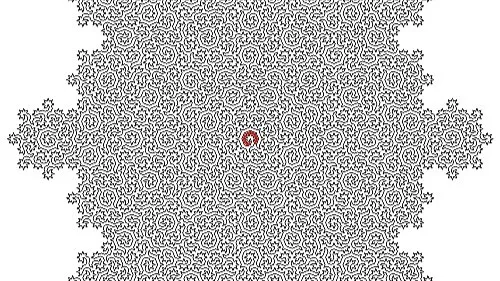
Physicists may have created the world's most difficult maze using a chess sequence, and it could help them understand the properties of otherworldly quasicrystals.
The maze is an example of a Hamiltonian cycle — a path that visits all of the points on a graph at least once. The researchers were inspired by the movement of a knight around a chessboard. The result is an infinitely expandable fractal maze that describes the structure of quasicrystals. The researchers published their findings May 1 in the journal Physical Review X.
"When we looked at the shapes of the lines we constructed, we noticed they formed incredibly intricate mazes," study lead author Felix Flicker, a physicist at the University of Bristol in the U.K., said in a statement. "The sizes of subsequent mazes grow exponentially — and there are an infinite number of them."
First represented in the irregular, non-repeating tile patterns of early Islamic art, quasicrystals are very rare crystals whose atoms fit into an ordered arrangement and yet never repeat. They are crystals, but they stubbornly break the rules of symmetry that scientists once used to divide traditional crystals from more chaotically structured solids.
Related: Pi calculated to 105 trillion digits, smashing world record
First theorized in 1981 and discovered in 1982, the once-controversial structures got Dan Shechtman, the scientist who found them, booted from his lab for defending his discovery — before later earning him the 2011 Nobel Prize in chemistry. Since then, quasicrystals have been synthesized in labs, discovered in meteorites and fossilized lightning, and found to have formed in the wake of the Trinity bomb test in 1945.
RELATED STORIES
To recreate the quasicrystals' bizarre structure, the researchers in the new study used a 2D version of Ammann-Beenker tiling, a type of aperiodic tiling similar to Penrose tiles. The researchers created an algorithm to find a Hamiltonian cycle over these tiles, enabling them to mathematically represent each atom inside a quasicrystal from beginning to end.
Get the world’s most fascinating discoveries delivered straight to your inbox.
The result is an infinitely scalable fractal maze, but modeling quasicrystals has much deeper applications than a mind-boggling pattern. The researchers said their Hamiltonian cycle offers the fastest way for scanning tunneling microscopes to scan an object. It also provides insight into how complex proteins fold and offers suggestions for how to efficiently capture carbon dioxide molecules from the atmosphere.
"We show that certain quasicrystals provide a special case in which the problem is unexpectedly simple," Flicker said. "In this setting, we therefore render some seemingly-impossible problems tractable."

Ben Turner is the features editor at Live Science. He covers physics and astronomy, among other topics such as tech and climate change. He graduated from University College London with a degree in particle physics before training as a journalist. When he's not writing, Ben enjoys reading literature, playing the guitar and losing at chess.