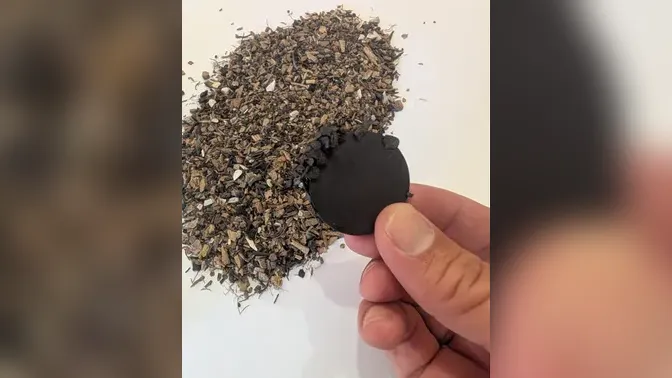
Archaeologists have uncovered two large piles of iron flakes on North Carolina's Hatteras Island that they say are evidence of a 16th-century "Lost Colony" of English settlers who disappeared in 1587. But some experts are unconvinced and say more evidence is needed.
"We've been digging there for 10 years off and on," Mark Horton, an archaeology professor at the Royal Agricultural University in the U.K., told Live Science, "and I think the real breakthrough was the hammer scale mixed in with 16th-century artifacts."
Hammer scale is a flaky byproduct of traditional blacksmithing. When iron is heated, a thin layer of iron oxide can form, which is then crushed into small pieces as the blacksmith hammers the iron.
"The colonists must have been desperate for a type of material that they otherwise didn't have," Horton said. "They're forging new iron artifacts from the material that they've got with them," he said, to make "new nails for building houses or ships."
Horton studies the Lost Colony, a group of about 120 English settlers who arrived on Roanoke Island in North Carolina's Outer Banks in 1587. The colonists struggled to survive and sent their leader, John White, back to England for supplies. When White returned in 1590, he couldn't find his compatriots — but he discovered the word "CROATOAN" carved into wood.
For centuries, historians and archaeologists have been puzzled by the disappearance of the colony. They've wondered whether the Croatoan tribe killed the settlers or whether the English moved elsewhere, perhaps to live with members of the Croatoan tribe on what is now called Hatteras Island.
Get the world’s most fascinating discoveries delivered straight to your inbox.
Hammer scale that was found on Hatteras Island.
(Image credit: Mark Horton / Croatoan Archaeological Society)
"But then last summer, we did an excavation on Hatteras Island, and we found hammer scale in a pit underneath a thick shell midden that contains virtually no European material in it at all," Horton said, adding that he thinks the English basically assimilated into the Indigenous tribe.
Radiocarbon dating of the layer of dirt in which the hammer scale was found suggests its age aligns with the Lost Colony. Since hammer scale is waste and not something that is traded, and because the Indigenous people are not known to have used iron forging technology, this iron trash strongly suggests that the English settlers made it to Hatteras Island in the late 16th century, Horton said. His group's finding has not yet been published in a peer-reviewed journal.
The new discovery fits in well with historical and archaeological information, Kathleen DuVal, a history professor at the University of North Carolina at Chapel Hill, told Live Science. "It absolutely makes sense that the Lost Colony would have moved to Hatteras Island," DuVal said. "They wrote exactly where they were going: to Croatoan."
A hand-colored woodcut depicts English settlers looking for the Roanoke Colony.
(Image credit: Alamy)
But not everyone is convinced by the piles of hammer scale. "I would like to see a hearth if we're talking about forging activity," Charles Ewen, a professor emeritus of archaeology at East Carolina University, told Live Science.
And even then, the hammer scale may be from Indigenous people's repurposing of the colonists' items for their own use, Ewen said, or it could even be trash from 16th-century explorers and settlers who stopped over while sailing the Gulf Stream up the East Coast. "The hammer scale is just not doing it for me without good context — and without a report, I'm not seeing good context," he said.
Horton said that, with archaeological excavations largely complete at the site — which is on private land, with cooperation from the landowner — he and his team plan to move forward with a publication.
"The hammer scale is another piece of really compelling evidence that we've got," Horton said, "but there are still several loose ends." For example, it is still a mystery whether some of the colonists moved elsewhere and whether some of them died at the Roanoke Island or Hatteras Island settlements.
Ewen, who co-authored the 2024 book "Becoming the Lost Colony: The History, Lore and Popular Culture of the Roanoke Mystery" (McFarland, 2024), said the archaeological and historical evidence does not clarify what happened to the Lost Colony. But he thinks that someday, the mystery might be solved, particularly "if we could find European burials that we could tie to the 16th century with European materials and not trade items," Ewen said.
Kristina Killgrove is a staff writer at Live Science with a focus on archaeology and paleoanthropology news. Her articles have also appeared in venues such as Forbes, Smithsonian, and Mental Floss. Kristina holds a Ph.D. in biological anthropology and an M.A. in classical archaeology from the University of North Carolina, as well as a B.A. in Latin from the University of Virginia, and she was formerly a university professor and researcher. She has received awards from the Society for American Archaeology and the American Anthropological Association for her science writing.
You must confirm your public display name before commenting
Please logout and then login again, you will then be prompted to enter your display name.