













'Building blocks of life' recovered from asteroid Ryugu are older than the solar system itself
The first analyses of samples brought back from the asteroid Ryugu show that this space rock contains some of the molecules needed for life.

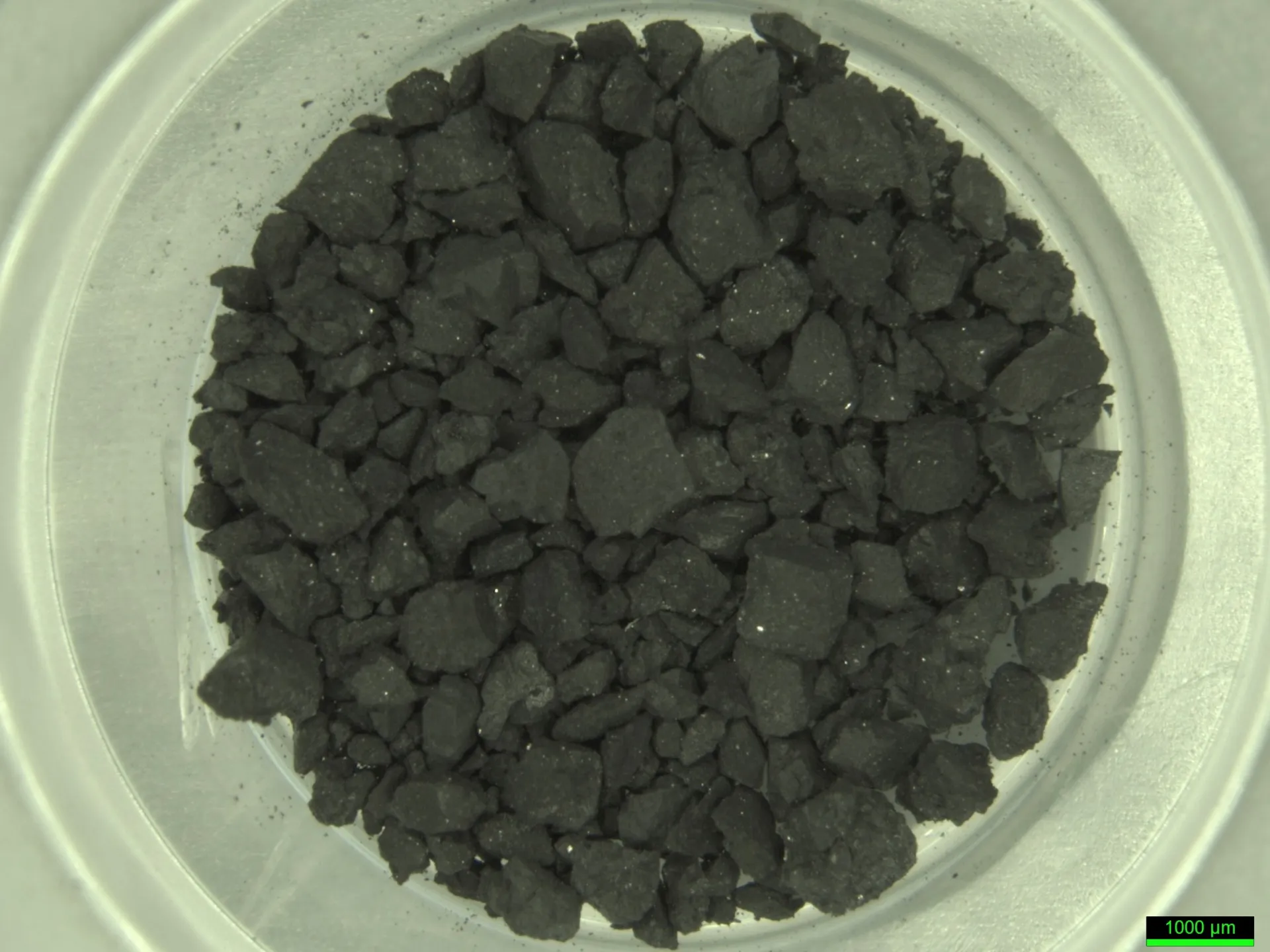
The asteroid Ryugu, which orbits the sun between Earth and Mars, contains many of the building blocks for life, a new analysis finds.
The study, published Feb. 23 in the journal Science, is one of the first peeks at the samples from Ryugu brought back by Japan's Hayabusa2 spacecraft in 2020. The mission is only the second time a spacecraft has successfully brought back a sample from an asteroid; In 2010, the first Hayabusa mission brought back dust from the Itokawa asteroid, but that sample was mere micrograms in size due to a failure of the collection system. Hayabusa2, by comparison, returned more than 0.17 ounces (5 grams) to Earth from the space rock officially known as 162173 Ryugu.
An analysis of a tiny portion of this sample revealed that the carbon-rich asteroid also contains molecules that are crucial to all known life, including 15 amino acids, the building blocks of proteins. These molecules themselves are not alive, but because they are found in all life, scientists call them "prebiotic." Researchers knew from previous studies of meteorites found on Earth that space rocks can contain prebiotic molecules, but rocks that have fallen through Earth's atmosphere might harbor such compounds due to contamination. It also wasn't clear whether these molecules could survive on an asteroid's surface or only deep within the asteroid body. In this case, the molecules came from surface dust.
"The presence of prebiotic molecules on the asteroid surface despite its harsh environment caused by solar heating and ultraviolet irradiation, as well as cosmic-ray irradiation under high-vacuum conditions, suggests that the uppermost surface grains of Ryugu have the potential to protect organic molecules," study leader Hiroshi Naraoka of Kyushu University in Japan said in a statement. That means that asteroids could potentially spread the building blocks of life throughout the solar system.
And according to a second study, also published in Science, the organic materials on Ryugu may even predate the formation of the solar system itself, instead having formed in a primordial cloud of interstellar dust that eventually coalesced into Ryugu's parent body. In other words, many of the ingredients for life may be baked into the solar system from the very start.
To capture an asteroid
Ryugu is a carbonaceous asteroid, a type that makes up 75% of the asteroids found in the solar system, according to NASA. These asteroids are essentially the scraps left behind when the solar system formed, making them an intriguing window into the molecules present some 4.5 billion years ago. As part of a collaboration with Japan's space agency, NASA received about 10% of the Hayabusa2 sample for testing, with additional research taking place in Europe as well.
Naraoka and a large international team extracted the molecules from just 30 micrograms (0.000001 ounces) of sample using a variety of solvents and analyzed the organic matter. They found thousands of combinations containing carbon, hydrogen, nitrogen, oxygen, and/or sulfur, including the 15 amino acids. Other compounds included amines, which are nitrogen-containing, and carboxylic acids, which have a specific structure including carbon, oxygen and hydrogen. The compounds discovered were generally consistent with what has been seen in carbonaceous meteorites that have been exposed to water in space and found on Earth,study co-author Jason Dworkin, an astrobiologist at NASA’s Goddard Space Flight Center, said in the statement.
Get the world’s most fascinating discoveries delivered straight to your inbox.
However, the researchers did not find sugars or nucleobases, key components of DNA and RNA.
Related content
"It is possible these compounds are present in asteroid Ryugu but are below our analytical detection limits given the relatively small sample mass available for study," study co-author Daniel Glavin, also an astrobiologist at NASA Goddard, said in the statement.
Researchers have only just begun to analyze the Ryugu samples, and soon plan to compare them to samples from another asteroid. In September, NASA's OSIRIS-REx mission is slated to return samples to Earth from 101955 Bennu, another carbonaceous asteroid.
"OSIRIS-REx is expected to return much more sample mass from Bennu and will provide another important opportunity to look for trace organic building blocks of life in a carbon-rich asteroid," Dworkin said.

Stephanie Pappas is a contributing writer for Live Science, covering topics ranging from geoscience to archaeology to the human brain and behavior. She was previously a senior writer for Live Science but is now a freelancer based in Denver, Colorado, and regularly contributes to Scientific American and The Monitor, the monthly magazine of the American Psychological Association. Stephanie received a bachelor's degree in psychology from the University of South Carolina and a graduate certificate in science communication from the University of California, Santa Cruz.