Tiny particles of rock gathered from the asteroid Ryugu are some of the most primordial bits of material ever examined on Earth and could give us a glimpse into the origins of the solar system.
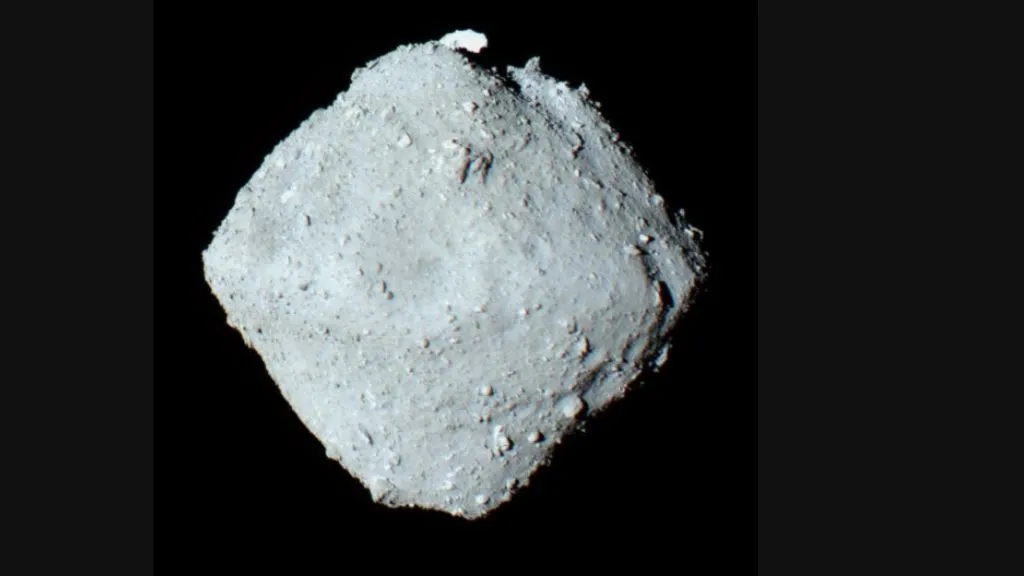
Asteroid 162173 Ryugu measures about 2,953 feet (900 meters) in diameter and orbits the sun between Earth and Mars, occasionally crossing Earth's orbit, according to Live Science's sister site Space.com. The carbonaceous, or C-type, asteroid spins like a top as it hurtles through space, and like other C-type asteroids, Ryugu likely contains material from the nebula (giant cloud of dust and gas) that gave birth to the sun and its planets billions of years ago, scientists think.
In 2019, the Japanese spacecraft Hayabusa2 collected samples from the surface of Ryugu, and on Dec. 6, 2020, those samples were successfully transported to Earth in an airtight container tucked inside the reentry capsule. Now, in two new papers published Monday (Dec. 20) in the journal Nature Astronomy, scientists present results from the initial analysis of these remarkable bits of space rock.
"We are just at the beginning of our investigations, but our results suggest that these samples are among the most primordial material available in our laboratories," said Cédric Pilorget, an assistant professor in the Institute of Space Astrophysics at the Paris-Saclay University in France and first author of one of the studies. The exact age of the material remains unknown but should be revealed in future studies.
In total, the asteroid samples include about 0.2 ounces (5.4 grams) of material. The largest particles of rock measure about 0.31 inches (8 millimeters) across; the smallest have diameters less than 0.04 inch (1 mm), so they resemble fine dust. To the naked eye, the samples look like incredibly dark bits of black pepper, Toru Yada, an associate senior researcher at the Japan Aerospace Exploration Agency and first author of the second study, told Live Science.
While they handled the space rock, Yada and his colleagues kept the material in a vacuum chamber or in a sealed environment filled with purified nitrogen. "Thus, the Ryugu samples have been handled without exposing [them] to the Earth's atmosphere," he said. The team assessed the samples using an optical microscope and various instruments that measure how the rocks absorb, emit and reflect different wavelengths of light in the visible and infrared spectra.
Sign up for the Live Science daily newsletter now
Get the world’s most fascinating discoveries delivered straight to your inbox.
Asteroid 162173 Ryugu
(Image credit: ISAS/JAXA, CC BY 4.0 , via Wikimedia Commons)
The pitch-dark asteroid bits reflect only about 2% to 3% of the light that hits them, the team found. And the researchers were surprised to discover that the samples' bulk density — the mass of the particles divided by the total volume they occupy — was lower than that of known carbonaceous meteorites, Yada said. This finding hints that the rocks are highly porous, meaning that between the individual grains of materials in the rocks exist many pockets of empty space that would allow water and gas to seep through.
This finding aligns with preliminary data collected by the Hayabusa2 spacecraft, which also hinted that the rocks on Ryugu's surface are highly porous, according to Space.com.
Following Yada's analyses, Pilorget and his team used a technique known as hyperspectral microscopy to take a closer look at the composition of the asteroid samples. Their hyperspectral microscope works by illuminating the samples with different wavelengths of light in the visible and infrared spectra and snapping high-resolution pictures as it does so. Each snapshot measures about 0.2 by 0.2 inches (5 mm by 5 mm), and each individual pixel provides data on the microscopic scale. In this way, the team revealed fine details of the rocks' color, structure and chemical composition.
Snapshots of the Ryugu samples revealed that the rock particles are composed of a "hydrated matrix," which includes materials such as clay, with carbon-based compounds embedded throughout. "Some of the material properties were close to those of the carbonaceous chondrites," a class of carbonous meteorites, "that we have in our collections, while some were clearly distinct," Pilorget said.
The Ryugu samples are among the darkest ever examined, for example, and "we have to understand why and what it implies regarding the formation and evolution of this material," he said. In addition, the team discovered traces of ammonia-rich compounds in the rock, which "could have some implications regarding the origin of Ryugu and our understanding of primordial material."
These initial analyses represent the first step in figuring out what Ryugu can tell us about the early solar system, but exposing all of the space rocks' secrets will take some time. "A lot will come by combining additional techniques — in particular, the ones that will be capable of accessing the very fine scales," Pilorget said.
These additional techniques will include various chemical analyses, which can reveal the chronological history of when the asteroid first formed and at what ages it came into contact with water, Yada said. Further assessments of the organic compounds and minerals in the samples will also provide key information about how the asteroid and its original body first formed. Researchers can also examine the volatile compounds, or those that can be easily vaporized, within the samples; these sorts of tests can reveal how solar winds shaped the asteroid's surface over time, Yada said.
"Once again, we are only at the beginning of our investigations," Pilorget said.
Nicoletta Lanese is the health channel editor at Live Science and was previously a news editor and staff writer at the site. She is a recipient of the 2026 AHCJ International Health Study Fellowship, with a project focused on antibiotic stewardship practices in Japan and the U.S. They hold a graduate certificate in science communication from UC Santa Cruz and degrees in neuroscience and dance from the University of Florida. Beyond Live Science, Lanese's work has appeared in The Scientist, Science News, the Mercury News, Mongabay and Stanford Medicine Magazine, among other outlets. Based in NYC, she also remains involved in dance and performs in local choreographers' work.