















Great White Shark's Bite Not So Strong
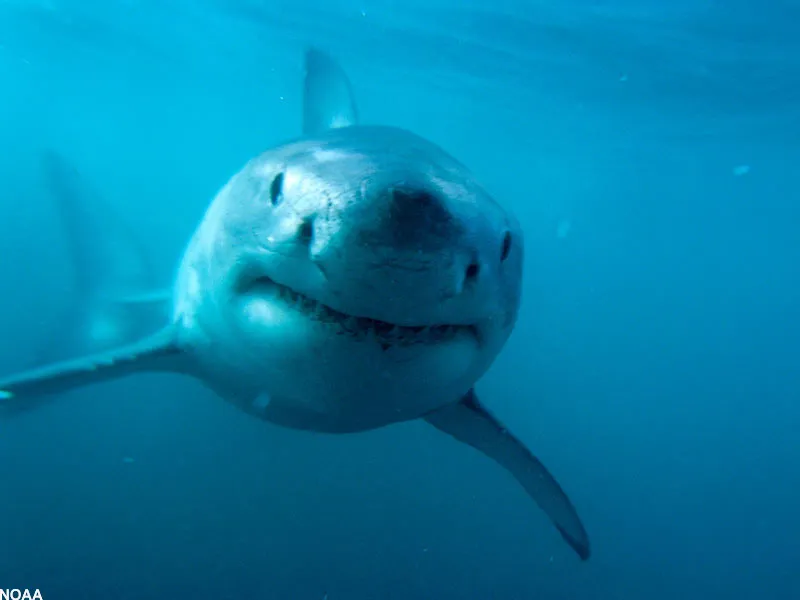
A digital rendering of a great white shark's maw could lead to the first accurate estimate of the power behind a full-force bite.
The shark's ability to inflict killer damage on anything it grabs, however, probably is due to saw-like teeth and not the amount of bite force, the study researchers say. Once a great white clamps down on a prey with its razor-sharp teeth, the shark often shakes the catch from side to side to initiate a sawing action.
Daniel Huber, a biologist at the University of Tampa in Florida, examined an eight-foot (2.4-meter) great white shark that had died after becoming entangled in nets off the coast of Australia. Huber and his colleagues dissected the shark's head and took several measurements, including the size and placement of the jaw muscles.
"We are figuring out in three dimensions the leverage of all of these jaw muscles," Huber told LiveScience. The jaws work like a set of pliers, where pliers with long handles would let you grab an item with more force than pliers with short handles.
From this data, the researchers are developing a 3-D digital recreation of the shark and a computer simulation of a full-force bite. They will compare the final force estimate with those from tiger and bull sharks, which, along with the great white, are responsible for most shark attacks on humans.
“The white has the narrowest head of the three, so it has less space for jaw muscles,” Huber said. “Consequently, we’re expecting that it will have a lower bite force on a pound-for-pound basis.”
But great whites would still top the charts as savviest hunters and most adept at capturing prey.
Get the world’s most fascinating discoveries delivered straight to your inbox.
“Much of the damage inflicted by white sharks is due to their teeth, and not necessarily to the force,” Huber said.
The research is being sponsored by the University of New South Wales, University of Tampa, University of Newcastle in Australia and the Computational Biomechanics Research Group.
- Top 10 Deadliest Animals
- Image Gallery: Great White Sharks
- Vote For Your Favorite Shark
Jeanna Bryner is managing editor of Scientific American. Previously she was editor in chief of Live Science and, prior to that, an editor at Scholastic's Science World magazine. Bryner has an English degree from Salisbury University, a master's degree in biogeochemistry and environmental sciences from the University of Maryland and a graduate science journalism degree from New York University. She has worked as a biologist in Florida, where she monitored wetlands and did field surveys for endangered species, including the gorgeous Florida Scrub Jay. She also received an ocean sciences journalism fellowship from the Woods Hole Oceanographic Institution. She is a firm believer that science is for everyone and that just about everything can be viewed through the lens of science.