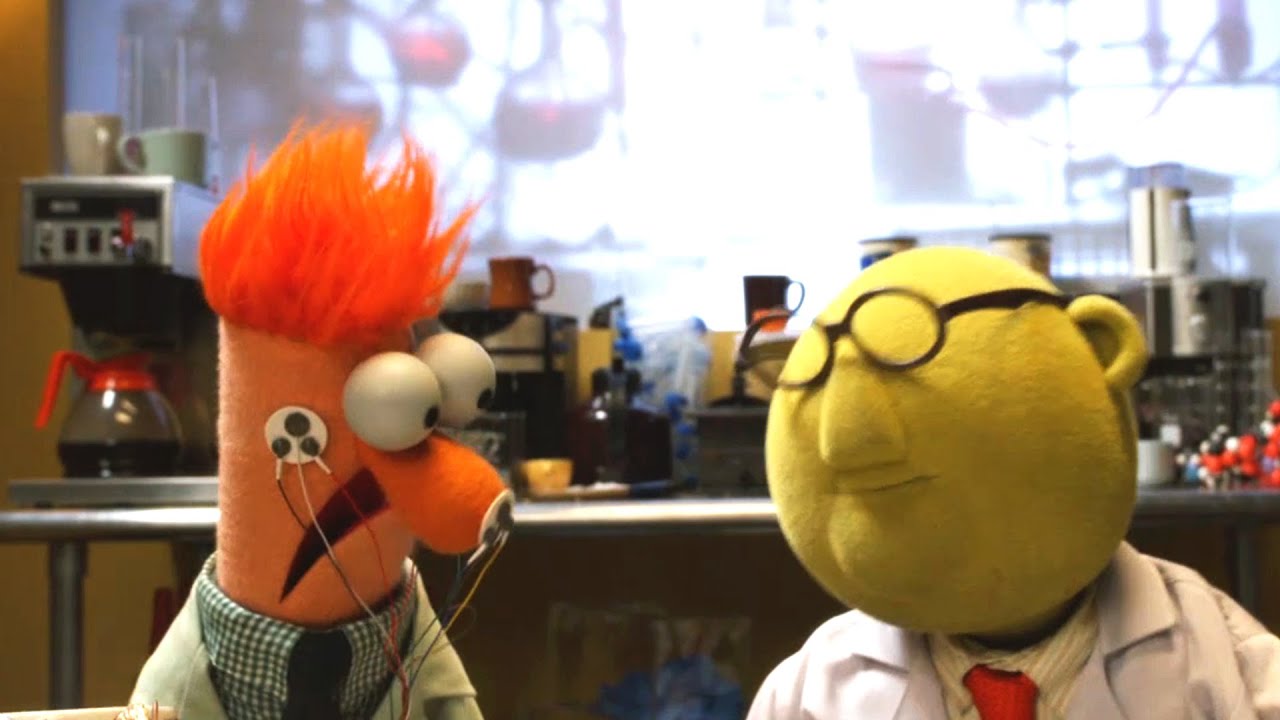
Mars is the only known planet in the universe inhabited solely by robots, but on Monday (Aug. 13) NASA's Mars Reconnaissance Orbiter had a close encounter of the furred kind. Dotting the surface of the Red Planet's southern pole is, apparently, a geological formation that looks just like the balloon-eyed, scarlet-maned science Muppet, Beaker.
Astronomers at the University of Arizona's Lunar and Planetary Laboratory shared a photo of the cartoonish formation on Twitter early Monday morning. The photo was snapped by the High Resolution Imaging Science Experiment (HiRISE), an ultra-high-resolution camera that's been observing Mars aboard NASA's Orbiter since 2006. Not much is known yet about the Beaker-esque formation, save that it's part of the terrain near Mars' South Pole — one of the few regions not obscured by the ongoing planet-wide dust storm.
The HiRISE Twitter account noted that the image offered up "a nice dose of pareidolia," referring to the psychological phenomenon of seeing faces (or other familiar patterns) where there aren't any. Mars might as well be the pareidolia capital of our solar system; beyond Beaker's mugshot, recon robots have imaged Martian formations that look like a smiley face, Gandhi, a spooky shrouded lady and even Jabba the Hutt. [In Images: Ghostly Faces on Mars]
Latest Videos FromLive Science
Whether the Beaker Formation presents any exciting research opportunities is a question for another day (especially while Mars' hard-working Opportunity Rover remains eerily silent following the devastation of the dust storm).
But, if nothing else, the formation's discovery can be taken as an overdue honor for Earth's most-abused Muppet. As a lab assistant to Dr. Bunsen Honeydew of Muppet Labs, Beaker has been blinded, bludgeoned, electro-shocked, force-fed "edible" paperclips and unethically cloned, to name a few workplace incidents. (It is unclear if Beaker received a stipend or course credit for any of this.) In this reporter's opinion, to have a permanent spot on the Red Planet is modest compensation for all of Beaker's efforts to advance Muppet science.
Beaker could not be immediately reached for comment on the discovery, but sources familiar with the Muppet believe he would have said, "Meep meep."
Originally published on Live Science.