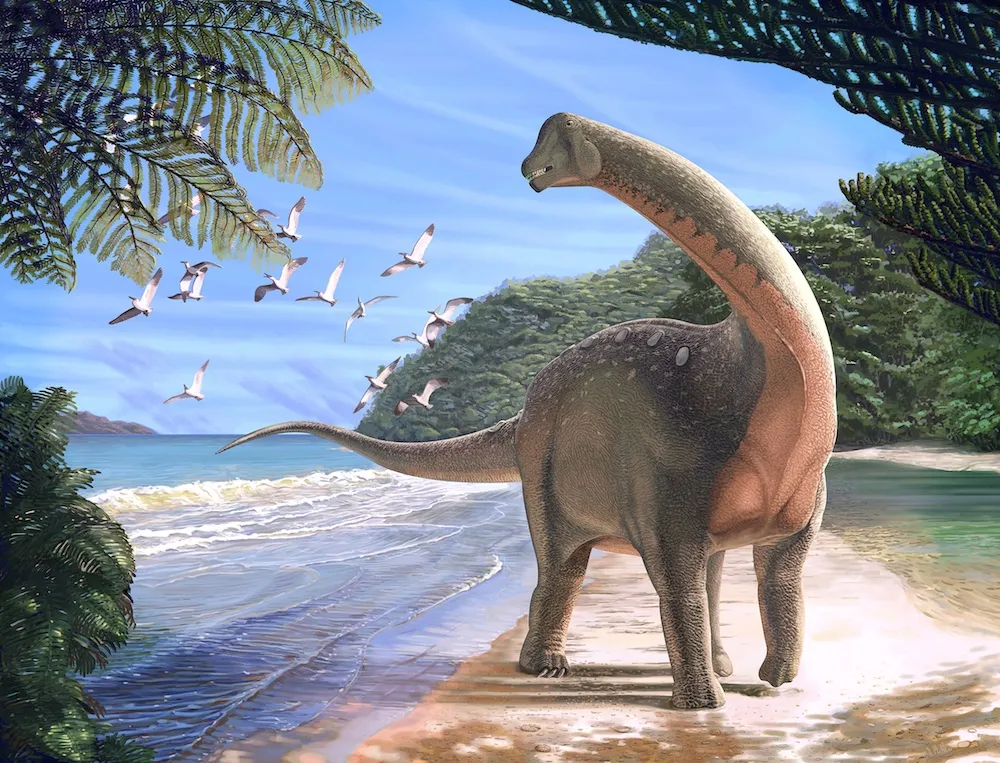
Even though it was discovered in Egypt, Mansourasaurus shahinae had more in common with dinosaurs uncovered in Europe than it did with dinosaurs found in southern Africa.
(Image credit: Andrew McAfee/Carnegie Museum of Natural History)
Egypt is known for its magnificent pyramids and powerful pharaohs, but now the country is gaining fame among paleontologists, especially now that an international team has uncovered the remains of an 80-million-year-old dinosaur the size of a school bus that had bony plates embedded in its skin during its lifetime.
Egyptian researchers discovered the newfound sauropod — a long-necked, long-tailed herbivorous dinosaur named Mansourasaurus shahinae — in the Sahara Desert. The find is remarkable, given the rarity of dinosaur fossils in Africa from the Late Cretaceous (100 million to 66 million years ago), the period of time just before the 6-mile-long (10 kilometers) asteroid slammed into Earth and killed the nonavian dinosaurs, the researchers said.
"Africa remains a giant question mark in terms of land-dwelling animals at the end of the age of dinosaurs," study co-researcher Eric Gorscak, a postdoctoral research scientist at The Field Museum in Chicago, who started the project as a doctoral student at Ohio University, said in a statement. "Mansourasaurus helps us address long-standing questions about Africa's fossil record and paleobiology — what animals were living there, and to what other species were these animals most closely related?" [See Images of the Egyptian Dinosaur]
His co-researcher, Matt Lamanna said his "jaw hit the floor," when he saw photos of M. shahinae's fossils. "This was the Holy Grail — a well-preserved dinosaur from the end of the age of dinosaurs in Africa — that we paleontologists had been searching for for a long, long time," Lamanna, a paleontologist at the Carnegie Museum of Natural History, in Pittsburgh, said in the statement.
A skeletal reconstruction of the roughly 80-million-year-old Mansourasaurus shahinae. The colored bones are those that are preserved in the original fossil; other bones are based on those of closely related dinosaurs.
(Image credit: Andrew McAfee/Carnegie Museum of Natural History)
Were African dinosaurs isolated?
The discovery of M. shahinae reveals how dinosaurs evolved to be different from one another as the continents split apart. During the Triassic and Jurassic periods, the continents were joined together as the supercontinent Pangaea. Scientists know that the continents began to split apart during the Cretaceous, but it's unclear how well connected Africa was to Europe and the Southern Hemisphere landmasses, the researchers said. Without this knowledge, it's challenging to know if Africa's animals were completely cut off from the rest of the world, they said.
Luckily, studying ancient animal fossils can help scientists unravel this mystery. For instance, if Africa still had land connections to Europe during the Cretaceous period, its animals would likely have similar anatomies to those on neighboring landmasses. But if the continents were fully separated, the animals in Africa likely would have evolved different characteristics, the researchers said.
Late Cretaceous dinosaur fossils from Egypt, however, are challenging to find. Unlike the exposed, rocky regions that make dinosaur hunting easy in the U.S. Rocky Mountains, the Gobi Desert in Mongolia or the Patagonia region of Argentina and Chile, much of the land in Africa is covered with lush vegetation, making it difficult for paleontologists to know where to dig (i.e., no bones poking out of the ground).
Sign up for the Live Science daily newsletter now
Get the world’s most fascinating discoveries delivered straight to your inbox.
That's why "Mansourasaurus shahinae is a key new dinosaur species and a critical discovery for Egyptian and African paleontology," Gorscak said.
Indeed, M. shahinae is more closely related to the dinosaurs of Europe and Asia than it is to those in southern Africa or even South America, according to an analysis done by lead study researcher Hesham Sallam, a lecturer in the Department of Geology at Mansoura University in Egypt, and his colleagues. This suggests that some dinosaurs were moving between Africa and Europe during the Late Cretaceous, Sallam said in the statement. [Gallery: Reconstructed Dinosaur 'Chase']
Students Mai El-Amir and Sara Saber excavate ribs and other bones of the new titanosaurian dinosaur Mansourasaurus shahinae in the Sahara Desert of Egypt. The team’s field tents are visible in the background.
(Image credit: Mansoura University)
Egyptian titanosaur
Researchers named Mansourasaurus shahinae after Mansoura University and Mona Shahin, who helped develop the Mansoura University Vertebrate Paleontology (MUVP) initiative in 2010 to educate Egyptian vertebrate paleontologists. [Titanosaur Photos: Meet the Largest Dinosaur on Record]
M. shahinae belongs to Titanosauria, a group of enormous sauropods — including Argentinosaurus, Dreadnoughtusand Patagotitan — that lived around the world during the Cretaceous period, the researchers said. However, although M. shahinae is the most complete dinosaur specimen from the Late Cretaceous of Egypt, it wasn't the largest titanosaur on record; it weighed about as much as an African bull elephant, the researchers said. (That's more than 10 times less than Patagotitan, which likely weighed a whopping 69 tons, or 62 metric tons, Live Science previously reported.)
Besides M. shahinae, there are just five other dinosaur species known from Egypt: huge predatory dinosaurs — Bahariasaurus ingens, Carcharodontosaurus saharicus and (most famously) Spinosaurus aegyptiacus, a dinosaur that could likely swim — and two titanosaurian sauropods — Aegyptosaurus baharijensis and Paralititan stromeri, Lamanna told Live Science.
However, with the exception of the newfound M. shahinae, "all of these Egyptian dinosaurs are about 95 million years old," Lamanna told Live Science. "At about 80 million years old, our new beastie is the only named dinosaur from the last 30 million years of the Cretaceous in Egypt."
Laura is the managing editor at Live Science. She also runs the archaeology section and the Life's Little Mysteries series. Her work has appeared in The New York Times, Scholastic, Popular Science and Spectrum, a site on autism research. She has won multiple awards from the Society of Professional Journalists and the Washington Newspaper Publishers Association for her reporting at a weekly newspaper near Seattle. Laura holds a bachelor's degree in English literature and psychology from Washington University in St. Louis and a master's degree in science writing from NYU.