














Did the Solar Eclipse Damage Your Eyes? Here's How to Tell

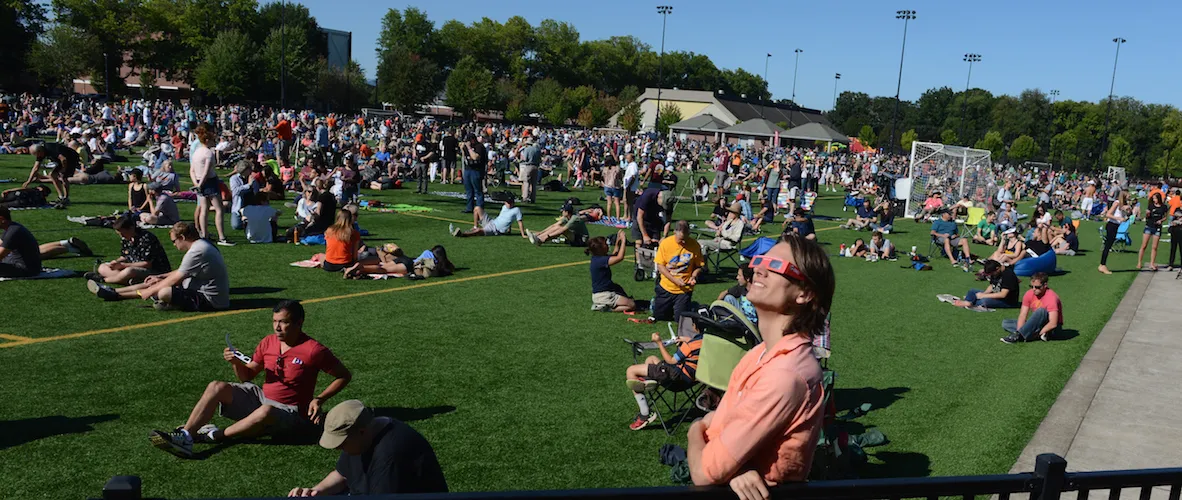
Many watchers of today's solar eclipse may have glanced at the sun without proper eye protection, if only for a brief moment. This can be dangerous, as looking directly at the sun can cause eye damage. But how do you know if you've hurt your eyes?
The solar eclipse wowed viewers across the United States today (Aug. 21) as it passed from the West Coast to the East Coast. As millions tried to catch a glimpse of the phenomenon, many may have taken a peek without proper eye protection, either intentionally or by accident. Even President Donald Trump was photographed apparently looking sunward at the eclipse without eye protection.
Experts stress that you should not look directly at the sun without proper eye protection, which includes special eclipse glasses or solar viewers. That's because looking directly at the sun, even for a short period, can cause damage to the eyes' retina — a condition known as solar retinopathy. The damage occurs in the fovea, a spot in the retina that is responsible for sharp, central vision, according to the American Academy of Ophthalmology (AAO).
There's no amount of time that's considered "safe" to look at the sun without proper eye protection, said Dr. Neil Bressler, a professor of ophthalmology at The Johns Hopkins University School of Medicine. Even looking for a few seconds could cause damage, and the longer you stare, the higher your chances of experiencing damage, Bressler said. [Photos: 2017 Great American Solar Eclipse]
These symptoms can include the following:
- Blurry vision
- A central blind spot in one or both eyes
- Increased sensitivity to light
- Distorted vision
- Changes in the way you see color, known as "chromatopsia"
People who experience discomfort or vision problems after an eclipse should visit an eye doctor for an eye exam, according to the American Optometric Association.
Fortunately, many people with solar retinopathy recover from their symptoms, but some have lasting vision problems. For example, in a 2002 study, 13 out of 15 patients in England with solar retinopathy resulting from viewing an eclipse in 1999 had normal vision in an eye exam eight to 12 months later. Still, even some patients with normal vision in an eye test had subtle eye symptoms, such as a small blind spot in their vision.
Get the world’s most fascinating discoveries delivered straight to your inbox.
Original article on Live Science.

Rachael is a Live Science contributor, and was a former channel editor and senior writer for Live Science between 2010 and 2022. She has a master's degree in journalism from New York University's Science, Health and Environmental Reporting Program. She also holds a B.S. in molecular biology and an M.S. in biology from the University of California, San Diego. Her work has appeared in Scienceline, The Washington Post and Scientific American.