













Gold Probes Could Reveal Cancer in Your Body
Microscopic bars of gold floating in the bloodstream may someday help doctors find cancers in the human body.
At Purdue University, scientists are chemically forming gold nanorods that are just 20 nanometers wide and 60 nanometers long, says Alexander Wei, an associate professor of chemistry. That's 200 times smaller than a red blood cell.
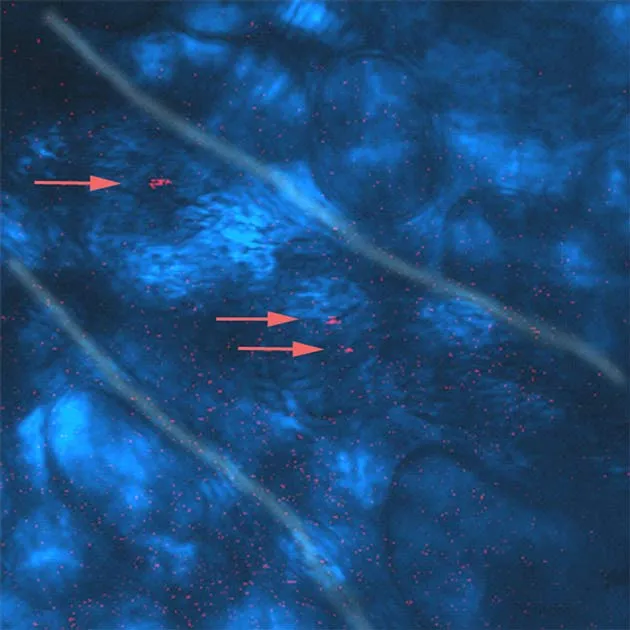
When the scientists inject these nanorods into a mouse and then focus a laser beam of light at a wavelength just longer than visible on its paper-thin ears, the gold flecks sparkle, or "fluoresce," as they move through the rodent's blood vessels. The gold nanorods glow almost 60 times brighter than the fluorescent dyes used in conventional imaging.
Eventually new imaging systems that trace the paths of these sparkling rods—perhaps through such trouble spots as emerging cancers and tumors —could produce clearer pictures than currently available, the scientists say. Gold is the material of choice as the contrast agent, Wei says, because it fluoresces reliably and is biochemically inert and so safer to the body than some alternatives.
Wei's team has refined this chemical-synthesis technique so they can control the growth of these rods precisely. Tight control is crucial to the imaging process because it is the nanorods' proportions that determine the frequency of the light that will nudge them into fluorescence. And using just the right light frequency, 830 nanometers for a 20-by-60 nanometer rod, is what makes it possible to excite the nanorods through the skin.
"The amount of light that can pass through tissue starts to increase beyond about 750 nanometers. That's the end of the visible range," Wei says.
Above 750 nanometers, the border of the near-infrared range, light penetrates more deeply into the tissues that block visible light. But there is also a limit to how long the wavelengths can be. As light wavelengths rise above 1,000 nanometers, or a micron, water in the body begins to absorb the light.
Get the world’s most fascinating discoveries delivered straight to your inbox.
"There is a window of opportunity to flash light through your body," he says, "and it is between 800 nanometers and about 1,300 nanometers."
Even within this window, however, light cannot penetrate very far into tissue, Wei says. That's why the researchers have scrutinized mouse ears instead of, say, mouse hearts. If commercially-available medical imaging devices were to be based on the lab equipment used for these experiments, they would work best for detecting surface cancers, such as melanomas.
But it is also possible, he says, that the technology might be adapted to incorporate the sort of miniaturized laser-and-camera equipped probes that surgeons already use to reach deep into the body.
- Image Gallery: Micromachines
- High-tech Probes Sneak Inside Your Cells
- Microbe and Machine Merged to Create First 'Cellborg'
- Printable Skin: 'Inkjet' Breakthrough Makes Human Tissue
- Nanotechnology May Need Regulation