Live Science Plus





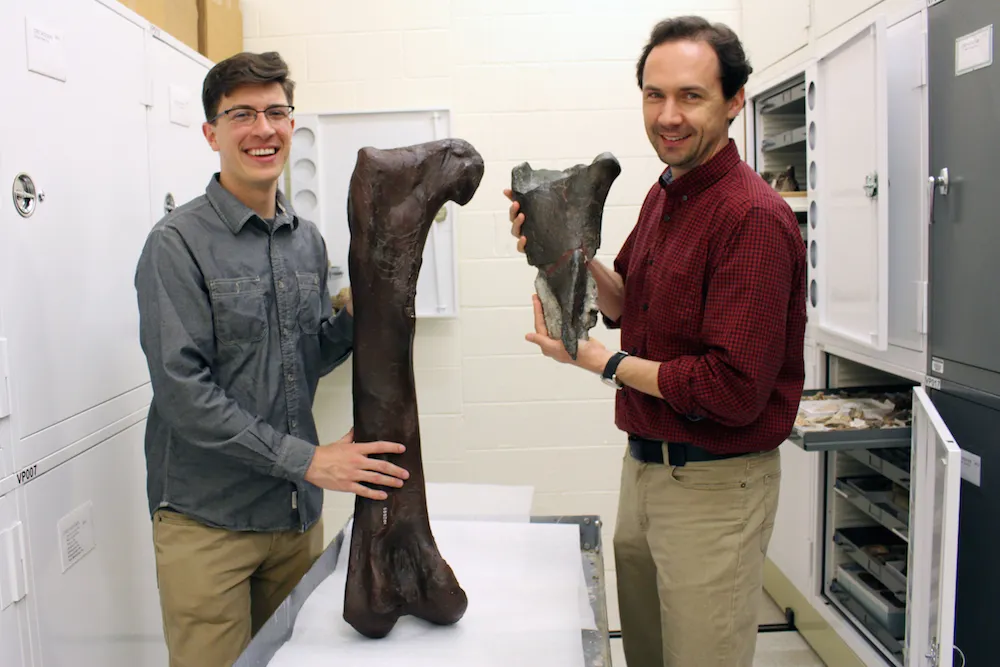
A fragmented femur bone hidden underwater for millions of years has become the first evidence that a dinosaur once roamed Washington, a new study finds.
And not just any dinosaur: This beast was a theropod — a two-legged, mostly meat-eating group of beasts, such as Tyrannosaurus rex and Velociraptor, that are related to modern-day birds, the researchers said.
Scientists found the 80-million-year-old fossil of the dinosaur when they were searching for ammonites — extinct marine invertebrates with spiral shells — and other fossilized animals. They had focused their fieldwork in the San Juan Islands, an archipelago located a short ferry ride away from the Seattle area. [See Images of the Fossil of the First Dinosaur Found in Washington]
In April 2012, when the tide was out, they noticed a fossilized bone embedded in the marine rock. The researchers immediately contacted paleontologists at the University of Washington, who sent out a team in May of that year to excavate the fossil with a rock saw.
"The rock there is tremendously hard, so it took them a full day to excavate it," said Christian Sidor, a co-author of the study and a curator of vertebrate paleontology at the Burke Museum at the University of Washington.
Sidor and his colleagues spent about a year and a half preparing the fossil, and "for the longest time, I was unconvinced that we were going to be able to say anything else besides 'It's a large bone,'" he told Live Science. "What was exposed on the surface really had no anatomy. I couldn't tell if it was a dinosaur, couldn't tell if it was a marine reptile, couldn't tell anything about it."

But once they removed the fossil from the rock and flipped it over, the researchers saw several telltale signs that the fossil was half of the left femur (thighbone) of a theropod dinosaur. It measures 16.7 inches long by 8.7 inches wide (42 by 22 centimeters) but would have been almost 4 feet (1.2 meters) long — or slightly smaller than a T. rex thighbone — before it broke, the researchers said.
Several clues suggest the fossil belonged to a theropod, Sidor said. For instance, the fossil once had a hollow middle cavity, which was unique to theropods during the late Cretaceous period. (Now, the hollow portion is filled with rocks and fossilized clams, Sidor said.)
"That's one really great diagnostic feature for carnivorous dinosaurs, or theropods," Sidor said. "You always hear about T. rex having hollow bones or Velociraptor having hollow bones. Modern birds have hollow bones, and that's one of the features that links birds and theropod dinosaurs."
Moreover, the bone has a feature positioned closely to the hip, called a fourth trochanter — another indication it belonged to a theropod, he said.
But, "that's it," Sidor said. "We're lucky we got what we got." [Wipe Out: History's Most Mysterious Extinctions]
The researchers were able to paint a more detailed picture of this creature by analyzing its surroundings. They uncovered the specimen near fossils of the clam species Crassatellites conradiana, which lived in shallow water, the researchers said. These clams suggest the dinosaur died near the sea, was tossed around by the waves and found its nearly eternal resting place among the clams, they said.
A Washington first
The finding makes Washington the 37th U.S. state known to have dinosaur fossils, the researchers said.
There are a variety of reasons dinosaurs aren't in all 50 states. Hawaii, for example, doesn't have dinosaur fossils because dinosaurs died out 65 million years ago, or some 59 million years before the Hawaiian islands formed, Sidor said.
Some states, such as Florida and Louisiana, were underwater during the age of the dinosaurs, or were scraped clean by ice-age glaciers, making evidence hard to find, he said.
In Washington's case, active plate tectonics and a vast amount of urban development have made it difficult for scientists to find dinosaur fossils there, the researchers said. However, researchers have uncovered isolated dinosaur skeletons and bones in neighboring areas, including those of ankylosaurian and hadrosaurian dinosaurs in the coastal or marine Cretaceous rocks of Oregon, California and south central Alaska, the researchers said.
It's unclear what species of dinosaur the Washington fossil belongs to, Sidor said. It's not a T. rex, which lived about 15 million years after this dinosaur roamed Earth, he said. Perhaps it belonged to a tyrannosauroid, a group of dinosaurs that were active in North America during the Late Cretaceous, Sidor said.
The new study shows that, "one of the fun things about paleontology is there are always cool little surprises, cool fossils, even if they're not necessarily the most Earth-shattering discoveries on the planet," said Andrew Farke, a paleontologist at the Raymond M. Alf Museum of Paleontology in Claremont, California, who was not involved in the study.
"It's incredibly cool in showing that there's potential everywhere for finding dinosaurs," Farke said. "My hope is this really inspires people up in Washington and the surrounding areas to look at their world a little differently."
The study was published online today (May 20) in the journal PLOS ONE.
Follow Laura Geggel on Twitter @LauraGeggel. Follow Live Science @livescience, Facebook & Google+. Original article on Live Science.